
Hongshanornis
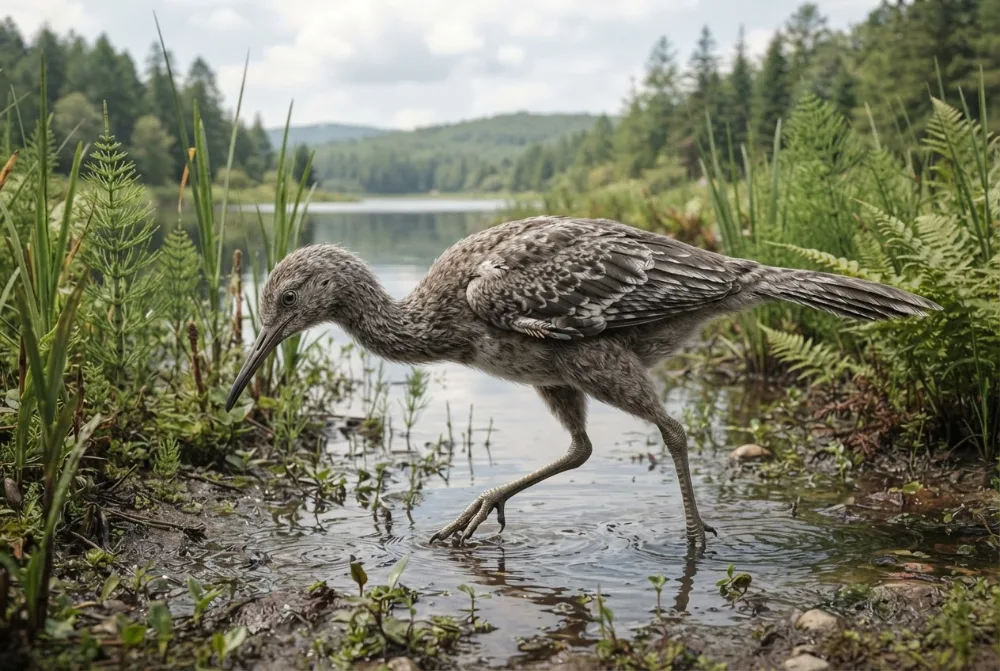
Hongshanornis was a small, beaked bird that lived near lakes and marshes in Early Cretaceous China. It had long legs for wading in shallow water and a slender beak for catching fish or bugs. This bird is one of the earliest known beaked ornithurine birds, a group that includes modern birds.1
When did it live?
How big was it?
How long was it?
How tall was it?
estimate
How heavy was it?
How big was Hongshanornis compared to YOU?
Just maths in your browser. Nothing is saved or sent anywhere.
How fast was it?


Fun facts
Hongshanornis had a beak in both its upper and lower jaws, making it the earliest known beaked ornithurine bird.1
This bird had a predentary bone in its lower jaw, a feature once thought unique to ornithischian dinosaurs.1
Hongshanornis lived about 125 to 120 million years ago, during the Early Cretaceous period.2
Its long legs and short, less curved claws show it was a wading bird, not a tree-dweller.1
One fossil of Hongshanornis preserved gizzard stones (gastroliths), which helped it grind up food.3
Hongshanornis was originally thought to be toothless, but later studies found it had small teeth in both jaws.3

Ask Rex about Hongshanornis
Rex only answers questions about this page. 10 questions a month.
Rex is an AI and can make mistakes. He runs on servers in the EU and questions are never saved. Never type your name or other personal things.
Myth buster
Myth: Hongshanornis was completely toothless like modern birds.
Truth: Scientists now know it had small teeth in both upper and lower jaws, though it also had a beak.3
For dino experts
- Scientific name
- Hongshanornis
- Named by
- Zhou and Zhang 20055
- Group
- Early birds
- Family / clade
- Hongshanornithidae5
- Classification
- Theropoda > Avialae5
- Age of the rocks
- 126 to 120 million years (Barremian / Aptian)5
- Rock formations
- Yixian5
- Countries
- China5
- Fossil records
- 2 in the Paleobiology Database5
- Discovery
- Hongshanornis was named by Zhou and Zhang in 2005. The first fossil, a nearly complete skeleton with feathers, was found in the Yixian Formation at Shifo, Ningcheng, Inner Mongolia, China.12
- Still debated
- Scientists still debate whether Hongshanornis was more closely related to modern birds than toothed ornithurines, or if teeth were lost several times in early bird evolution.1
Where the facts come from
- Discovery of an ornithurine bird and its implication for Early Cretaceous avian radiation | PNAS (pnas.org)
- PBDB Taxon (paleobiodb.org)
- Hongshanornis (en.wikipedia.org)
- PeerJ A new specimen of the Early Cretaceous bird Hongshanornis longicresta: insights into the aerodynamics and diet of a basal ornithuromorph (peerj.com)
- Hongshanornis in The Paleobiology Database (CC BY 4.0): age, places, rock formations, classification.
Every fact on this page has a number that points to its source. If we got something wrong, sorry, we are dino fans, not a science journal. Tell us at hello@dinowiki.app and we will fix it.
 Rex is hungry! Dino Wiki is a dad's project for his dino-loving son, free with no ads. Grown-ups can feed Rex a snack to help keep it online.Feed Rex
 Archaeopteryx
 Hesperornis
 Ichthyornis
 Baptornis
 Jurapteryx
 Gobipteryx
 Stegosaurus
 Iguanodon
 Giganotosaurus
 Microraptor
 Deinonychus
 Baryonyx