
Iguanodon
Iguanodon was a big, plant-eating dinosaur that lived during the Early Cretaceous period. It had a thumb spike like a sharp weapon and a beak for snipping leaves. This dinosaur could walk on two legs or all fours.12
When did it live?
How big was it?
Fun facts
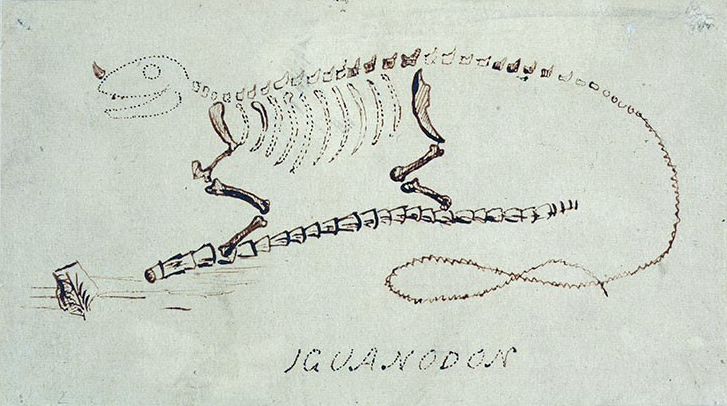
Iguanodon was named in 1825 by Gideon Mantell after he found teeth that looked like iguana teeth.1
Its thumb had a big, sharp spike that scientists think was used for defense against predators.1
Iguanodon had a flexible little finger that could grasp objects, unlike its other fingers which were more like hooves.1
When Iguanodon closed its mouth, the bones in its upper jaw would bow out, making the teeth grind against each other like a chewing motion.1
The front of Iguanodon's mouth had no teeth, just a bony beak covered with a hard material for cropping plants.1
Iguanodon could reach food from ground level up to 4 to 5 metres (13 to 16 feet) high, so it ate both low plants and tree leaves.1
In 1878, many complete Iguanodon skeletons were found in a coal mine in Bernissart, Belgium, which helped scientists understand the dinosaur much better.1
Myth buster
Myth: Iguanodon was a slow, clumsy dinosaur that always walked on four legs.
Truth: Iguanodon could walk on two legs or all fours, and it was probably quite agile for its size.2
For dino experts
- Scientific name
- Iguanodon
- Named by
- Mantell 18253
- Group
- Beaked plant-eaters
- Family / clade
- Ankylopollexia3
- Classification
- Ornithischia > Ornithopoda > Iguanodontia3
- Age of the rocks
- 155 to 66 million years (Kimmeridgian to Maastrichtian)3
- Rock formations
- Arcillas de Morella, Weald Clay, Wessex3
- Countries
- United Kingdom, Spain, Germany, France, Portugal, Belgium3
- Fossil records
- 133 in the Paleobiology Database3
- Also known as
- Heterosaurus, Iguanosaurus, Struthopus, Therosaurus (older names now counted as the same animal)3
- Discovery
- Iguanodon was first named by Gideon Mantell in 1825 based on fossil teeth found in Sussex, England. Later, in 1878, many complete skeletons were discovered in a Belgian coal mine and studied by Louis Dollo.1
- Still debated
- Scientists still debate exactly what plants Iguanodon ate. Some think it ate horsetails, cycads, and conifers, while others link it to the spread of flowering plants.1
Where the facts come from
- Iguanodon (en.wikipedia.org)
- Iguanodon | Diet, Habitat & Extinction (britannica.com)
- Iguanodon in The Paleobiology Database (CC BY 4.0): age, places, rock formations, classification.
Every fact on this page has a number that points to its source. If we got something wrong, sorry, we are dino fans, not a science journal. Tell us at hello@dinowiki.app and we will fix it.
 Rex is hungry! Dino Wiki is free with no ads. Grown-ups can feed Rex a snack to keep it that way.Feed Rex
 Tenontosaurus
 Thescelosaurus
 Zalmoxes
 Camptosaurus
 Rhabdodon
 Nanosaurus
 Stegosaurus
 Archaeopteryx
 Giganotosaurus
 Microraptor
 Deinonychus
 Baryonyx