
Jurapteryx
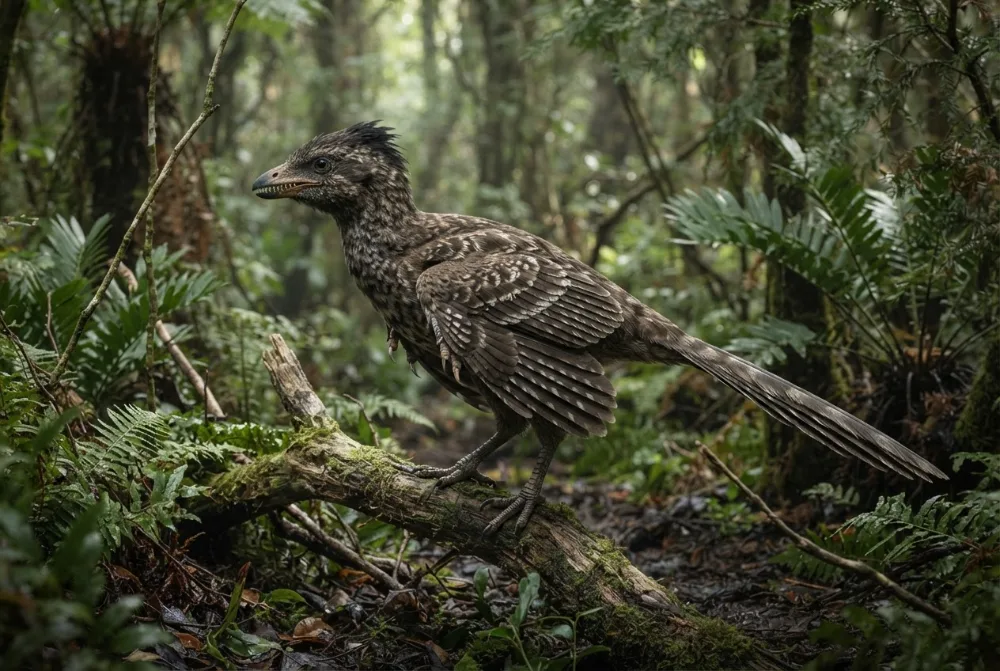
Jurapteryx was a small, feathered avialan that lived during the Jurassic and Cretaceous periods. It could fly and had sharp teeth for catching fish and insects. Think of it as an early, toothed bird that fluttered through ancient forests.1
When did it live?
How big was it?
Fun facts
Jurapteryx is sometimes considered a synonym of Archaeopteryx, meaning some scientists think they are the same animal.1
Its name means 'Jurassic wing', because it lived during the Jurassic Period and had wings for flying.1
The only known fossil of Jurapteryx is a complete skeleton, found in the Altmühltal Formation of Germany.1
Jurapteryx lived in a coastal environment, near shallow lagoons where it could hunt for fish.1
It was a small avialan, about the size of a modern crow, with a wingspan of around half a meter.1
Jurapteryx had teeth, unlike modern birds, which it used to catch slippery prey like fish.1
Myth buster
Myth: Jurapteryx is a completely separate species from Archaeopteryx.
Truth: Many scientists think Jurapteryx is actually a synonym of Archaeopteryx, meaning it may be the same genus.1
For dino experts
- Scientific name
- Jurapteryx
- Named by
- Howgate 19851
- Group
- Early birds
- Family / clade
- Avialae1
- Classification
- Theropoda > Avialae1
- Age of the rocks
- 149 to 121 million years (Tithonian to Barremian)1
- Rock formations
- Altmühltal1
- Countries
- Germany1
- Fossil records
- 10 in the Paleobiology Database1
- Discovery
- Jurapteryx was named by M. E. Howgate in 1985, based on a complete skeleton found at Workerszell, Eichstätt, Germany.1
- Still debated
- Scientists are still debating whether Jurapteryx is a distinct genus or just a species of Archaeopteryx.1
Where the facts come from
- Jurapteryx in The Paleobiology Database (CC BY 4.0): age, places, rock formations, classification.
Every fact on this page has a number that points to its source. If we got something wrong, sorry, we are dino fans, not a science journal. Tell us at hello@dinowiki.app and we will fix it.
 Rex is hungry! Dino Wiki is free with no ads. Grown-ups can feed Rex a snack to keep it that way.Feed Rex
 Archaeopteryx
 Hesperornis
 Ichthyornis
 Baptornis
 Gobipteryx
 Martinavis
 Stegosaurus
 Iguanodon
 Giganotosaurus
 Microraptor
 Deinonychus
 Baryonyx