
Deinonychus
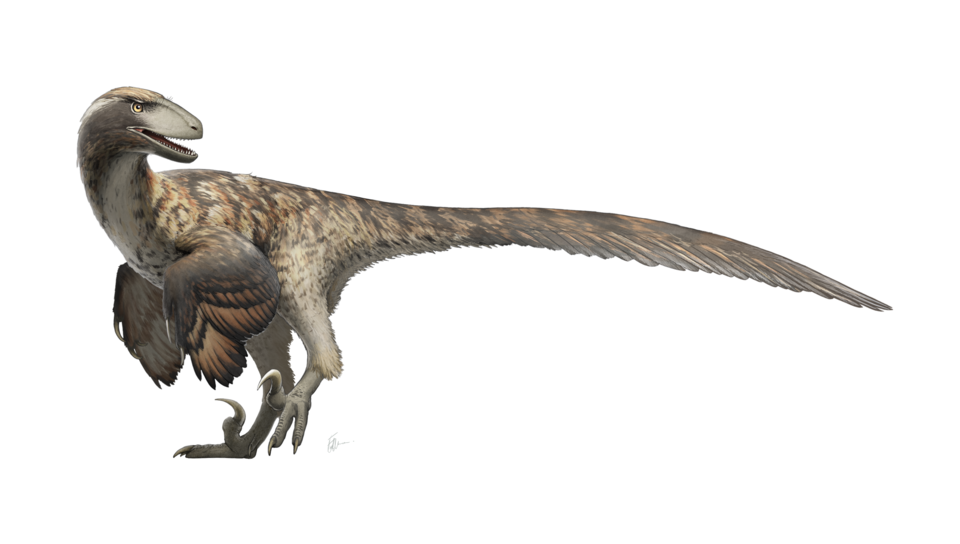
Deinonychus was a fast, smart hunter with a huge sickle-shaped claw on each foot. It used those claws to slash at prey, and its stiff tail helped it keep balance while running and fighting.2
When did it live?
How big was it?
Fun facts
Deinonychus had a huge, curved claw on the second toe of each foot. That claw was about 13 centimetres (5 inches) long and was probably used like a slashing weapon.2
Its tail was stiffened by long bony rods, which helped it balance perfectly when it ran or attacked.21
Deinonychus had very flexible wrists, so it could grab and hold prey with its long, clawed hands.1
The name 'Deinonychus' means 'terrible claw', because of that huge foot claw.1
Deinonychus lived during the Early Cretaceous Period, about 145 to 100 million years ago.2
Deinonychus was the model for the 'raptor' dinosaurs in the movie Jurassic Park.2
Myth buster
Myth: Some people think Deinonychus was a Jurassic dinosaur, like in Jurassic Park.
Truth: Deinonychus actually lived in the Early Cretaceous Period, not the Jurassic.2
For dino experts
- Scientific name
- Deinonychus
- Named by
- Ostrom 19693
- Group
- Raptors
- Family / clade
- Dromaeosauridae3
- Classification
- Theropoda > Dromaeosauridae3
- Age of the rocks
- 143 to 94 million years (Berriasian to Cenomanian)3
- Rock formations
- Cloverly, Antlers, Cedar Mountain3
- Countries
- USA, Brazil3
- Fossil records
- 47 in the Paleobiology Database3
- Discovery
- Deinonychus was discovered in 1964 by Grant E. Meyer and John Ostrom near Bridger, Montana. They dug up more than 1000 bones from at least three animals.1
- Still debated
- Scientists still debate exactly how Deinonychus used its big foot claw, whether it slashed or stabbed its prey.2
Where the facts come from
- A new theropod dinosaur from the Lower Cretaceous of Montana (elischolar.library.yale.edu)
- Deinonychus | Carnivorous, Jurassic, Raptor | Britannica (britannica.com)
- Deinonychus in The Paleobiology Database (CC BY 4.0): age, places, rock formations, classification.
Every fact on this page has a number that points to its source. If we got something wrong, sorry, we are dino fans, not a science journal. Tell us at hello@dinowiki.app and we will fix it.
 Rex is hungry! Dino Wiki is free with no ads. Grown-ups can feed Rex a snack to keep it that way.Feed Rex
 Velociraptor
 Microraptor
 Asiamericana
 Richardoestesia
 Saurornitholestes
 Troodon
 Stegosaurus
 Iguanodon
 Archaeopteryx
 Giganotosaurus
 Baryonyx
 Paronychodon