
Rhamphorhynchus
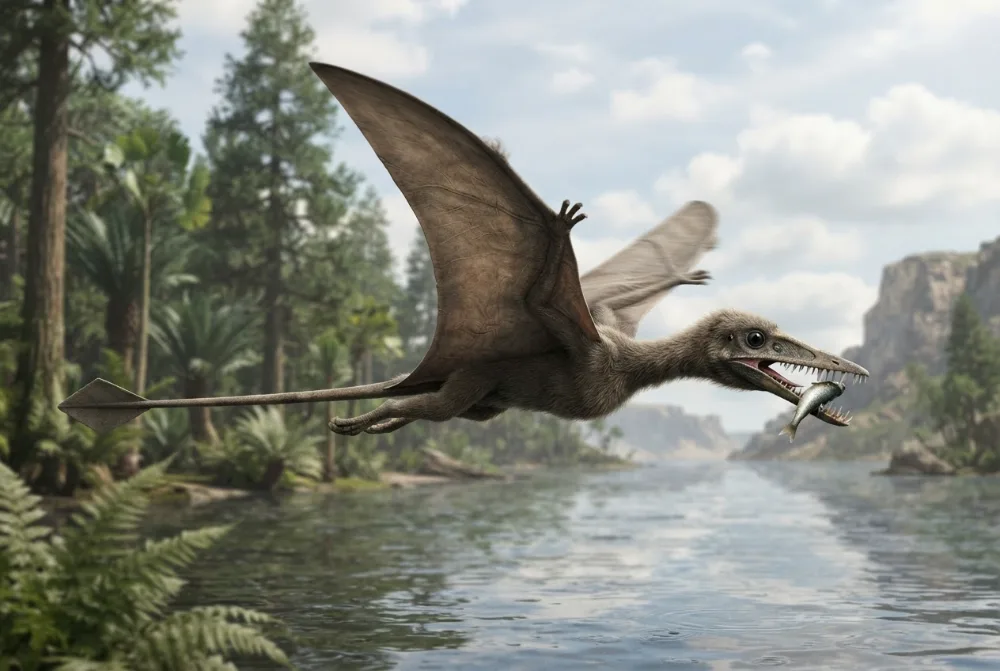
Rhamphorhynchus was a flying reptile that lived in the Late Jurassic. It had a very long tail with a diamond-shaped flap at the tip. It used its needle-like teeth to catch slippery fish.12
Ɗuum wuurii nde?
Hol no o mawni?
No juutuno?
No tedduno?
Hol no Rhamphorhynchus mawninoo, so fondaama bee AAN?
Hiisa tan nder browser maa. Walaa huunde danndetee walla neldetee ka nokku fuu.
How fast was it?
Anndal belɗungal
Its tail was stiffened with ligaments and ended in a diamond-shaped rudder, which may have helped it steer while flying.12
Rhamphorhynchus had no teeth at the very tip of its beak, but the rest of its beak held many forward-angled teeth that interlocked to trap fish.1
Fossils of Rhamphorhynchus often show impressions of soft parts, including wing membranes and fuzz-like pycnofibers.1
It probably swam and launched from the water like modern birds, not just flew over the waves.1
Rhamphorhynchus lived about 150 to 148 million years ago, during the late Jurassic Period.1
Naamne ɓurɗe naamneede fii Rhamphorhynchus
?How big was Rhamphorhynchus?
Most adults had a wingspan of about 1 metre (3.3 feet), but the largest known specimen reached about 1.8 metres (5.9 feet) across. A huge fragmentary fossil may have had a wingspan of over 3 metres (10 feet).15
?What did Rhamphorhynchus eat?
It mainly ate fish and squid-like animals called cephalopods. Fossil stomach contents and droppings often contain fish and cephalopod remains.12
?Could Rhamphorhynchus swim?
Yes, it probably swam and launched from the water like modern birds. Its broad feet and body shape suggest it was good at swimming.1
?When did Rhamphorhynchus live?
It lived during the Late Jurassic Period, about 150 to 148 million years ago.12
?Was Rhamphorhynchus a dinosaur?
No, it was a pterosaur, a flying reptile that is not a dinosaur. Pterosaurs are close cousins of dinosaurs.12
?Why did Rhamphorhynchus have a long tail?
The long tail ended in a diamond-shaped flap that may have helped it steer while flying. The tail was stiffened with ligaments to keep it straight.12
?Did Rhamphorhynchus have feathers?
It did not have feathers, but it had a fuzzy coat called pycnofibers, which are like simple hairs. These are different from feathers.1
?Where have Rhamphorhynchus fossils been found?
The best fossils come from the Solnhofen limestone in Bavaria, Germany. Fragmentary remains have also been found in England, Tanzania, Spain, and Portugal.1

Naamnu Rex fii Rhamphorhynchus
Rex jaabata ƴamle dow hello ngo'o tan. Ƴamle 10 e lewru.
Rex ko AI, o waawi waɗugo juumre. O golla ka serverji nder EU, naamne danndetaake abada. Taa winndu innde maa walla huunde goɗnde ngam maa.
Feññinoowo goonga
Fenaande: Some people think Rhamphorhynchus was a dinosaur.
Goonga: Rhamphorhynchus was a pterosaur, a flying reptile, not a dinosaur.1
Ngam annduɓe dino
- Innde ganndal
- Rhamphorhynchus
- Inndoowo
- Meyer 18476
- Fedde
- Reptilji diwooji
- Fedde / clade
- Rhamphorhynchidae6
- Fedde
- Pterosauria > Rhamphorhynchidae6
- Duuɓi kaaƴe
- 159 haa 143 miliyon duuɓi (Oxfordian / Tithonian)6
- Cuuɗi kaaƴe
- Solnhofen, Solnhofener Plattenkalk, Painten6
- Leyɗe
- Germany, Portugal, Tanzania, United Kingdom6
- Fosilji tawaaɗi
- 30 nder Paleobiology Database6
- Tawgol
- The first specimen was brought to scientist Samuel Thomas von Sömmerring in 1825. It was later named Ornithocephalus muensteri by Goldfuss in 1831, and then renamed Rhamphorhynchus by Hermann von Meyer in 1847.13
- Haa jooni ɓe ɗon yeddondira
- Scientists still debate exactly how many species of Rhamphorhynchus there were, because many similar fossils have been given different names.1
To haalaaji ummii
- Rhamphorhynchus (en.wikipedia.org)
- Rhamphorhynchus | Pterosaur, Jurassic & Flying Reptile | Britannica (britannica.com)
- PBDB Taxon (paleobiodb.org)
- Life History of Rhamphorhynchus Inferred from Bone Histology and the Diversity of Pterosaurian Growth Strategies (pmc.ncbi.nlm.nih.gov)
- A giant specimen of Rhamphorhynchus muensteri and comments on the ontogeny of rhamphorhynchines (pmc.ncbi.nlm.nih.gov)
- Rhamphorhynchus in The Paleobiology Database (CC BY 4.0): duuɓi, nokkuuje, cuuɗi kaaƴe, pecce.
Kala anndal nder ngal hello mari limre holloore iwdi mum. Si min mbaɗii juumre, yaafo min, min ko yiɗɓe dino, min wanaa jaaynde anndal. Haalan min ka hello@dinowiki.app, min moƴƴinan ɗum.
 Rex ɗon weelo! Dino Wiki, ɗum golle baaba ngam ɓiyiiko gorko mo yiɗi dinosauruuji, alaa njoɓdi, alaa ko yeeyata. Mawɓe mbaawi hokkude Rex ñaamdu ngam wallude lowre ndee heddoo e internet.Nyaamnu Rex
 Pteranodon
 Quetzalcoatlus
 Dorygnathus
 Anhanguera
 Pterodactylus
 Eudimorphodon
 Brachiosaurus
 Diplodocus
 Allosaurus
 Brontosaurus
 Compsognathus
 Camarasaurus