
Rhamphorhynchus
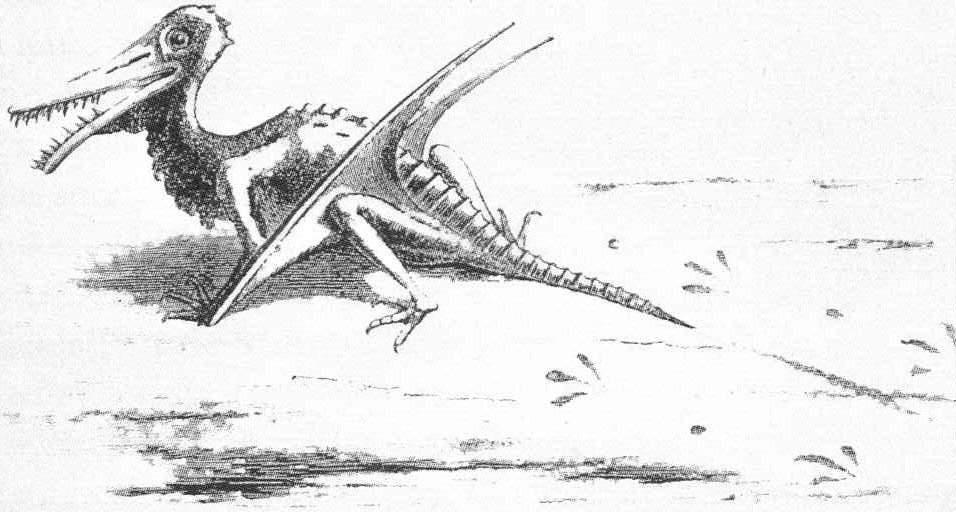
Rhamphorhynchus was a flying reptile that lived in the Late Jurassic. It had a very long tail with a diamond-shaped flap at the tip. It used its needle-like teeth to catch slippery fish.12
When did it live?
How big was it?
Fun facts
Its tail was stiffened with ligaments and ended in a diamond-shaped rudder, which may have helped it steer while flying.12
Rhamphorhynchus had no teeth at the very tip of its beak, but the rest of its beak held many forward-angled teeth that interlocked to trap fish.1
Fossils of Rhamphorhynchus often show impressions of soft parts, including wing membranes and fuzz-like pycnofibers.1
It probably swam and launched from the water like modern birds, not just flew over the waves.1
Rhamphorhynchus lived about 150 to 148 million years ago, during the late Jurassic Period.1
Myth buster
Myth: Some people think Rhamphorhynchus was a dinosaur.
Truth: Rhamphorhynchus was a pterosaur, a flying reptile, not a dinosaur.1
For dino experts
- Scientific name
- Rhamphorhynchus
- Named by
- Meyer 18474
- Group
- Flying reptiles
- Family / clade
- Rhamphorhynchidae4
- Classification
- Pterosauria > Rhamphorhynchidae4
- Age of the rocks
- 159 to 143 million years (Oxfordian to Tithonian)4
- Rock formations
- Solnhofen, Solnhofener Plattenkalk, Painten4
- Countries
- Germany, Portugal, Tanzania, United Kingdom4
- Fossil records
- 30 in the Paleobiology Database4
- Discovery
- The first specimen was brought to scientist Samuel Thomas von Sömmerring in 1825. It was later named Ornithocephalus muensteri by Goldfuss in 1831, and then renamed Rhamphorhynchus by Hermann von Meyer in 1847.13
- Still debated
- Scientists still debate exactly how many species of Rhamphorhynchus there were, because many similar fossils have been given different names.1
Where the facts come from
- Rhamphorhynchus (en.wikipedia.org)
- Rhamphorhynchus | Pterosaur, Jurassic & Flying Reptile | Britannica (britannica.com)
- PBDB Taxon (paleobiodb.org)
- Rhamphorhynchus in The Paleobiology Database (CC BY 4.0): age, places, rock formations, classification.
Every fact on this page has a number that points to its source. If we got something wrong, sorry, we are dino fans, not a science journal. Tell us at hello@dinowiki.app and we will fix it.
 Rex is hungry! Dino Wiki is free with no ads. Grown-ups can feed Rex a snack to keep it that way.Feed Rex
 Pteranodon
 Quetzalcoatlus
 Dorygnathus
 Anhanguera
 Pterodactylus
 Eudimorphodon
 Brachiosaurus
 Diplodocus
 Allosaurus
 Brontosaurus
 Compsognathus
 Camarasaurus