
Anhanguera
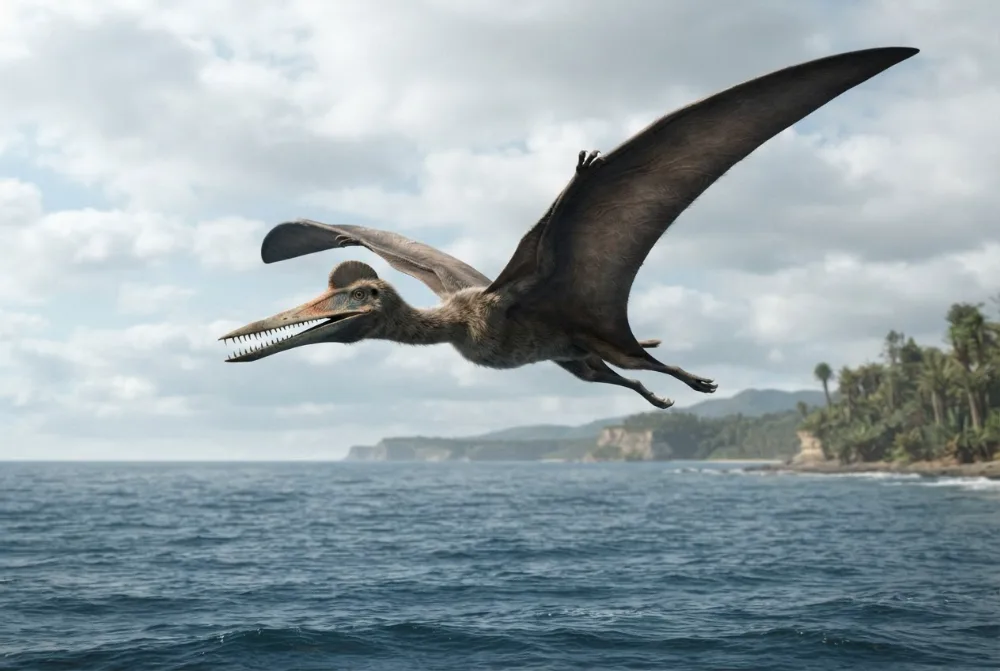
Anhanguera was a flying reptile that soared over ancient seas. It had a long, toothy beak and a wingspan as wide as a car. It was not a dinosaur, but a pterosaur, a close cousin of dinosaurs.1
Ɗuum wuurii nde?
Hol no o mawni?
No juutuno?
No tedduno?
Hol no Anhanguera mawninoo, so fondaama bee AAN?
Hiisa tan nder browser maa. Walaa huunde danndetee walla neldetee ka nokku fuu.
How fast was it?
Anndal belɗungal
Anhanguera had a crest on the front of its upper jaw, but it was set farther back on the skull than in its close relatives Coloborhynchus and Ornithocheirus.1
Some Anhanguera fossils have a small, blunt crest at the back of the skull, similar to other pteranodontoids.1
A study in 2003 showed that Anhanguera likely held its head at an angle to the ground, based on its inner ear structure, which helped it keep its balance.1
Anhanguera had bony rings in its eye sockets called scleral rings, which may have supported its eyes, similar to modern birds.1
The name Anhanguera comes from the Tupi language and means 'old spirit' or 'spirit protector of the animals'.1
Anhanguera lived during the Early to Late Cretaceous, from about 112 to 93 million years ago.1
Naamne ɓurɗe naamneede fii Anhanguera
?How big was Anhanguera?
Anhanguera had a wingspan of about 4.6 meters (15 ft).1
?What did Anhanguera eat?
Anhanguera ate fish. It had sharp, curved teeth to pierce and grip slippery fish.13
?Why did Anhanguera have a crest?
Scientists aren't sure. It might have been for display to attract mates or show off, or it might have helped the animal eat.3
?Could Anhanguera fly?
Yes, Anhanguera was a flying reptile. It had thin, light bones to save weight and a large brain area for coordinating flight, similar to birds.3
?When did Anhanguera live?
Anhanguera lived during the Early to Late Cretaceous, from about 112 to 93 million years ago.1

Naamnu Rex fii Anhanguera
Rex jaabata ƴamle dow hello ngo'o tan. Ƴamle 10 e lewru.
Rex ko AI, o waawi waɗugo juumre. O golla ka serverji nder EU, naamne danndetaake abada. Taa winndu innde maa walla huunde goɗnde ngam maa.
Ngam annduɓe dino
- Innde ganndal
- Anhanguera
- Inndoowo
- Campos and Kellner 19854
- Fedde
- Reptilji diwooji
- Fedde / clade
- Ornithocheiroidea4
- Fedde
- Pterosauria > Pterodactyloidea4
- Duuɓi kaaƴe
- 137 haa 94 miliyon duuɓi (Valanginian / Cenomanian)4
- Cuuɗi kaaƴe
- Romualdo, West Melbury Marly Chalk, Toolebuc4
- Leyɗe
- Brazil, United Kingdom, Australia, Morocco, Egypt, Colombia4
- Fosilji tawaaɗi
- 18 nder Paleobiology Database4
- Tawgol
- Anhanguera was named in 1985 by Brazilian paleontologists Diogenes de Almeida Campos and Alexander Wilhelm Armin Kellner, based on a complete skull found in the Romualdo Formation of Brazil.14
- Haa jooni ɓe ɗon yeddondira
- Scientists are not sure whether the crests on the jaws were present in all Anhanguera individuals or only in some, possibly depending on age or sex.1
To haalaaji ummii
- Anhanguera (pterosaur) (en.wikipedia.org)
- _Anhanguera_ (pterosaur) — Grokipedia (grokipedia.com)
- Watch a pterosaur fly | Natural History Museum (nhm.ac.uk)
- Anhanguera in The Paleobiology Database (CC BY 4.0): duuɓi, nokkuuje, cuuɗi kaaƴe, pecce.
Kala anndal nder ngal hello mari limre holloore iwdi mum. Si min mbaɗii juumre, yaafo min, min ko yiɗɓe dino, min wanaa jaaynde anndal. Haalan min ka hello@dinowiki.app, min moƴƴinan ɗum.
 Rex ɗon weelo! Dino Wiki, ɗum golle baaba ngam ɓiyiiko gorko mo yiɗi dinosauruuji, alaa njoɓdi, alaa ko yeeyata. Mawɓe mbaawi hokkude Rex ñaamdu ngam wallude lowre ndee heddoo e internet.Nyaamnu Rex
 Pteranodon
 Quetzalcoatlus
 Dorygnathus
 Rhamphorhynchus
 Pterodactylus
 Eudimorphodon
 Stegosaurus
 Iguanodon
 Archaeopteryx
 Giganotosaurus
 Microraptor
 Deinonychus