
Ornithomimus
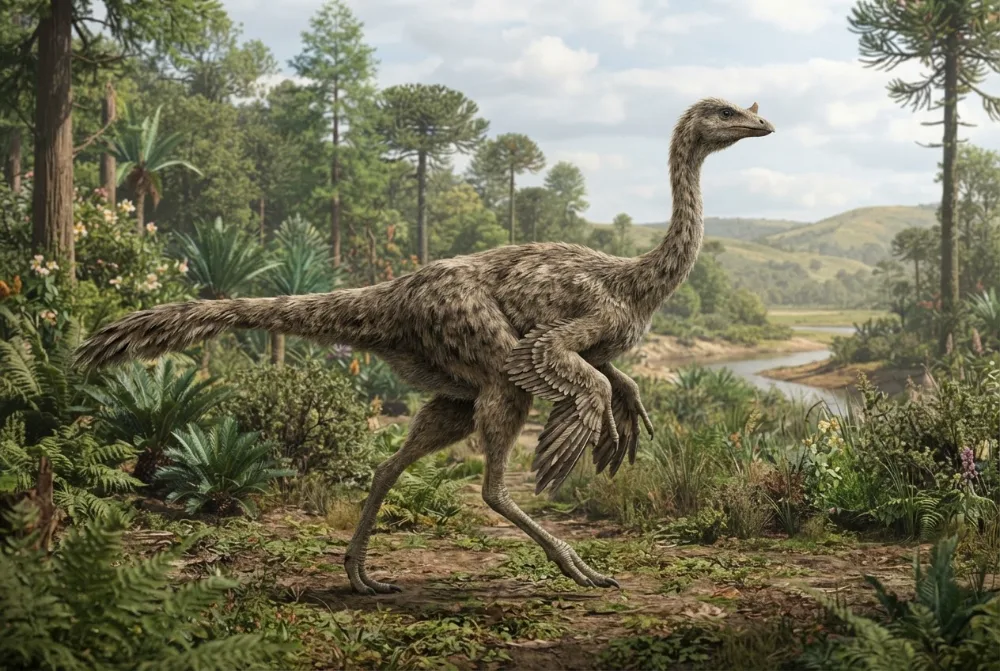
Ornithomimus was a fast, ostrich-like dinosaur that lived in North America during the Late Cretaceous. It had a small toothless beak, long legs, and was covered in downy feathers. Adults even had wings on their arms, which they probably used for showing off to mates.12
Ɗuum wuurii nde?
Hol no o mawni?
No juutuno?
No toowuno?
No tedduno?
Hol no Ornithomimus mawninoo, so fondaama bee AAN?
Hiisa tan nder browser maa. Walaa huunde danndetee walla neldetee ka nokku fuu.
How fast was it?
Anndal belɗungal
Ornithomimus was one of the first feathered dinosaurs found in the Western Hemisphere. Paleontologist François Therrien discovered the feathers in 2008.2
Its brain was small and its sense of smell was poor, so it probably relied on its big eyes and good eyesight to find food and avoid danger.2
Young Ornithomimus did not have wings on their arms. Only adults grew the long, stiff feathers that formed wings, which they used for courtship displays.2
Ornithomimus could run very fast thanks to its long, powerful legs and big leg muscles. It probably escaped predators by sprinting away.2
Its fingers had long, straight claws that might have helped it grab branches or dig for food.2
The name Ornithomimus means 'bird mimic' because its feet looked a lot like a bird's feet.1
Naamne ɓurɗe naamneede fii Ornithomimus
?How big was Ornithomimus?
Ornithomimus measured up to about 4 metres (13 feet) long and weighed up to 170 kilograms (375 pounds).45
?What did Ornithomimus eat?
Ornithomimus was probably an omnivore or plant-eater. It had a toothless beak and may have swallowed stones (gastroliths) to help grind up plants, like many birds do.15
?Did Ornithomimus have feathers?
Yes, Ornithomimus was covered in downy feathers. Adults also had long, stiff feathers on their arms that formed wings, used for display and courtship.15
?How fast could Ornithomimus run?
Ornithomimus could run very fast, probably between 30 and 60 km/h (19 to 37 mph), and maybe even up to 80 km/h (50 mph), as fast as an ostrich.5
?When did Ornithomimus live?
Ornithomimus lived during the Late Cretaceous period, about 74 to 66 million years ago.4
?Where was Ornithomimus found?
Fossils of Ornithomimus have been found in Canada (especially Alberta) and the United States (Colorado, Montana, Wyoming).14
Naamnu Rex fii Ornithomimus
Rex jaabata ƴamle dow hello ngo'o tan. Ƴamle 10 e lewru.
Rex ko AI, o waawi waɗugo juumre. O golla ka serverji nder EU, naamne danndetaake abada. Taa winndu innde maa walla huunde goɗnde ngam maa.
Feññinoowo goonga
Fenaande: Many people think Ornithomimus was a meat-eater like most other theropod dinosaurs.
Goonga: Ornithomimus had no teeth and a beak, so scientists think it was a plant-eater or an omnivore, not a carnivore.2
Ngam annduɓe dino
- Innde ganndal
- Ornithomimus
- Inndoowo
- Marsh 18906
- Fedde
- Dinosauri nannduɗi e ndaw
- Fedde / clade
- Ornithomimidae6
- Fedde
- Theropoda > Ornithomimosauria6
- Duuɓi kaaƴe
- 84 haa 66 miliyon duuɓi (Campanian / Maastrichtian)6
- Cuuɗi kaaƴe
- Lance, Horseshoe Canyon, Denver6
- Leyɗe
- USA, Canada6
- Fosilji tawaaɗi
- 35 nder Paleobiology Database6
- Tawgol
- The first Ornithomimus fossils were found in Colorado in 1889 by George Lyman Cannon. The famous paleontologist Othniel Charles Marsh named the dinosaur Ornithomimus velox in 1890.1
- Haa jooni ɓe ɗon yeddondira
- Scientists are still debating what Ornithomimus ate. Some think it was a plant-eater, others think it ate insects, small animals, and maybe fruit too.12
To haalaaji ummii
- Ornithomimus (en.wikipedia.org)
- Ornithomimus | The Canadian Encyclopedia (thecanadianencyclopedia.ca)
- Ornithomimus — size, diet & habitat | DinoLifePedia (dinolifepedia.com)
- Ornithomimus | Natural History Museum (nhm.ac.uk)
- Ornithomimus | The Canadian Encyclopedia (thecanadianencyclopedia.ca)
- Ornithomimus in The Paleobiology Database (CC BY 4.0): duuɓi, nokkuuje, cuuɗi kaaƴe, pecce.
Kala anndal nder ngal hello mari limre holloore iwdi mum. Si min mbaɗii juumre, yaafo min, min ko yiɗɓe dino, min wanaa jaaynde anndal. Haalan min ka hello@dinowiki.app, min moƴƴinan ɗum.
 Rex ɗon weelo! Dino Wiki, ɗum golle baaba ngam ɓiyiiko gorko mo yiɗi dinosauruuji, alaa njoɓdi, alaa ko yeeyata. Mawɓe mbaawi hokkude Rex ñaamdu ngam wallude lowre ndee heddoo e internet.Nyaamnu Rex
 Gallimimus
 Struthiomimus
 Deinocheirus
 Dromiceiomimus
 Archaeornithomimus
 Anserimimus
 Tyrannosaurus
 Triceratops
 Velociraptor
 Spinosaurus
 Ankylosaurus
 Parasaurolophus