
Ornithomimus
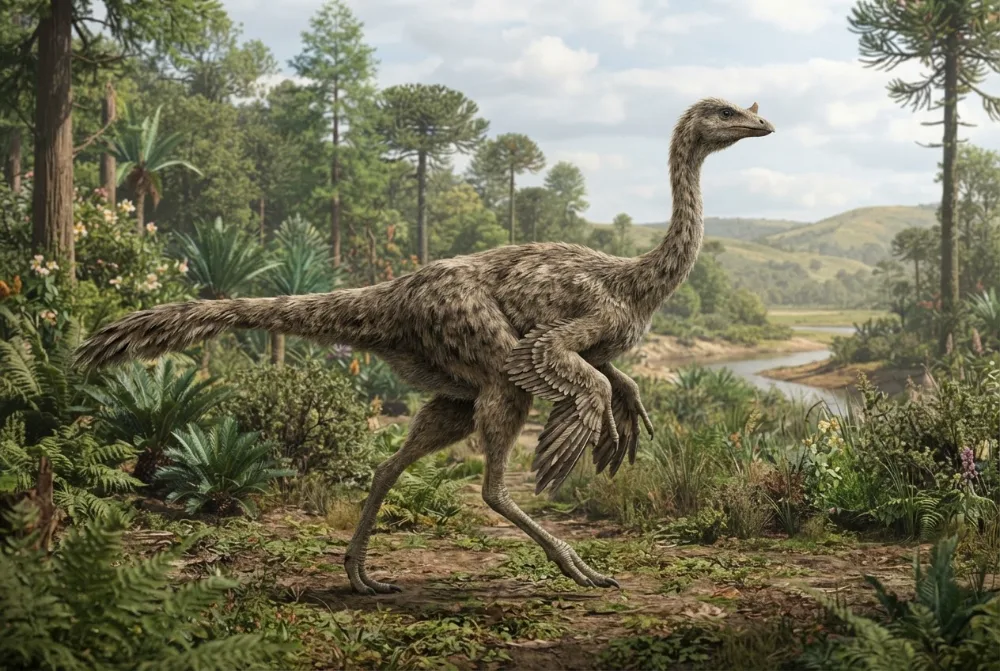
Ornithomimus was a fast, ostrich-like dinosaur that lived in North America during the Late Cretaceous. It had a small toothless beak, long legs, and was covered in downy feathers. Adults even had wings on their arms, which they probably used for showing off to mates.12
When did it live?
How big was it?
Fun facts
Ornithomimus was one of the first feathered dinosaurs found in the Western Hemisphere. Paleontologist François Therrien discovered the feathers in 2008.2
Its brain was small and its sense of smell was poor, so it probably relied on its big eyes and good eyesight to find food and avoid danger.2
Young Ornithomimus did not have wings on their arms. Only adults grew the long, stiff feathers that formed wings, which they used for courtship displays.2
Ornithomimus could run very fast thanks to its long, powerful legs and big leg muscles. It probably escaped predators by sprinting away.2
Its fingers had long, straight claws that might have helped it grab branches or dig for food.2
The name Ornithomimus means 'bird mimic' because its feet looked a lot like a bird's feet.1
Myth buster
Myth: Many people think Ornithomimus was a meat-eater like most other theropod dinosaurs.
Truth: Ornithomimus had no teeth and a beak, so scientists think it was a plant-eater or an omnivore, not a carnivore.2
For dino experts
- Scientific name
- Ornithomimus
- Named by
- Marsh 18903
- Group
- Ostrich dinos
- Family / clade
- Ornithomimidae3
- Classification
- Theropoda > Ornithomimosauria3
- Age of the rocks
- 84 to 66 million years (Campanian to Maastrichtian)3
- Rock formations
- Lance, Horseshoe Canyon, Denver3
- Countries
- USA, Canada3
- Fossil records
- 35 in the Paleobiology Database3
- Discovery
- The first Ornithomimus fossils were found in Colorado in 1889 by George Lyman Cannon. The famous paleontologist Othniel Charles Marsh named the dinosaur Ornithomimus velox in 1890.1
- Still debated
- Scientists are still debating what Ornithomimus ate. Some think it was a plant-eater, others think it ate insects, small animals, and maybe fruit too.12
Where the facts come from
- Ornithomimus (en.wikipedia.org)
- Ornithomimus | The Canadian Encyclopedia (thecanadianencyclopedia.ca)
- Ornithomimus in The Paleobiology Database (CC BY 4.0): age, places, rock formations, classification.
Every fact on this page has a number that points to its source. If we got something wrong, sorry, we are dino fans, not a science journal. Tell us at hello@dinowiki.app and we will fix it.
 Rex is hungry! Dino Wiki is free with no ads. Grown-ups can feed Rex a snack to keep it that way.Feed Rex
 Gallimimus
 Struthiomimus
 Deinocheirus
 Dromiceiomimus
 Archaeornithomimus
 Anserimimus
 Triceratops
 Velociraptor
 Spinosaurus
 Ankylosaurus
 Parasaurolophus