
Archaeornithomimus
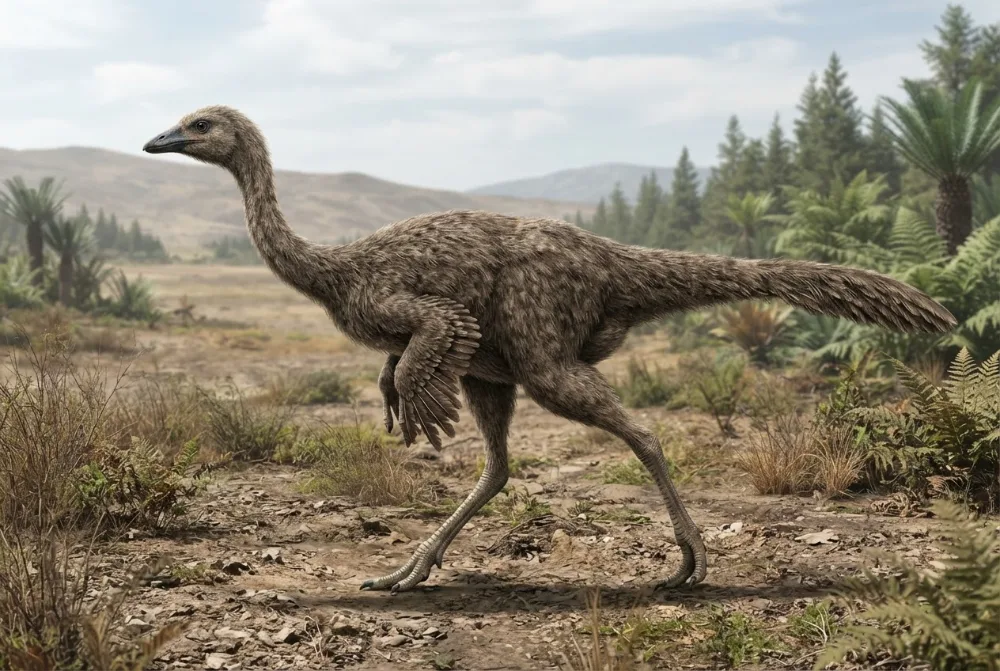
Archaeornithomimus was a fast, ostrich-like dinosaur that lived in Asia during the Late Cretaceous. It had a beak, long legs, and probably feathers. It could run quickly to escape predators or chase small prey.1
Ɗuum wuurii nde?
Hol no o mawni?
No juutuno?
No tedduno?
Hol no Archaeornithomimus mawninoo, so fondaama bee AAN?
Hiisa tan nder browser maa. Walaa huunde danndetee walla neldetee ka nokku fuu.
How fast was it?
Anndal belɗungal
Its neck bones had air spaces inside, like modern birds, which made its neck lighter.1
Scientists think it had feathers that looked like those of an ostrich.1
It lived alongside the giant dinosaur Gigantoraptor and the predator Alectrosaurus.1
No stress fractures were found in its foot bones, meaning it probably didn't run too hard or too often.1
Its third toe bone was not pinched at the top, so its foot was not built for extreme speed like some other ornithomimids.1
The first fossils were found by an expedition led by Roy Chapman Andrews in 1923.1
Naamne ɓurɗe naamneede fii Archaeornithomimus
?How big was Archaeornithomimus?
About 3.4 metres (11 feet) long and weighed over 71.5 kilograms (158 pounds).1
?What did Archaeornithomimus eat?
It was an omnivore with a horny beak, eating small mammals, plants, fruit, eggs, and even hatchlings of other dinosaurs.1
?Did Archaeornithomimus have feathers?
Yes, scientists think it had feathers that looked like those of an ostrich.1
?When did Archaeornithomimus live?
It lived during the Late Cretaceous period, about 96 million years ago.1
?Where was Archaeornithomimus found?
Its fossils were found in the Iren Dabasu Formation of Inner Mongolia, China.1
?Was Archaeornithomimus a dinosaur?
Yes, it was a theropod dinosaur, specifically an ornithomimosaurian.1
Naamnu Rex fii Archaeornithomimus
Rex jaabata ƴamle dow hello ngo'o tan. Ƴamle 10 e lewru.
Rex ko AI, o waawi waɗugo juumre. O golla ka serverji nder EU, naamne danndetaake abada. Taa winndu innde maa walla huunde goɗnde ngam maa.
Ngam annduɓe dino
- Innde ganndal
- Archaeornithomimus
- Inndoowo
- Russell 19724
- Fedde
- Dinosauri nannduɗi e ndaw
- Fedde / clade
- Ornithomimidae4
- Fedde
- Theropoda > Ornithomimosauria4
- Duuɓi kaaƴe
- 90 haa 72 miliyon duuɓi (Coniacian / Campanian)4
- Cuuɗi kaaƴe
- Iren Dabasu, Dabrazhin4
- Leyɗe
- China, Kazakhstan4
- Fosilji tawaaɗi
- 3 nder Paleobiology Database4
- Tawgol
- The first fossils were found in 1923 in Inner Mongolia by an American Museum of Natural History expedition. In 1933, Charles Gilmore named them Ornithomimus asiaticus. In 1972, Dale Russell gave them their own genus, Archaeornithomimus.1
- Haa jooni ɓe ɗon yeddondira
- Scientists are not sure whether Archaeornithomimus was a true ornithomimid or a more primitive ornithomimosaur. Some studies place it inside the family, others outside.1
To haalaaji ummii
- Archaeornithomimus (en.wikipedia.org)
- Archaeornithomimus | Natural History Museum (nhm.ac.uk)
- PBDB Taxon (paleobiodb.org)
- Archaeornithomimus in The Paleobiology Database (CC BY 4.0): duuɓi, nokkuuje, cuuɗi kaaƴe, pecce.
Kala anndal nder ngal hello mari limre holloore iwdi mum. Si min mbaɗii juumre, yaafo min, min ko yiɗɓe dino, min wanaa jaaynde anndal. Haalan min ka hello@dinowiki.app, min moƴƴinan ɗum.
 Rex ɗon weelo! Dino Wiki, ɗum golle baaba ngam ɓiyiiko gorko mo yiɗi dinosauruuji, alaa njoɓdi, alaa ko yeeyata. Mawɓe mbaawi hokkude Rex ñaamdu ngam wallude lowre ndee heddoo e internet.Nyaamnu Rex
 Gallimimus
 Ornithomimus
 Struthiomimus
 Deinocheirus
 Dromiceiomimus
 Anserimimus
 Tyrannosaurus
 Triceratops
 Velociraptor
 Spinosaurus
 Ankylosaurus
 Parasaurolophus