Ɗuum wuurii nde?

Hol no o mawni?
No juutuno?
No toowuno?
No tedduno?
Hol no Struthiomimus mawninoo, so fondaama bee AAN?
Hiisa tan nder browser maa. Walaa huunde danndetee walla neldetee ka nokku fuu.
How fast was it?
Anndal belɗungal
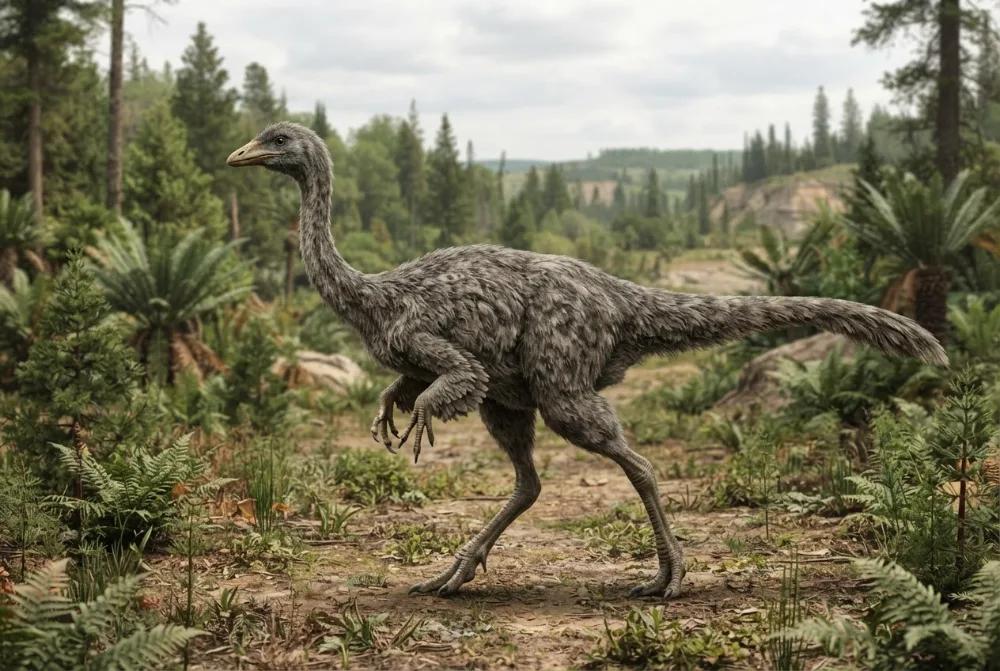
Struthiomimus looked a bit like a featherless ostrich with a long tail.1
Its neck made up about 40% of the length of its body in front of the hips.2
It had three fingers on each hand that were roughly the same length, which is unusual for a theropod.2
Its tail was relatively stiff and probably helped it keep balance while running.2
Some scientists think its hands worked like a hook or clamp to pull branches close, but others think they supported wing feathers.2
Naamne ɓurɗe naamneede fii Struthiomimus
?How big was Struthiomimus?
About 4.3 metres (14 feet) long, 1.4 metres (4.5 feet) tall at the hips, and weighed around 150 kilograms (330 pounds). A larger specimen weighed about 234 kilograms (515 pounds).21
?How fast could Struthiomimus run?
It could run between 50 and 80 km/h (31 to 50 mph), using its long legs to escape predators like tyrannosaurs.2
?What did Struthiomimus eat?
It was probably an omnivore, eating both plants and small animals like insects, mammals, and reptiles. Its toothless beak was good for cropping plants and maybe filtering food from water.21
?Did Struthiomimus have feathers?
Yes, it likely had feathers all over its body. Its arm bones show adaptations that may have supported wing feathers.2
?Where did Struthiomimus live?
It lived in western North America, in what is now Canada and the United States, during the Late Cretaceous period.21
?Why is it called Struthiomimus?
Its name means 'ostrich mimic' because it looked a lot like a modern ostrich, with long legs, a long neck, and a toothless beak.21
?Was Struthiomimus bigger than a human?
Yes, it was about 4.3 metres long and stood about 1.4 metres tall at the hips, which is taller than most people.2
Naamnu Rex fii Struthiomimus
Rex jaabata ƴamle dow hello ngo'o tan. Ƴamle 10 e lewru.
Rex ko AI, o waawi waɗugo juumre. O golla ka serverji nder EU, naamne danndetaake abada. Taa winndu innde maa walla huunde goɗnde ngam maa.
Feññinoowo goonga
Fenaande: Struthiomimus was a fierce meat-eater like other theropods.
Goonga: It had no teeth and a beak, and most scientists think it ate both plants and small animals, not just meat.2
Ngam annduɓe dino
- Innde ganndal
- Struthiomimus
- Inndoowo
- Osborn 19163
- Fedde
- Dinosauri nannduɗi e ndaw
- Fedde / clade
- Ornithomimidae3
- Fedde
- Theropoda > Ornithomimosauria3
- Duuɓi kaaƴe
- 84 haa 66 miliyon duuɓi (Campanian / Maastrichtian)3
- Cuuɗi kaaƴe
- Oldman, Kirtland, Dinosaur Park3
- Leyɗe
- Canada, USA3
- Fosilji tawaaɗi
- 18 nder Paleobiology Database3
- Tawgol
- Lawrence Lambe found the first remains in 1901 and named them Ornithomimus altus. In 1914, Barnum Brown found a nearly complete skeleton in Alberta, and Henry Fairfield Osborn named it Struthiomimus in 1917.2
- Haa jooni ɓe ɗon yeddondira
- Scientists still debate what Struthiomimus ate. Some think it was a plant-eater, others think it was a meat-eater, and some even suggest it filtered food from water.2
To haalaaji ummii
- Struthiomimus | Natural History Museum (nhm.ac.uk)
- Struthiomimus (en.wikipedia.org)
- Struthiomimus in The Paleobiology Database (CC BY 4.0): duuɓi, nokkuuje, cuuɗi kaaƴe, pecce.
Kala anndal nder ngal hello mari limre holloore iwdi mum. Si min mbaɗii juumre, yaafo min, min ko yiɗɓe dino, min wanaa jaaynde anndal. Haalan min ka hello@dinowiki.app, min moƴƴinan ɗum.
 Rex ɗon weelo! Dino Wiki, ɗum golle baaba ngam ɓiyiiko gorko mo yiɗi dinosauruuji, alaa njoɓdi, alaa ko yeeyata. Mawɓe mbaawi hokkude Rex ñaamdu ngam wallude lowre ndee heddoo e internet.Nyaamnu Rex
 Gallimimus
 Ornithomimus
 Deinocheirus
 Dromiceiomimus
 Archaeornithomimus
 Anserimimus
 Tyrannosaurus
 Triceratops
 Velociraptor
 Spinosaurus
 Ankylosaurus
 Parasaurolophus