
Harpymimus
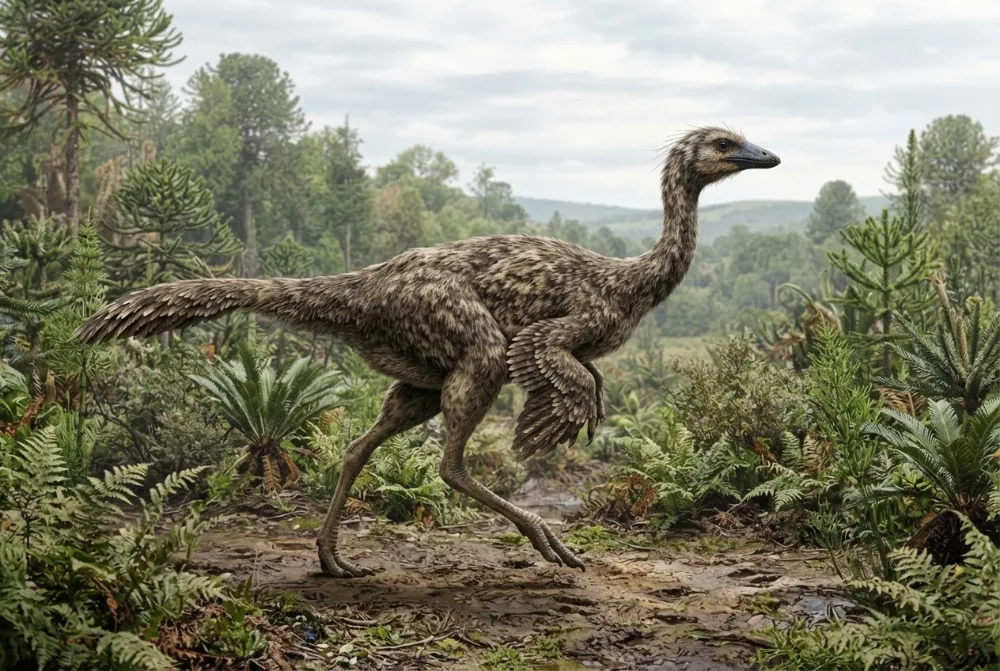
Harpymimus was an early, ostrich-like dinosaur that ran on two long legs. Unlike its later relatives, it still had small teeth in its lower jaw to grab food. It lived in what is now Mongolia during the Early Cretaceous.21
Ɗuum wuurii nde?
Hol no o mawni?
No juutuno?
No tedduno?
Hol no Harpymimus mawninoo, so fondaama bee AAN?
Hiisa tan nder browser maa. Walaa huunde danndetee walla neldetee ka nokku fuu.
How fast was it?
Anndal belɗungal
Harpymimus had about 11 small, blunt teeth only in its lower jaw, unlike later ostrich dinosaurs which had no teeth at all.2
Its name comes from the Harpies, scary bird monsters from Greek myths, and the Greek word for mimic.2
The only known skeleton is almost complete but was crushed flat, making some details hard to see.2
Harpymimus had a long neck, long arms with sharp claws, and long legs built for running.2
It lived alongside the horned dinosaur Psittacosaurus in the same region of Mongolia.2
Scientists think Harpymimus was an early member of the group that includes the giant-clawed Deinocheirus.2
Naamne ɓurɗe naamneede fii Harpymimus
?How big was Harpymimus?
About 2 metres (6.6 feet) long and weighed over 146.5 kilograms (323 pounds).12
?What did Harpymimus eat?
It was omnivorous. Its small, blunt teeth and beak were used for grabbing and holding food, not cutting or piercing.12
?Did Harpymimus have feathers?
The sources do not mention feathers, but as a theropod dinosaur related to birds, it may have had simple feathers. No direct evidence has been found.2
?When did Harpymimus live?
It lived during the Early Cretaceous Period, about 121 to 99 million years ago.1
Naamnu Rex fii Harpymimus
Rex jaabata ƴamle dow hello ngo'o tan. Ƴamle 10 e lewru.
Rex ko AI, o waawi waɗugo juumre. O golla ka serverji nder EU, naamne danndetaake abada. Taa winndu innde maa walla huunde goɗnde ngam maa.
Ngam annduɓe dino
- Innde ganndal
- Harpymimus
- Inndoowo
- Barsbold and Perle 19843
- Fedde
- Dinosauri nannduɗi e ndaw
- Fedde / clade
- Deinocheiridae3
- Fedde
- Theropoda > Ornithomimosauria3
- Duuɓi kaaƴe
- 110 haa 100 miliyon duuɓi (Albian)3
- Cuuɗi kaaƴe
- Khuren Dukh3
- Leyɗe
- Mongolia3
- Fosilji tawaaɗi
- 1 nder Paleobiology Database3
- Tawgol
- A Soviet-Mongolian expedition found the skeleton in the Gobi Desert in 1981. In 1984, paleontologists Rinchen Barsbold and Altangerel Perle named it Harpymimus okladnikovi after the archaeologist Alexey Okladnikov.2
- Haa jooni ɓe ɗon yeddondira
- Scientists are not sure exactly how Harpymimus used its small teeth, since they were too blunt for cutting meat or plants.2
To haalaaji ummii
- Harpymimus | Natural History Museum (nhm.ac.uk)
- Harpymimus (en.wikipedia.org)
- Harpymimus in The Paleobiology Database (CC BY 4.0): duuɓi, nokkuuje, cuuɗi kaaƴe, pecce.
Kala anndal nder ngal hello mari limre holloore iwdi mum. Si min mbaɗii juumre, yaafo min, min ko yiɗɓe dino, min wanaa jaaynde anndal. Haalan min ka hello@dinowiki.app, min moƴƴinan ɗum.
 Rex ɗon weelo! Dino Wiki, ɗum golle baaba ngam ɓiyiiko gorko mo yiɗi dinosauruuji, alaa njoɓdi, alaa ko yeeyata. Mawɓe mbaawi hokkude Rex ñaamdu ngam wallude lowre ndee heddoo e internet.Nyaamnu Rex
 Gallimimus
 Ornithomimus
 Struthiomimus
 Deinocheirus
 Dromiceiomimus
 Archaeornithomimus
 Stegosaurus
 Iguanodon
 Archaeopteryx
 Giganotosaurus
 Microraptor
 Deinonychus