
Zalmoxes
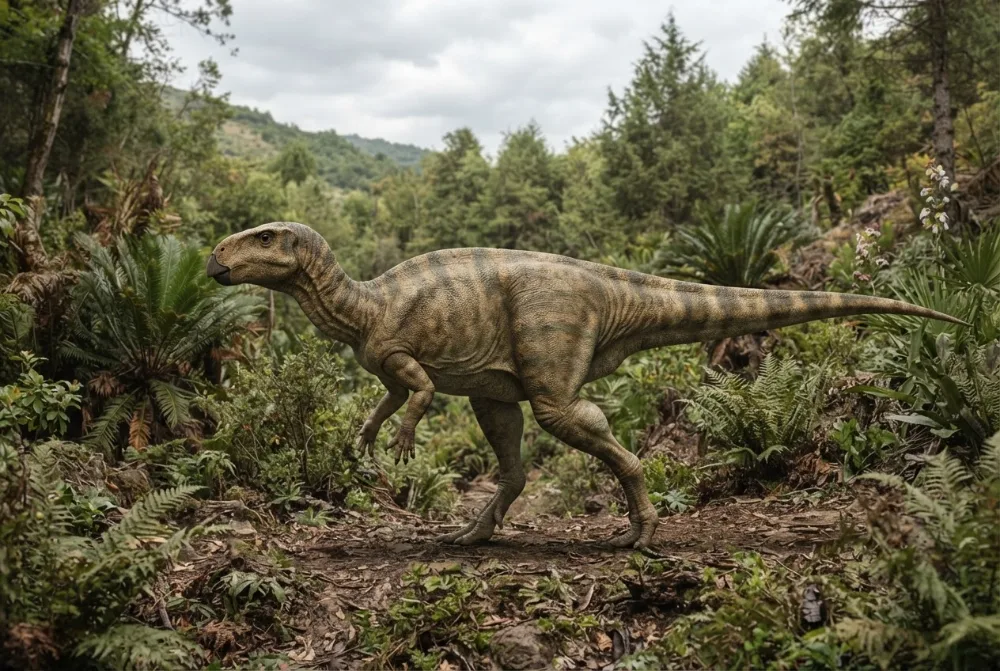
Zalmoxes was a small, plant-eating dinosaur that lived on an island called Hateg, in what is now Romania. It walked on two legs, had a beak, and ate tough plants. It was about the size of a small car, but some were even smaller!1
When did it live?
How big was it?
How long was it?
How heavy was it?
How big was Zalmoxes compared to YOU?
Just maths in your browser. Nothing is saved or sent anywhere.
Fun facts
Zalmoxes had a slow growth rate and a long growth period, which is different from many other dinosaurs.1
It lived on an island, and scientists think it might have been smaller than its relatives because of island dwarfism, though some think it was already small.1
Zalmoxes had a large triangular head and a beak, which helped it eat tough plants.1
Fossils of Zalmoxes have been found in Austria and France too, not just Romania.4
One species of Zalmoxes, called Z. shqiperorum, was later reclassified as a different type of dinosaur, a ceratopsian, not an ornithopod.1
Zalmoxes was one of the most common vertebrates in Transylvania during the latest Cretaceous period.1
Most asked questions about Zalmoxes
?How big was Zalmoxes?
Zalmoxes was small, with adults of Z. robustus reaching about 2.5 metres (8.2 feet) long and weighing about 45 kilograms (99 pounds). An unnamed species grew to about 2.9 metres (9.5 feet) long.1
?What did Zalmoxes eat?
Zalmoxes ate tough, fibrous plants like soft shoots, horsetails, angiosperms, pteridophytes, and ferns. It had a beak and could process C3 plants.1
?When did Zalmoxes live?
Zalmoxes lived during the Maastrichtian age of the Late Cretaceous, about 70 to 66 million years ago. It was one of the most common vertebrates in Transylvania at that time.13
?Where was Zalmoxes found?
Fossils of Zalmoxes have been found in Romania, specifically in the Hateg Basin of Transylvania. Some sources also mention finds in Austria and France, but the main site is Romania.13
?Was Zalmoxes a dinosaur?
Yes, Zalmoxes was a dinosaur, specifically a small ornithopod. It is classified as a probable rhabdodontid ornithopod, not a ceratopsian, though one species was later reclassified.13
?Why was Zalmoxes small?
Scientists once thought Zalmoxes was small due to island dwarfism, but later studies suggest it was already close to the size of its ancestors. Some related species were larger or smaller due to island effects.1
Ask Rex about Zalmoxes
Rex only answers questions about this page. 3 questions a day.
Rex is an AI and can make mistakes. He runs on servers in the EU and questions are never saved. Never type your name or other personal things.
Myth buster
Myth: Some people think Zalmoxes was a dwarf dinosaur because it lived on an island.
Truth: Scientists now think Zalmoxes was already small, and its larger relative Rhabdodon had island gigantism, while a smaller relative Mochlodon had island dwarfism.1
For dino experts
- Scientific name
- Zalmoxes
- Named by
- Weishampel et al. 20034
- Group
- Beaked plant-eaters
- Family / clade
- Rhabdodontoidea4
- Classification
- Ornithischia > Ornithopoda > Iguanodontia4
- Age of the rocks
- 84 to 66 million years (Campanian / Maastrichtian)4
- Rock formations
- Sebeş, Sînpetru, Densuș-Ciula4
- Countries
- Romania, Austria, France4
- Fossil records
- 44 in the Paleobiology Database4
- Also known as
- Onychosaurus (older names now counted as the same animal)4
- Discovery
- The first fossils were named Mochlodon robustus by Baron Franz Nopcsa in 1899. In 2003, scientists renamed them Zalmoxes robustus after studying new remains.12
- Still debated
- Scientists still debate whether Zalmoxes was a dwarf species or just naturally small, and how it is related to other similar dinosaurs.1
Where the facts come from
- Zalmoxes (en.wikipedia.org)
- Osteology and phylogeny of Zalmoxes (n. g.), an unusual Euornithopod dinosaur from the latest Cretaceous of Romania (tandfonline.com)
- Zalmoxes | Natural History Museum (nhm.ac.uk)
- Zalmoxes in The Paleobiology Database (CC BY 4.0): age, places, rock formations, classification.
Every fact on this page has a number that points to its source. If we got something wrong, sorry, we are dino fans, not a science journal. Tell us at hello@dinowiki.app and we will fix it.
 Rex is hungry! Dino Wiki is a dad's project for his dino-loving son, free with no ads. Grown-ups can feed Rex a snack to help keep it online.Feed Rex
 Iguanodon
 Tenontosaurus
 Thescelosaurus
 Camptosaurus
 Rhabdodon
 Nanosaurus
 Tyrannosaurus
 Triceratops
 Velociraptor
 Spinosaurus
 Ankylosaurus
 Parasaurolophus