
Thescelosaurus
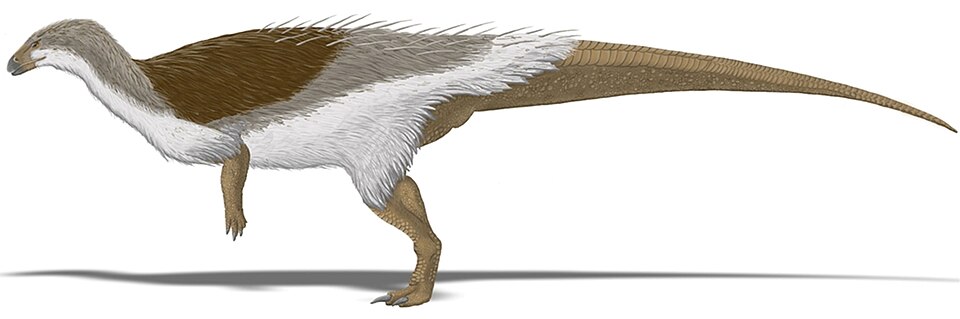
Thescelosaurus was a small, plant-eating dinosaur that lived near the end of the age of dinosaurs. It walked on two legs, had a long tail that helped it balance, and a toothless beak at the front of its snout. It was one of the last non-bird dinosaurs before they all went extinct 66 million years ago.1
When did it live?
How big was it?
Fun facts
Thescelosaurus had more teeth than its relatives, and the teeth were different shapes for different jobs.1
Its tail made up half its body length and was stiffened by rod-like tendons.1
Scientists think Thescelosaurus might have dug burrows, because it had a good sense of smell but poor hearing, like modern burrowing animals.1
A fossil of Thescelosaurus was thought to have a preserved heart in 2000, but later scientists doubted that idea.1
Its brain was small, which might mean it lived in groups of only two or three animals.1
Thescelosaurus had five fingers on its hand and four toes on its foot.1
It was probably not a fast runner, because its thigh bone was longer than its shin bone.1
Myth buster
Myth: Some people thought Thescelosaurus had a fossilized heart.
Truth: Scientists now doubt that the object found inside a specimen was a heart.1
For dino experts
- Scientific name
- Thescelosaurus
- Named by
- Gilmore 19132
- Group
- Beaked plant-eaters
- Family / clade
- Thescelosauridae2
- Classification
- Ornithischia2
- Age of the rocks
- 94 to 66 million years (Turonian to Maastrichtian)2
- Rock formations
- Hell Creek, Lance, Oldman2
- Countries
- USA, Canada2
- Fossil records
- 55 in the Paleobiology Database2
- Also known as
- Bugenasaura (older names now counted as the same animal)2
- Discovery
- The first skeleton was found in 1891 by John Bell Hatcher in Wyoming, but the dinosaur was named Thescelosaurus by Charles W. Gilmore in 1913.1
- Still debated
- Scientists still debate whether some species, like Thescelosaurus garbanii, belong in their own separate genus.1
Where the facts come from
- Thescelosaurus (en.wikipedia.org)
- Thescelosaurus in The Paleobiology Database (CC BY 4.0): age, places, rock formations, classification.
Every fact on this page has a number that points to its source. If we got something wrong, sorry, we are dino fans, not a science journal. Tell us at hello@dinowiki.app and we will fix it.
 Rex is hungry! Dino Wiki is free with no ads. Grown-ups can feed Rex a snack to keep it that way.Feed Rex
 Iguanodon
 Tenontosaurus
 Zalmoxes
 Camptosaurus
 Rhabdodon
 Nanosaurus
 Triceratops
 Velociraptor
 Spinosaurus
 Ankylosaurus
 Parasaurolophus