
Rhabdodon
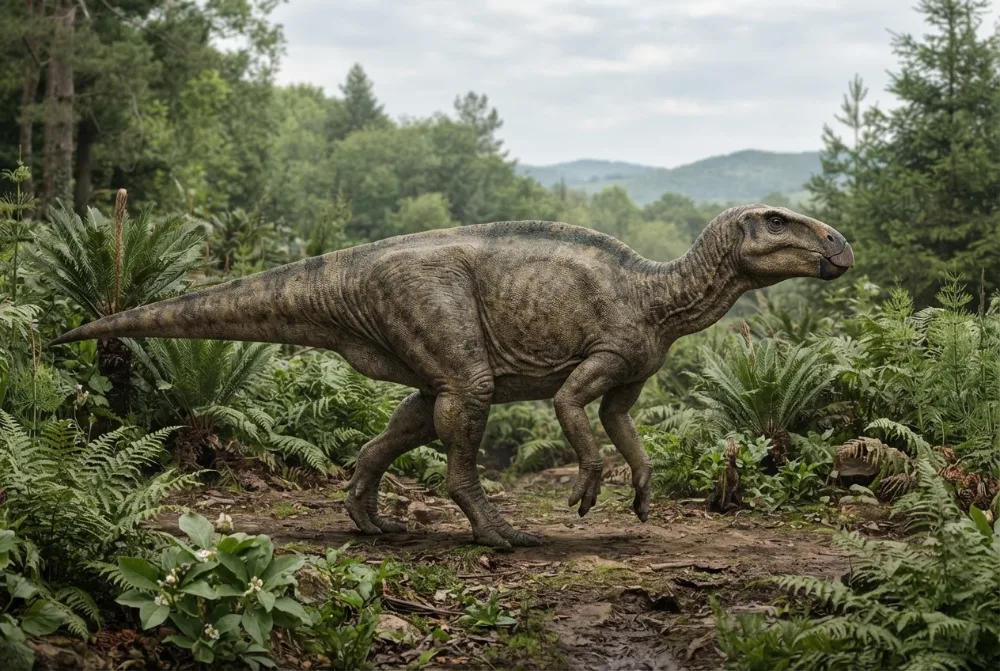
Rhabdodon was a plant-eating dinosaur that lived in Europe near the end of the Age of Dinosaurs. It had a strong beak for snipping leaves and walked on two legs, but could also drop to all fours. It was one of the biggest members of its family, the rhabdodontids.21
When did it live?
How big was it?
Fun facts
Rhabdodon lived about 72 to 69 million years ago, during the Late Cretaceous period.2
Its name means 'rod tooth' because its teeth were shaped like little rods.1
Rhabdodon was big for a rhabdodontid, measuring about 4 metres (13 feet) long and weighing 250 kilograms (550 pounds). Some fossils suggest it could grow up to 6 metres (20 feet) long.2
Scientists once thought Rhabdodon was a dwarf dinosaur because it lived on islands, but new research shows it was actually a giant compared to its closest relatives.2
Rhabdodon shared its home with other dinosaurs like the sauropod Ampelosaurus and the carnivorous theropods Arcovenator and Pyroraptor.2
Myth buster
Myth: Rhabdodon was a small, weak dinosaur because it lived on islands.
Truth: Rhabdodon was actually one of the largest rhabdodontids, and scientists now think it grew big on the mainland, not as a dwarf on islands.2
For dino experts
- Scientific name
- Rhabdodon
- Named by
- Matheron 18693
- Group
- Beaked plant-eaters
- Family / clade
- Rhabdodontidae3
- Classification
- Ornithischia > Ornithopoda > Iguanodontia3
- Age of the rocks
- 84 to 66 million years (Campanian to Maastrichtian)3
- Rock formations
- Marnes Rouges Inférieures, Grès à Reptiles, Grünbach3
- Countries
- France, Spain, Romania, Austria3
- Fossil records
- 37 in the Paleobiology Database3
- Also known as
- Oligosaurus, Ornithomerus (older names now counted as the same animal)3
- Discovery
- Rhabdodon was named by French paleontologist Philippe Matheron in 1869 based on fossils from the Fuveau Basin in southern France. The name was originally spelled two ways, but the ICZN officially fixed it as Rhabdodon priscus in 1988.23
- Still debated
- Scientists are not sure whether Rhabdodon was a dwarf or a giant, because some fossils are much larger than others, and it lived on both islands and the mainland.2
Where the facts come from
- Rhabdodon (nhm.ac.uk)
- Rhabdodon (en.wikipedia.org)
- Rhabdodon in The Paleobiology Database (CC BY 4.0): age, places, rock formations, classification.
Every fact on this page has a number that points to its source. If we got something wrong, sorry, we are dino fans, not a science journal. Tell us at hello@dinowiki.app and we will fix it.
 Rex is hungry! Dino Wiki is free with no ads. Grown-ups can feed Rex a snack to keep it that way.Feed Rex
 Iguanodon
 Tenontosaurus
 Thescelosaurus
 Zalmoxes
 Camptosaurus
 Nanosaurus
 Triceratops
 Velociraptor
 Spinosaurus
 Ankylosaurus
 Parasaurolophus