
Uktenadactylus
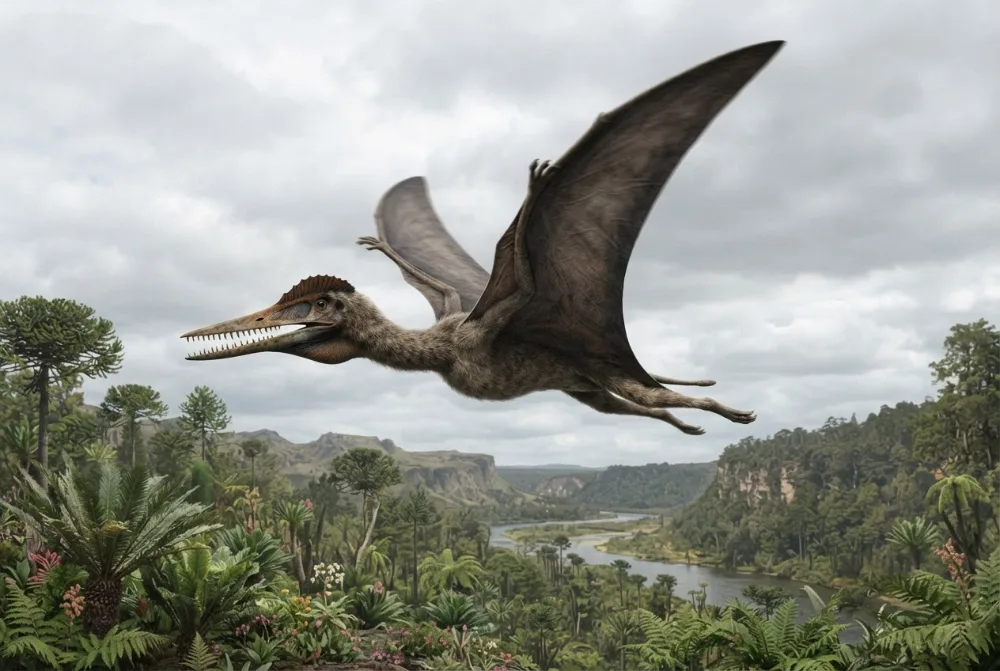
Uktenadactylus was a flying reptile that soared over the seas of Texas and England about 110 million years ago. It had a big crest on its snout and a mouth full of sharp teeth, perfect for catching fish. This pterosaur was not a dinosaur, but a close relative of the famous Pterodactyl.14
When did it live?
How big was it?
How wide were its wings?
How big was Uktenadactylus compared to YOU?
Just maths in your browser. Nothing is saved or sent anywhere.
How fast was it?
Fun facts
Uktenadactylus is known from only a few snout fragments, so scientists are still guessing its full size.1
The name Uktenadactylus comes from the Uktena, a giant horned snake in Cherokee legends, and the Greek word for finger.1
Its snout had a crest that curved upward and was about 7.5 centimetres (3 inches) tall at its highest point.1
The third pair of teeth in its upper jaw were the biggest, each about 1.8 centimetres (0.7 inches) wide.1
Uktenadactylus lived during the Early Cretaceous period, about 125 to 100 million years ago.4
It belonged to a group of pterosaurs called anhanguerids, which had long, toothed jaws and often fished near coasts.1
Most asked questions about Uktenadactylus
?How big was Uktenadactylus?
Scientists estimate it had a wingspan of about 7 to 8 metres, possibly up to 9 metres. This is based on comparisons with similar pterosaurs like Coloborhynchus and Tropeognathus.3
?What did Uktenadactylus eat?
It ate fish. Its long, toothed jaws and sharp teeth were perfect for catching fish near the coast.1
?Is Uktenadactylus a dinosaur?
No, it is a pterosaur, a flying reptile that is not a dinosaur. It is a close relative of Pterodactyl.1

Ask Rex about Uktenadactylus
Rex only answers questions about this page. 10 questions a month.
Rex is an AI and can make mistakes. He runs on servers in the EU and questions are never saved. Never type your name or other personal things.
For dino experts
- Scientific name
- Uktenadactylus
- Named by
- Rodrigues and Kellner 20084
- Group
- Flying reptiles
- Family / clade
- Anhangueridae4
- Classification
- Pterosauria > Pterodactyloidea4
- Age of the rocks
- 126 to 100 million years (Barremian / Albian)4
- Rock formations
- Paw Paw, Wessex4
- Countries
- USA, United Kingdom4
- Fossil records
- 2 in the Paleobiology Database4
- Discovery
- The first fossil, a partial snout, was found in 1992 in Tarrant County, Texas, by Chris Wadleigh. In 1994, Yuong Nam-Lee named it Coloborhynchus wadleighi. In 2009, Brazilian paleontologists Taissa Rodrigues and Alexander Kellner gave it its own genus, Uktenadactylus.1
- Still debated
- Scientists are not sure how big Uktenadactylus was, because only pieces of its snout have been found.1
Where the facts come from
- Uktenadactylus (en.wikipedia.org)
- Uktenadactylus wadleighi | Pterosaur Database by DinoAnimals.com (dinoanimals.com)
- Uktenadactylus – DINOSAURS AND BARBARIANS (dinosaursandbarbarians.com)
- Uktenadactylus in The Paleobiology Database (CC BY 4.0): age, places, rock formations, classification.
Every fact on this page has a number that points to its source. If we got something wrong, sorry, we are dino fans, not a science journal. Tell us at hello@dinowiki.app and we will fix it.
 Rex is hungry! Dino Wiki is a dad's project for his dino-loving son, free with no ads. Grown-ups can feed Rex a snack to help keep it online.Feed Rex
 Pteranodon
 Quetzalcoatlus
 Dorygnathus
 Rhamphorhynchus
 Anhanguera
 Pterodactylus
 Stegosaurus
 Iguanodon
 Archaeopteryx
 Giganotosaurus
 Microraptor
 Deinonychus