
Tawa
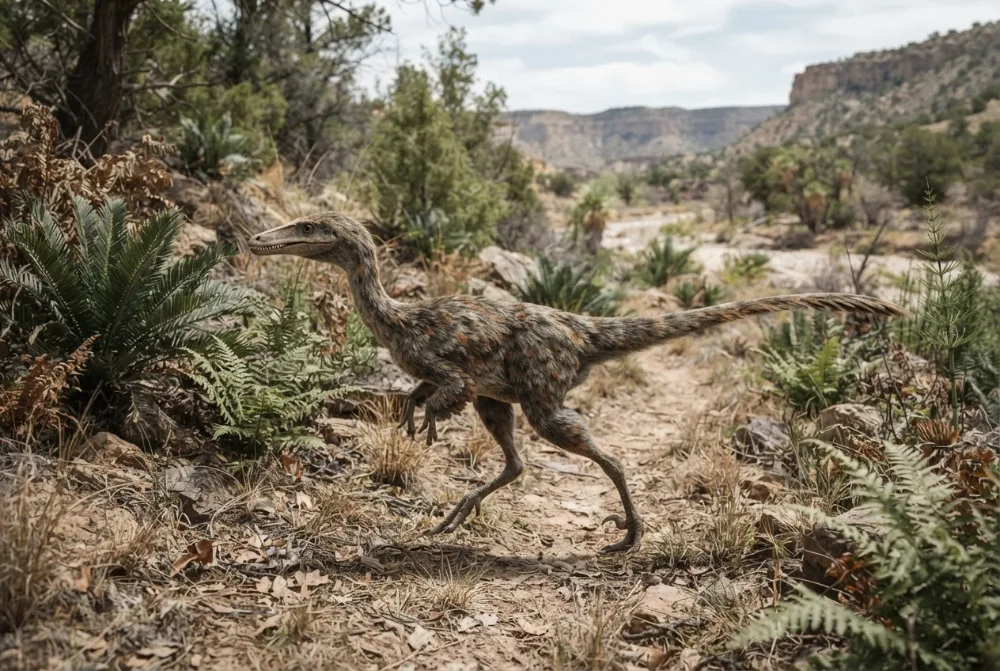
Tawa was a small, fast dinosaur that lived about 215 million years ago in what is now New Mexico. It had a slender body and a kink in its upper jaw, and it may have been one of the earliest meat-eating dinosaurs.1
When did it live?
How big was it?
Fun facts
Tawa's fossils were discovered at the Hayden Quarry in Ghost Ranch, New Mexico, starting in 2004.1
The name Tawa comes from the Hopi word for the sun god, and the species name hallae honors Ruth Hall, founder of the Ghost Ranch Museum of Paleontology.1
Tawa had a kink in its upper jaw, between the maxilla and premaxilla, similar to some other early theropods.1
Scientists think Tawa helps show that the earliest dinosaurs evolved in South America and then spread across the supercontinent Pangaea.1
The holotype specimen of Tawa is a juvenile, with an open braincase and unfused bones.1
An isolated femur suggests that adult Tawa could be at least 30% larger than the juvenile holotype.1
For dino experts
- Scientific name
- Tawa
- Named by
- Nesbitt et al. 20092
- Group
- First dinosaurs
- Family / clade
- Saurischia2
- Age of the rocks
- 227 to 206 million years (Norian)2
- Rock formations
- Chinle2
- Countries
- USA2
- Fossil records
- 3 in the Paleobiology Database2
- Discovery
- Tawa was first described in 2009 by a team led by Sterling J. Nesbitt, based on fossils found in New Mexico.1
- Still debated
- Scientists debate whether Tawa is a true theropod or a more basal saurischian, and whether it belongs to the group Coelophysoidea.1
Where the facts come from
- Tawa hallae (en.wikipedia.org)
- Tawa in The Paleobiology Database (CC BY 4.0): age, places, rock formations, classification.
Every fact on this page has a number that points to its source. If we got something wrong, sorry, we are dino fans, not a science journal. Tell us at hello@dinowiki.app and we will fix it.
 Rex is hungry! Dino Wiki is free with no ads. Grown-ups can feed Rex a snack to keep it that way.Feed Rex
 Herrerasaurus
 Chindesaurus
 Nyasasaurus
 Staurikosaurus
 Alwalkeria
 Daemonosaurus
 Nothosaurus
 Massospondylus
 Plateosaurus
 Coelophysis
 Podokesaurus
 Simosaurus