
Massospondylus
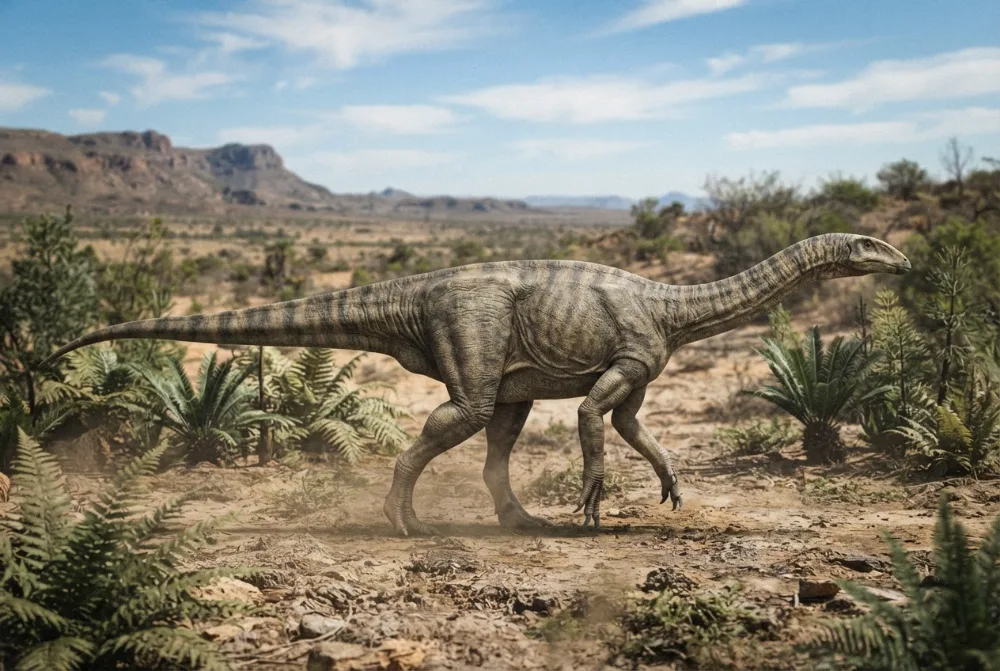
Massospondylus was an early long-necked dinosaur that lived in southern Africa during the Early Jurassic. It had a small head, a long neck and tail, and a slender body. This dinosaur walked on two legs and used its sharp thumb claws to pull down branches or dig up plants.1
When did it live?
How big was it?
How long was it?
How tall was it?
at the hips
How heavy was it?
How big was Massospondylus compared to YOU?
Just maths in your browser. Nothing is saved or sent anywhere.
Fun facts
Massospondylus was one of the first dinosaurs to be named, described by Richard Owen in 1854.1
Its name means 'longer vertebra' because Owen thought the neck bones were tail bones.1
Fossil eggs and embryos of Massospondylus have been found, and they are among the oldest known dinosaur eggs.1
The eggshell of Massospondylus was extremely thin, less than 0.1 mm (0.0039 in) thick.1
Baby Massospondylus had proportionally longer arms and a larger head than adults, suggesting they may have walked on four legs when young.1
Massospondylus could speed up or slow down its growth depending on how much food was available.1
The oldest known Massospondylus was about 20 years old when it died.1
Most asked questions about Massospondylus
?How big was Massospondylus?
Massospondylus was about 4 to 6 metres (13 to 20 feet) long, with a small head, long neck and tail, and a slender body. It weighed around 150 kilograms (330 pounds) according to the Natural History Museum.13
?What did Massospondylus eat?
It was probably a herbivore (plant-eater), though some scientists think it may have been omnivorous. It used its sharp thumb claws to pull down branches or dig up plants, and it may have swallowed stones to help grind tough leaves in its stomach.12
?Did Massospondylus walk on two legs or four?
It is now considered to have been bipedal (walked on two legs), though it was long thought to be quadrupedal. Some studies suggest babies may have walked on four legs, but newer research says it was bipedal at all ages.1
?When did Massospondylus live?
It lived during the Early Jurassic, about 201 to 184 million years ago.13
?Where was Massospondylus found?
Fossils have been found in southern Africa, including South Africa, Lesotho, and Zimbabwe, and also in Namibia. Some fossils from the US and Argentina were once assigned to it but are now considered different dinosaurs.12
?Did Massospondylus lay eggs?
Yes, it laid eggs, and some of the oldest known dinosaur eggs and embryos belong to this genus. The eggshells were extremely thin, less than 0.1 mm (0.004 in) thick.1
Ask Rex about Massospondylus
Rex only answers questions about this page. 3 questions a day.
Rex is an AI and can make mistakes. He runs on servers in the EU and questions are never saved. Never type your name or other personal things.
Myth buster
Myth: Massospondylus was a four-legged (quadrupedal) dinosaur.
Truth: Scientists now think Massospondylus walked on two legs (bipedal), though babies may have been four-legged.1
For dino experts
- Scientific name
- Massospondylus
- Named by
- Owen 18544
- Group
- Long-necks
- Family / clade
- Massospondylidae4
- Classification
- Sauropodomorpha4
- Age of the rocks
- 237 to 175 million years (Carnian / Toarcian)4
- Rock formations
- Elliot, Mpandi, Forest Sandstone4
- Countries
- South Africa, Zimbabwe, Lesotho, Namibia4
- Fossil records
- 80 in the Paleobiology Database4
- Discovery
- The first fossils of Massospondylus were found in 1853 or 1854 by Joseph Millard Orpen and his brothers on a farm in the Drakensberg mountains near Harrismith, South Africa. Their father donated the fossils to the Hunterian Museum in London, where Richard Owen described and named the dinosaur in 1854.1
- Still debated
- Scientists are still debating whether Massospondylus was purely a plant-eater or also ate small animals or carrion.1
Where the facts come from
- Massospondylus (en.wikipedia.org)
- enchantedlearning.com (enchantedlearning.com)
- Massospondylus | Natural History Museum (nhm.ac.uk)
- Massospondylus in The Paleobiology Database (CC BY 4.0): age, places, rock formations, classification.
Every fact on this page has a number that points to its source. If we got something wrong, sorry, we are dino fans, not a science journal. Tell us at hello@dinowiki.app and we will fix it.
 Rex is hungry! Dino Wiki is a dad's project for his dino-loving son, free with no ads. Grown-ups can feed Rex a snack to help keep it online.Feed Rex
 Brachiosaurus
 Diplodocus
 Brontosaurus
 Argentinosaurus
 Camarasaurus
 Morosaurus
 Nothosaurus
 Coelophysis
 Podokesaurus
 Simosaurus
 Eudimorphodon
 Herrerasaurus