
Staurikosaurus
Staurikosaurus was one of the very first dinosaurs to ever walk the Earth. It was a small, fast meat-eater that lived in what is now Brazil over 220 million years ago.12
When did it live?
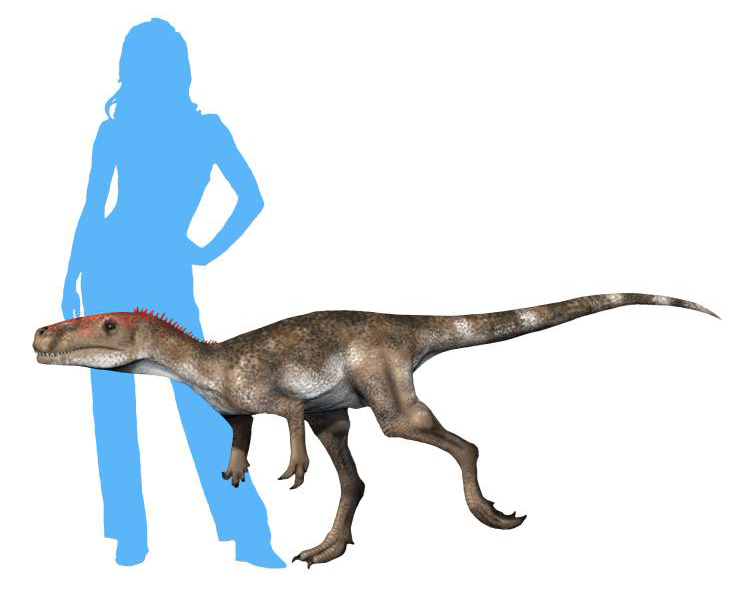
How big was it?
Fun facts
Staurikosaurus was one of the earliest known dinosaurs, living about 227 to 221 million years ago during the Triassic Period.1
It was only about 2 metres (6.6 feet) long, roughly the size of a large dog.1
Its name means 'southern cross lizard', after the Southern Cross constellation that can be seen from Brazil.1
Only a single partial skeleton has been found, including parts of the skull, backbone, hips and legs.3
Some scientists once thought Staurikosaurus might be the same as Herrerasaurus, another early dinosaur from Argentina.2
Staurikosaurus lived alongside giant amphibians and early crocodile-like reptiles in a warm, dry landscape.2
Myth buster
Myth: Many people think Staurikosaurus was a type of prosauropod or plant-eater.
Truth: Scientists now agree it was a theropod, a meat-eating dinosaur closely related to Herrerasaurus.2
For dino experts
- Scientific name
- Staurikosaurus
- Named by
- Colbert 19703
- Group
- First dinosaurs
- Family / clade
- Herrerasauridae3
- Classification
- Herrerasauridae3
- Age of the rocks
- 237 to 227 million years (Carnian)3
- Rock formations
- Santa Maria3
- Countries
- Brazil3
- Fossil records
- 2 in the Paleobiology Database3
- Also known as
- Teyuwasu (older names now counted as the same animal)3
- Discovery
- Staurikosaurus was named by American paleontologist Edwin H. Colbert in 1970, based on a partial skeleton found in the Santa Maria Formation of Brazil.31
- Still debated
- Scientists still debate whether Staurikosaurus was a very early theropod or a primitive dinosaur that lived before theropods split from other dinosaurs.2
Where the facts come from
- Staurikosaurus | Natural History Museum (nhm.ac.uk)
- PBDB Taxon (paleobiodb.org)
- Staurikosaurus in The Paleobiology Database (CC BY 4.0): age, places, rock formations, classification.
Every fact on this page has a number that points to its source. If we got something wrong, sorry, we are dino fans, not a science journal. Tell us at hello@dinowiki.app and we will fix it.
 Rex is hungry! Dino Wiki is free with no ads. Grown-ups can feed Rex a snack to keep it that way.Feed Rex
 Herrerasaurus
 Tawa
Tawa Chindesaurus
 Nyasasaurus
 Alwalkeria
 Daemonosaurus
 Nothosaurus
 Massospondylus
 Plateosaurus
 Coelophysis
 Podokesaurus
 Simosaurus