
Scutellosaurus
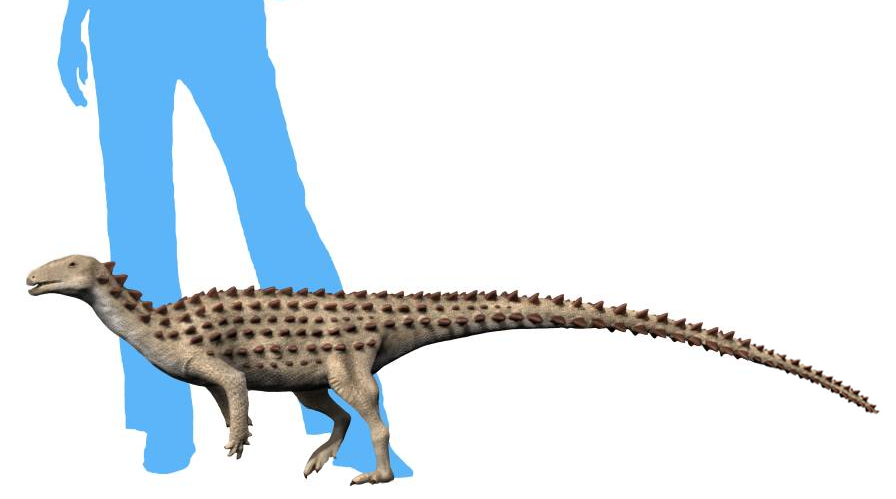
Scutellosaurus was one of the earliest armoured dinosaurs. It had hundreds of bony plates along its back and tail, like a tiny walking shield. It could run on its hind legs and used its long tail for balance.1
When did it live?
How big was it?
Fun facts
Scutellosaurus had over 300 bony plates called osteoderms on its neck, back and tail.1
It lived about 196 million years ago during the Early Jurassic Period.1
This dinosaur was only about 1.3 metres long, about the size of a large dog.1
Scutellosaurus could walk on two legs, unlike later armoured dinosaurs that walked on all fours.1
Its closest relatives include Emausaurus and Scelidosaurus, which were also early armoured dinosaurs.1
The first fossil was found by David Lawler on the Navajo Nation in Arizona.1
Its name means 'little-shielded lizard' because of the many small shields on its body.1
Myth buster
Myth: Some people think Scutellosaurus was a slow, heavy dinosaur like later ankylosaurs.
Truth: Scutellosaurus was lightly built and could probably run on its hind legs, making it much faster.1
For dino experts
- Scientific name
- Scutellosaurus
- Named by
- Colbert 19813
- Group
- Armoured dinos
- Family / clade
- Thyreophora3
- Classification
- Ornithischia > Thyreophora3
- Age of the rocks
- 201 to 184 million years (Hettangian to Pliensbachian)3
- Rock formations
- Kayenta3
- Countries
- USA3
- Fossil records
- 23 in the Paleobiology Database3
- Discovery
- Scutellosaurus was named by Edwin Colbert in 1981. The first fossils were collected by David Lawler in the Kayenta Formation of Arizona.13
- Still debated
- Scientists are not sure exactly how the bony plates were arranged on its body, because the fossils are incomplete.1
Where the facts come from
- Scutellosaurus (en.wikipedia.org)
- Scutellosaurus | Natural History Museum (nhm.ac.uk)
- Scutellosaurus in The Paleobiology Database (CC BY 4.0): age, places, rock formations, classification.
Every fact on this page has a number that points to its source. If we got something wrong, sorry, we are dino fans, not a science journal. Tell us at hello@dinowiki.app and we will fix it.
 Rex is hungry! Dino Wiki is free with no ads. Grown-ups can feed Rex a snack to keep it that way.Feed Rex
 Ankylosaurus
 Sauropelta
 Pinacosaurus
 Struthiosaurus
 Euoplocephalus
 Edmontonia
 Dilophosaurus
 Stenopterygius
 Dorygnathus
 Lufengosaurus
 Yunnanosaurus
 Sinosaurus