
Edmontonia
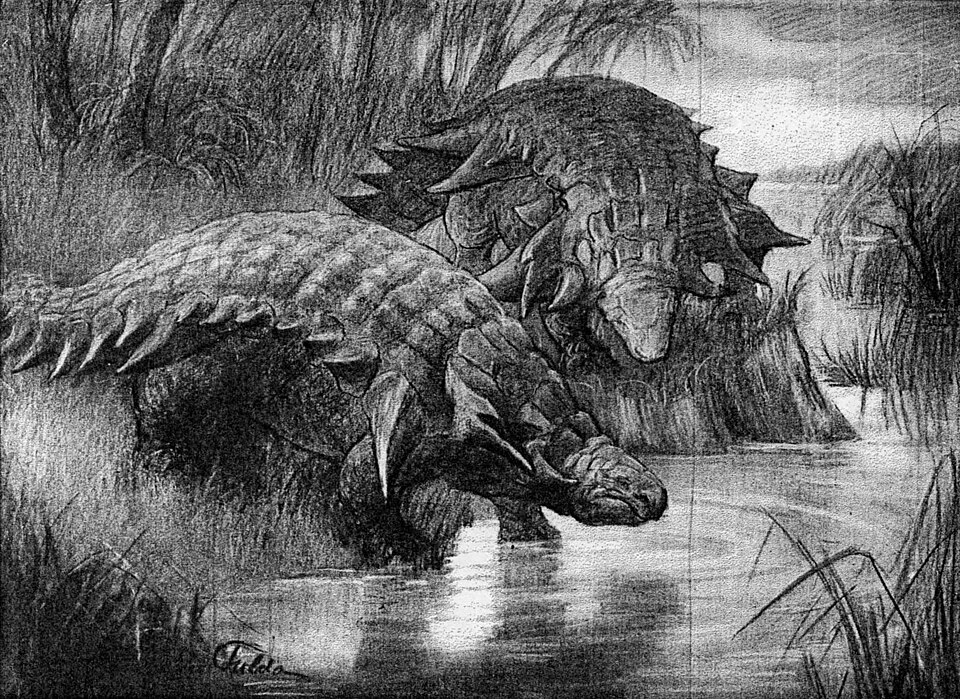
Edmontonia was a tank-like dinosaur covered in bony plates and sharp spikes. It walked on four legs and munched on low-growing plants. This nodosaurid dinosaur lived in western North America near the end of the Age of Dinosaurs.1
When did it live?
How big was it?
Fun facts
Edmontonia had four huge spikes sticking out from each shoulder, the largest of any nodosaurid. These spikes could have been used to fight other Edmontonia or to stab attacking predators.1
Its back and head were covered with small, oval bony plates that had a ridge down the middle. Its neck and shoulders were protected by three half-rings made of large keeled plates.1
Edmontonia lived alongside many other giant plant-eaters like the duck-billed dinosaurs Gryposaurus and Corythosaurus, and the horned dinosaurs Centrosaurus and Chasmosaurus.1
The only large predators that lived with Edmontonia were the tyrannosaurids Gorgosaurus and Daspletosaurus.1
Scientists think Edmontonia might have crouched down to protect its soft belly from predators, making it hard for a predator to flip it over.1
One species of Edmontonia, E. rugosidens, lived about 76.5 to 75 million years ago. The other species, E. longiceps, lived about 72 million years ago.1
Myth buster
Myth: Edmontonia could swing its tail like a club to defend itself.
Truth: Edmontonia was a nodosaurid, not an ankylosaurid. Nodosaurids did not have a tail club. Instead, Edmontonia relied on its shoulder spikes and body armor for protection.1
For dino experts
- Scientific name
- Edmontonia
- Named by
- Sternberg 19283
- Group
- Armoured dinos
- Family / clade
- Nodosauridae3
- Classification
- Ornithischia > Ankylosauria > Nodosauridae > Thyreophora3
- Age of the rocks
- 84 to 66 million years (Campanian to Maastrichtian)3
- Rock formations
- Judith River, Aguja, Hell Creek3
- Countries
- USA, Canada3
- Fossil records
- 16 in the Paleobiology Database3
- Also known as
- Chassternbergia, Denversaurus (older names now counted as the same animal)3
- Discovery
- Edmontonia was named by Charles M. Sternberg in 1928. The first fossils, including a skull and much of the skeleton, were found near Morrin, Alberta, Canada in 1924 by George Paterson.1
- Still debated
- Scientists still debate whether the fossils called Denversaurus and Chassternbergia are really separate dinosaurs or just different species of Edmontonia.2
Where the facts come from
- Edmontonia (en.wikipedia.org)
- PBDB Taxon (paleobiodb.org)
- Edmontonia in The Paleobiology Database (CC BY 4.0): age, places, rock formations, classification.
Every fact on this page has a number that points to its source. If we got something wrong, sorry, we are dino fans, not a science journal. Tell us at hello@dinowiki.app and we will fix it.
 Rex is hungry! Dino Wiki is free with no ads. Grown-ups can feed Rex a snack to keep it that way.Feed Rex
 Ankylosaurus
 Sauropelta
 Pinacosaurus
 Scutellosaurus
 Struthiosaurus
 Euoplocephalus
 Triceratops
 Velociraptor
 Spinosaurus
 Parasaurolophus
 Pteranodon