
Yunnanosaurus
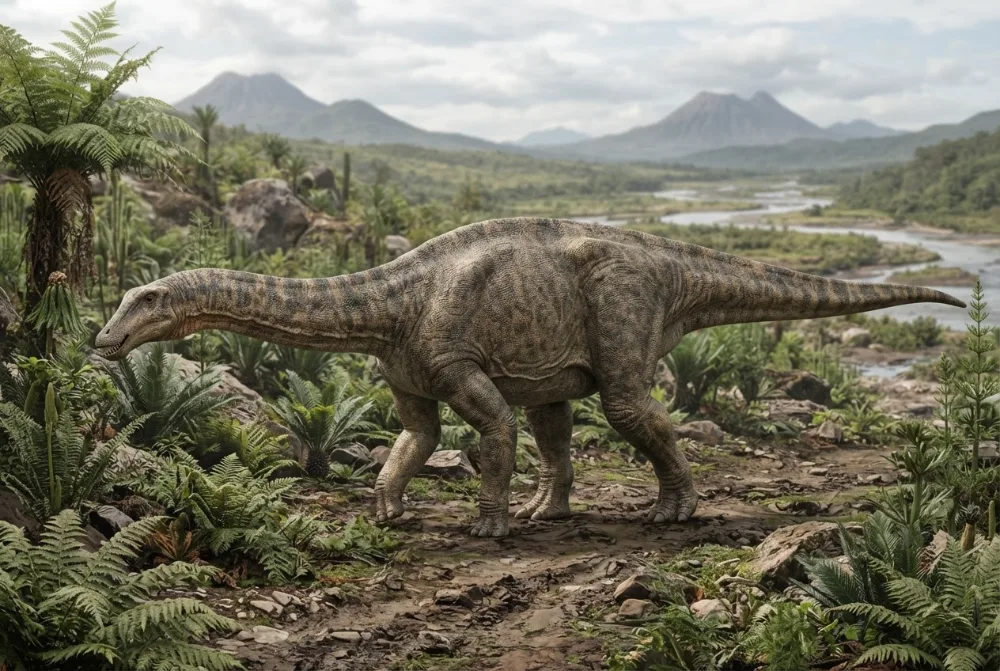
Yunnanosaurus was an early long-necked dinosaur that lived in China during the Early Jurassic. It could walk on two legs or all fours and used its spoon-shaped teeth to munch on plants.1
When did it live?
How big was it?
Fun facts
Yunnanosaurus had more than sixty spoon-shaped teeth that were self-sharpening because they wore against each other as the animal fed.1
Its teeth were advanced for an early sauropodomorph and looked like those of later giant sauropods, but scientists think this similarity evolved separately.1
The largest species, Yunnanosaurus youngi, reached about 13 metres (42 feet) long, as big as a school bus.1
The first fossils were discovered by Chinese paleontologist Yang Zhongjian (also known as C. C. Young) in the early 1940s.1
Yunnanosaurus lived between about 201 and 183 million years ago, during the Early Jurassic Period.12
It could walk on two legs or on all fours, making it a versatile mover through its ancient environment.1
Myth buster
Myth: Yunnanosaurus is often called a prosauropod, meaning it was a direct ancestor of sauropods.
Truth: Scientists now place Yunnanosaurus in a group called Sauropodiformes, which is closer to true sauropods but not a direct ancestor.1
For dino experts
- Scientific name
- Yunnanosaurus
- Named by
- Young 19403
- Group
- Long-necks
- Family / clade
- Sauropodiformes3
- Classification
- Sauropodomorpha3
- Age of the rocks
- 201 to 184 million years (Hettangian to Pliensbachian)3
- Rock formations
- Lufeng, Fengjiahe3
- Countries
- China3
- Fossil records
- 17 in the Paleobiology Database3
- Discovery
- Chinese paleontologist C. C. Young (Yang Zhongjian) named Yunnanosaurus in 1942 after finding many skeletons in Yunnan, China. The type species is Yunnanosaurus huangi.1
- Still debated
- Scientists are not sure whether Yunnanosaurus robustus is a separate species or just a larger individual of Yunnanosaurus huangi.1
Where the facts come from
- Yunnanosaurus (en.wikipedia.org)
- PBDB Taxon (paleobiodb.org)
- Yunnanosaurus in The Paleobiology Database (CC BY 4.0): age, places, rock formations, classification.
Every fact on this page has a number that points to its source. If we got something wrong, sorry, we are dino fans, not a science journal. Tell us at hello@dinowiki.app and we will fix it.
 Rex is hungry! Dino Wiki is free with no ads. Grown-ups can feed Rex a snack to keep it that way.Feed Rex
 Brachiosaurus
 Diplodocus
 Brontosaurus
 Argentinosaurus
 Camarasaurus
 Morosaurus
 Dilophosaurus
 Stenopterygius
 Dorygnathus
 Scutellosaurus
 Sinosaurus
 Temnodontosaurus