
Sauropelta
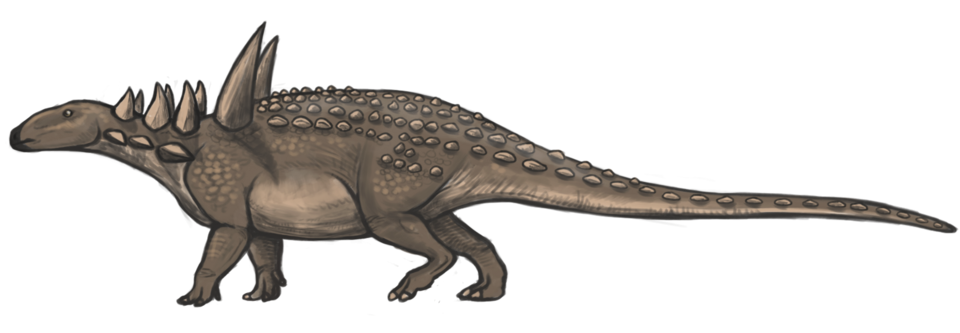
Sauropelta was an armoured dinosaur that looked like a walking tank. It had huge spikes on its neck and a long tail that made up half its body length. This plant-eater lived in North America during the Early Cretaceous period.21
When did it live?
How big was it?
Fun facts
Sauropelta had two rows of large, pointed spines on each side of its neck. The spines pointed backwards and upwards, and their bases were fused together, which limited neck movement.2
Its body was covered in bony armor, including small nodules and larger conical scutes. Over the hips, the armor plates locked together tightly to form a 'sacral shield'.2
Sauropelta is one of the earliest known nodosaurids. Most of its fossils come from rocks that are about 108.5 million years old.2
The first Sauropelta fossils were collected by famous dinosaur hunter Barnum Brown in the 1930s. But the dinosaur was not named until 1970, when John Ostrom gave it the name Sauropelta.2
Sauropelta lived in forested floodplains near rivers. It ate conifers and cycads, since grasses had not yet evolved.2
A nearly complete skeleton with its armor still in place is on display at the American Museum of Natural History in New York City.2
Myth buster
Myth: Sauropelta had a tail club like some other armoured dinosaurs.
Truth: Sauropelta was a nodosaurid, and nodosaurids did not have tail clubs. Instead, its tail had flat triangular plates pointing outwards.2
For dino experts
- Scientific name
- Sauropelta
- Named by
- Ostrom 19703
- Group
- Armoured dinos
- Family / clade
- Nodosauridae3
- Classification
- Ornithischia > Ankylosauria > Nodosauridae > Thyreophora3
- Age of the rocks
- 121 to 94 million years (Aptian to Cenomanian)3
- Rock formations
- Cloverly, Cedar Mountain, Wayan3
- Countries
- USA3
- Fossil records
- 34 in the Paleobiology Database3
- Discovery
- Barnum Brown collected the first fossils in the 1930s from Montana, USA. John Ostrom named the dinosaur Sauropelta in 1970, using specimens from both Brown's and his own expeditions.2
- Still debated
- Scientists are not sure if some large nodosaurid fossils from Utah belong to Sauropelta or to a different, unnamed species.2
Where the facts come from
- Sauropelta | Natural History Museum (nhm.ac.uk)
- Sauropelta (en.wikipedia.org)
- Sauropelta in The Paleobiology Database (CC BY 4.0): age, places, rock formations, classification.
Every fact on this page has a number that points to its source. If we got something wrong, sorry, we are dino fans, not a science journal. Tell us at hello@dinowiki.app and we will fix it.
 Rex is hungry! Dino Wiki is free with no ads. Grown-ups can feed Rex a snack to keep it that way.Feed Rex
 Ankylosaurus
 Pinacosaurus
 Scutellosaurus
 Struthiosaurus
 Euoplocephalus
 Edmontonia
 Stegosaurus
 Iguanodon
 Archaeopteryx
 Giganotosaurus
 Microraptor
 Deinonychus