
Dilophosaurus
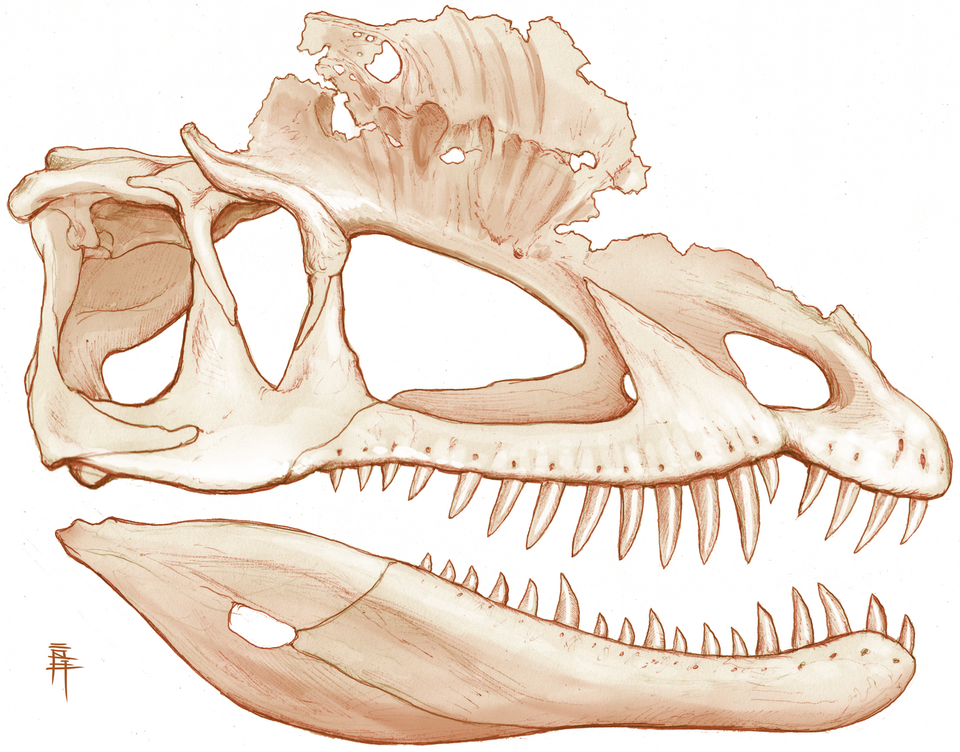
Dilophosaurus was a big, fast meat-eating dinosaur that lived in North America about 186 million years ago. It had two thin crests on its head and strong jaws that could crush bone. It was the biggest land predator in its neighborhood during the Early Jurassic.12
When did it live?
How big was it?
Fun facts
Dilophosaurus had two thin crests on its head made from the nasal and lacrimal bones. These crests might have been used for display or to attract mates.12
Its jaws were strong enough to puncture bone, and it may have been the top predator in its ecosystem.1
Some scientists think Dilophosaurus might have eaten fish. Its jaws had a 'rosette' of interlocking teeth like modern fish-eating crocodiles and gharials.1
Dilophosaurus breathed like a bird. Air sacs in its bones allowed unidirectional airflow in its lungs, which gave it more oxygen and made it a fast, active hunter.1
Fossil footprints of Dilophosaurus have been found, including traces where it rested.1
It lived in a seasonally dry environment with rivers and sand dunes, like a river oasis surrounded by a desert.1
Dilophosaurus was the largest land animal in North America during the Early Jurassic, bigger than any other predator at that time.2
Myth buster
Myth: Dilophosaurus could spit venom like in the movie Jurassic Park.
Truth: There is no evidence that Dilophosaurus spat venom. It was a large predator with strong jaws and teeth, not a small frilled dinosaur that spits poison.1
For dino experts
- Scientific name
- Dilophosaurus
- Named by
- Welles 19703
- Group
- Other meat-eaters
- Family / clade
- Neotheropoda3
- Classification
- Theropoda3
- Age of the rocks
- 201 to 184 million years (Hettangian to Pliensbachian)3
- Rock formations
- Kayenta, Dharmaram3
- Countries
- USA, India3
- Fossil records
- 14 in the Paleobiology Database3
- Discovery
- Three skeletons were found in northern Arizona in 1940 and collected in 1942. Scientist Samuel P. Welles named the first specimen Megalosaurus wetherilli in 1954. After finding a larger skeleton with crests, he renamed it Dilophosaurus wetherilli in 1970.1
- Still debated
- Scientists still debate whether Dilophosaurus was a fast predator that attacked large prey or a scavenger that ate smaller animals. Most now think it was an active hunter.1
Where the facts come from
- Dilophosaurus (en.wikipedia.org)
- A comprehensive anatomical and phylogenetic evaluation of Dilophosaurus wetherilli (Dinosauria, Theropoda) with descriptions of new specimens from the Kayenta Formation of northern Arizona (bioone.org)
- Dilophosaurus in The Paleobiology Database (CC BY 4.0): age, places, rock formations, classification.
Every fact on this page has a number that points to its source. If we got something wrong, sorry, we are dino fans, not a science journal. Tell us at hello@dinowiki.app and we will fix it.
 Rex is hungry! Dino Wiki is free with no ads. Grown-ups can feed Rex a snack to keep it that way.Feed Rex
 Allosaurus
 Carnotaurus
 Giganotosaurus
 Compsognathus
 Paronychodon
 Megalosaurus
 Stenopterygius
 Dorygnathus
 Lufengosaurus
 Scutellosaurus
 Yunnanosaurus
 Temnodontosaurus