
Saurolophus
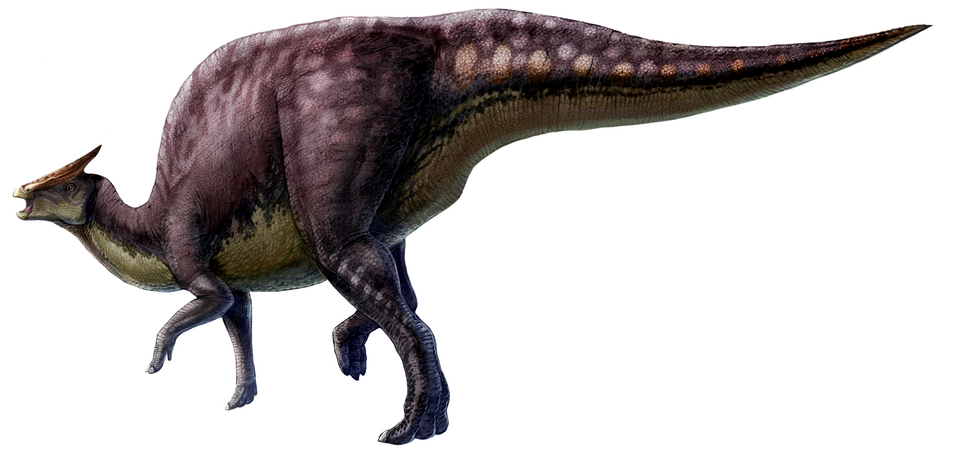
Saurolophus was a big, plant-eating dinosaur with a duck-like beak and a pointy crest on its head. It lived near the end of the Age of Dinosaurs in North America and Asia, and could walk on two legs or all fours.1
When did it live?
How big was it?
Fun facts
Saurolophus is one of the few dinosaurs known from both North America and Asia, which suggests they could cross land bridges.1
The first nearly complete dinosaur skeleton ever found in Canada was a Saurolophus, discovered in 1911.1
A huge bonebed in Mongolia called Dragon's Tomb contains at least 21 Saurolophus individuals, showing they lived in groups.1
Its teeth were packed into dental batteries, with hundreds of teeth that were constantly replaced, so it could chew tough plants.1
Saurolophus could reach food up to about 4 meters (13 feet) above the ground, thanks to its long neck and body.1
The crest on its head was a solid spike, not a hollow tube like in some other duck-billed dinosaurs.1
Myth buster
Myth: Some people think Saurolophus could swim in the ocean.
Truth: It lived near rivers and lakes, but it was a land animal that walked and ate plants on land.1
For dino experts
- Scientific name
- Saurolophus
- Named by
- Brown 19122
- Group
- Duck-bills
- Family / clade
- Hadrosauridae2
- Classification
- Ornithischia > Ornithopoda > Iguanodontia > Hadrosauridae2
- Age of the rocks
- 84 to 66 million years (Campanian to Maastrichtian)2
- Rock formations
- Nemegt, Horseshoe Canyon, Almond2
- Countries
- Mongolia, Canada, USA2
- Fossil records
- 38 in the Paleobiology Database2
- Discovery
- Barnum Brown named Saurolophus in 1912 from a nearly complete skeleton found in Alberta, Canada, in 1911.1
- Still debated
- Scientists still debate whether some fossils from California and Wyoming belong to Saurolophus or to a separate genus.1
Where the facts come from
- Saurolophus (en.wikipedia.org)
- Saurolophus in The Paleobiology Database (CC BY 4.0): age, places, rock formations, classification.
Every fact on this page has a number that points to its source. If we got something wrong, sorry, we are dino fans, not a science journal. Tell us at hello@dinowiki.app and we will fix it.
 Rex is hungry! Dino Wiki is free with no ads. Grown-ups can feed Rex a snack to keep it that way.Feed Rex
 Parasaurolophus
 Edmontosaurus
 Hypacrosaurus
 Corythosaurus
 Kritosaurus
 Gryposaurus
 Triceratops
 Velociraptor
 Spinosaurus
 Ankylosaurus
 Pteranodon