
Gryposaurus
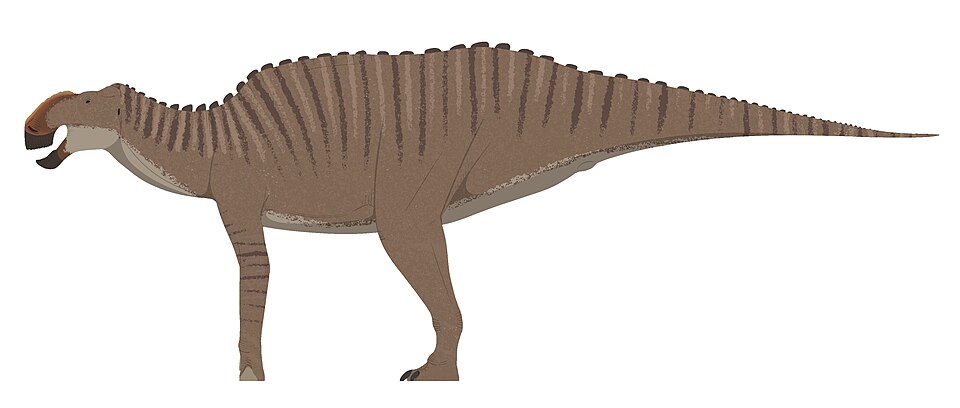
Gryposaurus was a duck-billed dinosaur with a funny hooked nose like a Roman nose. It lived in North America about 80 to 75 million years ago and could walk on two legs or all fours.1
When did it live?
How big was it?
Fun facts
Gryposaurus had a narrow, arching hump on its nose that looked like a Roman nose, which might have been used to tell species apart or to fight others of the same kind.1
Some Gryposaurus fossils even include skin impressions that show it had pyramid-shaped scales running along the middle of its back.1
Its teeth were packed into batteries of hundreds, and only a few were in use at a time, constantly being replaced like a conveyor belt.1
Gryposaurus probably lived near rivers, and it disappeared from the Dinosaur Park Formation before another duckbill called Prosaurolophus showed up.1
The species G. monumentensis was named one of the top 10 new species of 2008 by the International Institute for Species Exploration.1
Gryposaurus could reach food from the ground up to about 4 metres (13 feet) high, using its beak and cheek-like organs to hold plants.1
For dino experts
- Scientific name
- Gryposaurus
- Named by
- Lambe 19142
- Group
- Duck-bills
- Family / clade
- Hadrosauridae2
- Classification
- Ornithischia > Ornithopoda > Iguanodontia > Hadrosauridae2
- Age of the rocks
- 84 to 66 million years (Campanian to Maastrichtian)2
- Rock formations
- Dinosaur Park, Kaiparowits, Two Medicine2
- Countries
- Canada, USA2
- Fossil records
- 22 in the Paleobiology Database2
- Discovery
- Gryposaurus was named by Lawrence Lambe in 1914, based on a skull and partial skeleton collected by George F. Sternberg in 1913 from the Dinosaur Park Formation in Alberta, Canada.12
- Still debated
- Scientists still debate whether Gryposaurus and Kritosaurus are the same dinosaur, because their skulls are very similar.1
Where the facts come from
- Gryposaurus (en.wikipedia.org)
- Gryposaurus in The Paleobiology Database (CC BY 4.0): age, places, rock formations, classification.
Every fact on this page has a number that points to its source. If we got something wrong, sorry, we are dino fans, not a science journal. Tell us at hello@dinowiki.app and we will fix it.
 Rex is hungry! Dino Wiki is free with no ads. Grown-ups can feed Rex a snack to keep it that way.Feed Rex
 Parasaurolophus
 Edmontosaurus
 Saurolophus
 Hypacrosaurus
 Corythosaurus
 Kritosaurus
 Triceratops
 Velociraptor
 Spinosaurus
 Ankylosaurus
 Pteranodon