
Edmontosaurus
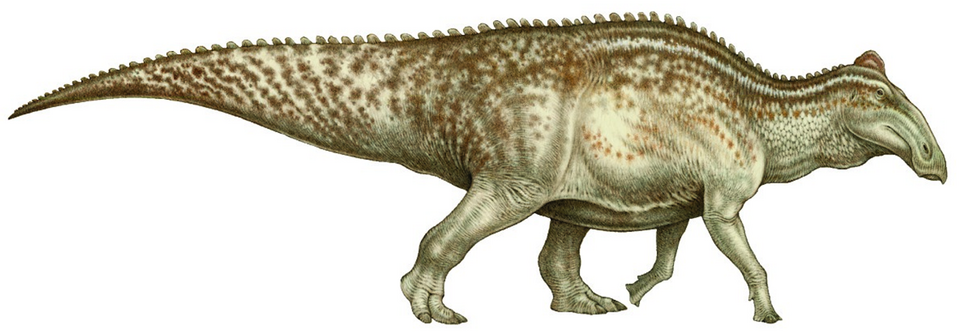
Edmontosaurus was a huge, plant-eating dinosaur with a duck-like beak. It lived in herds and was one of the biggest herbivores in North America, even bigger than T. rex!1
When did it live?
How big was it?
Fun facts
Edmontosaurus had a fleshy 'mitten' on its hands, formed by two long fingers wrapped together, which helped support its weight when walking on all fours.1
It could rear up on its hind legs to reach high branches, thanks to powerful hindlimbs and a long tail for balance.1
Edmontosaurus lived in huge herds of tens to hundreds of individuals, and many bonebeds with thousands of bones have been found.1
The first Edmontosaurus skeleton was put on display in Canada in 1913, making it the first mounted dinosaur skeleton in the country.1
Two species are known: E. regalis lived about 73 to 70 million years ago, and E. annectens lived about 68 to 66 million years ago.1
Edmontosaurus had a duck-like beak and hundreds of teeth that formed a grinding 'pavement' to chew tough plants.1
Myth buster
Myth: Some people think Edmontosaurus had a hollow crest on its head like some other duck-billed dinosaurs.
Truth: Edmontosaurus was a 'crestless' hadrosaur, meaning it did not have a large hollow crest. Its head was flat on top.1
For dino experts
- Scientific name
- Edmontosaurus
- Named by
- Lambe 19172
- Group
- Duck-bills
- Family / clade
- Hadrosauridae2
- Classification
- Ornithischia > Ornithopoda > Iguanodontia > Hadrosauridae2
- Age of the rocks
- 90 to 66 million years (Coniacian to Maastrichtian)2
- Rock formations
- Hell Creek, Lance, Horseshoe Canyon2
- Countries
- USA, Canada2
- Fossil records
- 85 in the Paleobiology Database2
- Also known as
- Anatosaurus, Anatotitan (older names now counted as the same animal)2
- Discovery
- The first Edmontosaurus fossil was found in 1912 near Drumheller, Alberta, Canada. It was named Edmontosaurus regalis in 1917 by Lawrence Lambe, after the Edmonton Formation where it was found.1
- Still debated
- Scientists are still debating whether some hadrosaur fossils from Alberta belong to E. annectens or are too incomplete to be sure.1
Where the facts come from
- Edmontosaurus | The Canadian Encyclopedia (thecanadianencyclopedia.ca)
- Edmontosaurus in The Paleobiology Database (CC BY 4.0): age, places, rock formations, classification.
Every fact on this page has a number that points to its source. If we got something wrong, sorry, we are dino fans, not a science journal. Tell us at hello@dinowiki.app and we will fix it.
 Rex is hungry! Dino Wiki is free with no ads. Grown-ups can feed Rex a snack to keep it that way.Feed Rex
 Parasaurolophus
 Saurolophus
 Hypacrosaurus
 Corythosaurus
 Kritosaurus
 Gryposaurus
 Triceratops
 Velociraptor
 Spinosaurus
 Ankylosaurus
 Pteranodon