
Kritosaurus
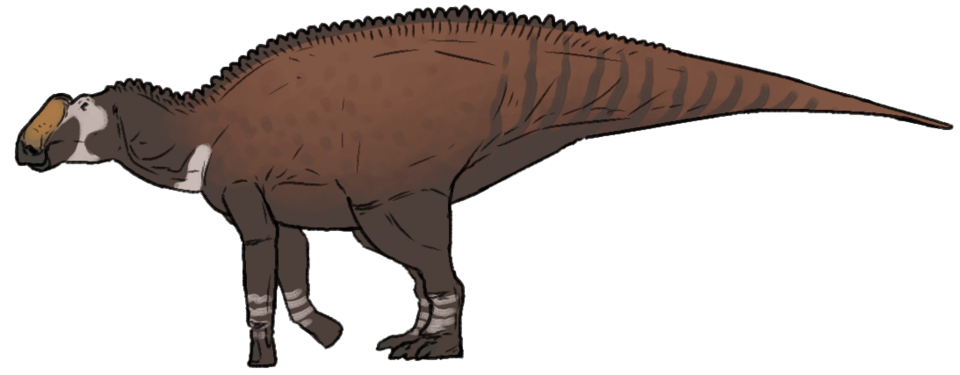
Kritosaurus was a duck-billed dinosaur that lived in North America near the end of the Age of Dinosaurs. It had a big, flat beak like a duck and could walk on two legs or all fours. This plant-eater munched on tough plants with hundreds of teeth in its cheeks.1
When did it live?
How big was it?
Fun facts
Kritosaurus means 'separated lizard' because the bones in its cheek were arranged in a special way.1
The first Kritosaurus fossil was found in 1904 by Barnum Brown in New Mexico, but the front of the skull was missing.1
Scientists once thought Kritosaurus had a Roman nose, but that was because the skull was broken and put back together wrong.1
Kritosaurus lived alongside other dinosaurs like Alamosaurus, Parasaurolophus, Pentaceratops, and Bistahieversor.1
Some scientists think Kritosaurus and Anasazisaurus might be the same dinosaur, but others disagree.1
Kritosaurus could reach about 9 metres (30 feet) long and weigh about 4 metric tons (4.4 short tons).1
Myth buster
Myth: Kritosaurus had a big bump on its nose like a Roman nose.
Truth: The original skull was broken and the nose area was reconstructed flat. Later scientists realized the real shape was probably arched like Gryposaurus.1
For dino experts
- Scientific name
- Kritosaurus
- Named by
- Brown 19102
- Group
- Duck-bills
- Family / clade
- Hadrosauridae2
- Classification
- Ornithischia > Ornithopoda > Iguanodontia > Hadrosauridae2
- Age of the rocks
- 86 to 66 million years (Santonian to Maastrichtian)2
- Rock formations
- Kirtland, Fruitland, Fruitland/Kirtland2
- Countries
- USA, Canada2
- Fossil records
- 25 in the Paleobiology Database2
- Discovery
- Barnum Brown discovered the first Kritosaurus fossil in 1904 in New Mexico. He named it in 1910, but the front of the skull was missing and he had to guess what it looked like.1
- Still debated
- Scientists still debate whether Kritosaurus is the same as Anasazisaurus and exactly how its skull was shaped.1
Where the facts come from
- Kritosaurus (en.wikipedia.org)
- Kritosaurus in The Paleobiology Database (CC BY 4.0): age, places, rock formations, classification.
Every fact on this page has a number that points to its source. If we got something wrong, sorry, we are dino fans, not a science journal. Tell us at hello@dinowiki.app and we will fix it.
 Rex is hungry! Dino Wiki is free with no ads. Grown-ups can feed Rex a snack to keep it that way.Feed Rex
 Parasaurolophus
 Edmontosaurus
 Saurolophus
 Hypacrosaurus
 Corythosaurus
 Gryposaurus
 Triceratops
 Velociraptor
 Spinosaurus
 Ankylosaurus
 Pteranodon