
Nagatitan
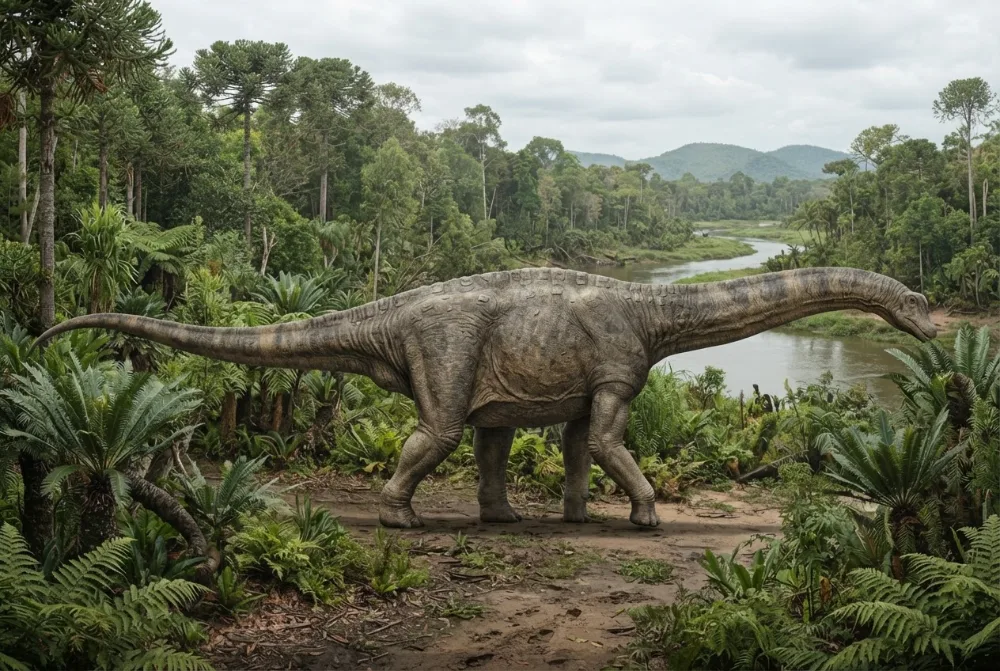
Nagatitan was a giant, long-necked plant-eater that stomped through what is now Thailand about 113 million years ago. It was the biggest dinosaur ever found in Southeast Asia, as long as two school buses!1
When did it live?
How big was it?
How long was it?
How heavy was it?
How big was Nagatitan compared to YOU?
Just maths in your browser. Nothing is saved or sent anywhere.
How fast was it?
Fun facts
Nagatitan is the largest dinosaur ever found in Southeast Asia, measuring about 27 metres (89 feet) long.1
It weighed as much as 25 to 28 tonnes, which is like 5 to 6 large elephants.2
Its backbone had two different shapes of joints, a feature not seen in other sauropods.2
Nagatitan lived about 113 million years ago, during the Early Cretaceous period.1
The fossils were found in a rock formation that also had fish, sharks, turtles, and crocodile-like animals.2
Scientists think Nagatitan grew so big because of warmer temperatures and more living space in Asia at that time.2
Most asked questions about Nagatitan
?How big was Nagatitan?
Nagatitan was about 6 metres long. That makes it a large sauropod found in Southeast Asia.31
?What did Nagatitan eat?
Nagatitan was a plant-eater, so it ate leaves and other plants. It had a long neck to reach high vegetation.1
?When did Nagatitan live?
Nagatitan lived about 113 million years ago, during the Early Cretaceous period.1
?Where was Nagatitan found?
Nagatitan was found in Thailand, in a rock formation called the Khok Kruat Formation. The fossils were discovered in 2016 near a pond.32
?Why did Nagatitan grow so big?
Scientists think Nagatitan grew so big because of warmer temperatures and more living space in Asia at that time.2
?Is Nagatitan a dinosaur?
Yes, Nagatitan is a dinosaur. It is a type of long-necked sauropod dinosaur.3

Ask Rex about Nagatitan
Rex only answers questions about this page. 10 questions a month.
Rex is an AI and can make mistakes. He runs on servers in the EU and questions are never saved. Never type your name or other personal things.
Myth buster
Myth: Some people think all long-necked dinosaurs were slow and sluggish.
Truth: Nagatitan, like other sauropods, was a giant but likely moved in a steady, efficient way to find food, and it was not a slowpoke in the way you might imagine.1
For dino experts
- Scientific name
- Nagatitan
- Named by
- Sethapanichsakul et al. 20264
- Group
- Long-necks
- Family / clade
- Euhelopodidae4
- Classification
- Sauropodomorpha > Sauropoda > Macronaria4
- Age of the rocks
- 121 to 100 million years (Aptian / Albian)4
- Rock formations
- Khok Kruat4
- Countries
- Thailand4
- Fossil records
- 1 in the Paleobiology Database4
- Discovery
- Scientists found a partial skeleton in the Ban Pha Nang Sua locality in Thailand and named it Nagatitan chaiyaphumensis in 2026, after the Naga serpent and the Chaiyaphum Province.41
- Still debated
- Scientists are still debating exactly how Nagatitan is related to other long-necked dinosaurs, since its bones show a mix of features.2
Where the facts come from
- Scientists dig up Southeast Asia's largest dinosaur in Thailand | Reuters (reuters.com)
- The first sauropod dinosaur from the Lower Cretaceous Khok Kruat Formation of Thailand enriches the diversity of somphospondylan titanosauriforms in southeast Asia | Scientific Reports (nature.com)
- Nagatitan (en.wikipedia.org)
- Nagatitan in The Paleobiology Database (CC BY 4.0): age, places, rock formations, classification.
Every fact on this page has a number that points to its source. If we got something wrong, sorry, we are dino fans, not a science journal. Tell us at hello@dinowiki.app and we will fix it.
 Rex is hungry! Dino Wiki is a dad's project for his dino-loving son, free with no ads. Grown-ups can feed Rex a snack to help keep it online.Feed Rex
 Brachiosaurus
 Diplodocus
 Brontosaurus
 Argentinosaurus
 Camarasaurus
 Morosaurus
 Stegosaurus
 Iguanodon
 Archaeopteryx
 Giganotosaurus
 Microraptor
 Deinonychus