
Camarasaurus
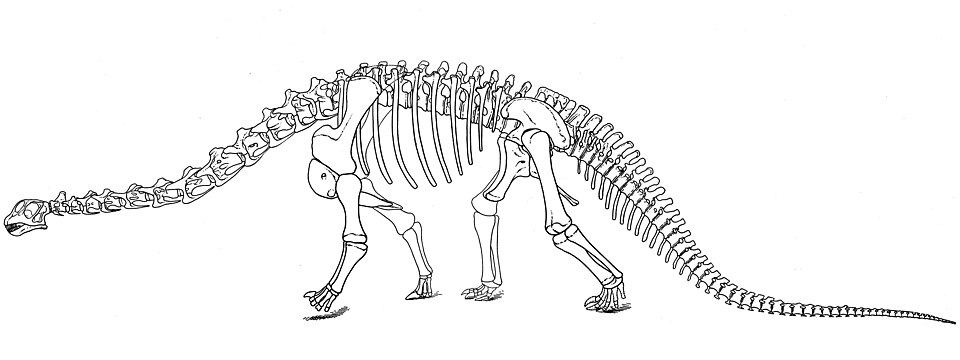
Camarasaurus was a giant, long-necked plant-eater that lived in North America during the Late Jurassic. It had a bulky body, a wide ribcage, and a surprisingly large skull for a sauropod. More than 530 fossils have been found, making it the most common dinosaur in the Morrison Formation.1
When did it live?
How big was it?
Fun facts
Camarasaurus means 'chambered lizard' because its backbone had hollow chambers, which helped lighten its skeleton.1
It had a relatively short neck and tail compared to other sauropods, and its front legs were longer than its back legs, making its shoulders higher than its hips.1
More than 530 specimens have been found, including several nearly complete skeletons, so scientists know a lot about this dinosaur.1
Camarasaurus lived alongside other famous dinosaurs like Diplodocus, Stegosaurus, and Allosaurus in the Morrison Formation.1
Its teeth had microscopic pits and scratches that show adults ate tough, coarse plants, while juveniles ate softer food.1
A nearly complete skeleton of a young Camarasaurus (CM 11338) was found with its neck curved upward, but that pose may have happened after death, not when it was alive.1
Myth buster
Myth: Camarasaurus could hold its neck straight up like a giraffe.
Truth: Scientists think its neck was held more horizontally or with a slight downward slope, not vertical like a swan.1
For dino experts
- Scientific name
- Camarasaurus
- Named by
- Cope 18772
- Group
- Long-necks
- Family / clade
- Camarasauridae2
- Classification
- Sauropodomorpha > Sauropoda > Macronaria2
- Age of the rocks
- 162 to 143 million years (Oxfordian to Tithonian)2
- Rock formations
- Morrison, Kadzi, Süntel2
- Countries
- USA, Zimbabwe, Germany2
- Fossil records
- 138 in the Paleobiology Database2
- Also known as
- Cathetosaurus, Caulodon, Uintasaurus (older names now counted as the same animal)2
- Discovery
- Camarasaurus was named in 1877 by Edward Drinker Cope, based on fossils from Garden Park, Colorado. Soon after, his rival Othniel Charles Marsh named similar fossils Morosaurus, but those are now considered the same genus.1
- Still debated
- Scientists still debate exactly how Camarasaurus held its neck and whether it could rear up on its hind legs to reach high plants.1
Where the facts come from
- Camarasaurus (en.wikipedia.org)
- Camarasaurus in The Paleobiology Database (CC BY 4.0): age, places, rock formations, classification.
Every fact on this page has a number that points to its source. If we got something wrong, sorry, we are dino fans, not a science journal. Tell us at hello@dinowiki.app and we will fix it.
 Rex is hungry! Dino Wiki is free with no ads. Grown-ups can feed Rex a snack to keep it that way.Feed Rex
 Brachiosaurus
 Diplodocus
 Brontosaurus
 Argentinosaurus
 Morosaurus
 Massospondylus
 Allosaurus
 Compsognathus
 Camptosaurus
 Nanosaurus
 Rhamphorhynchus
 Ceratosaurus