
Europatitan
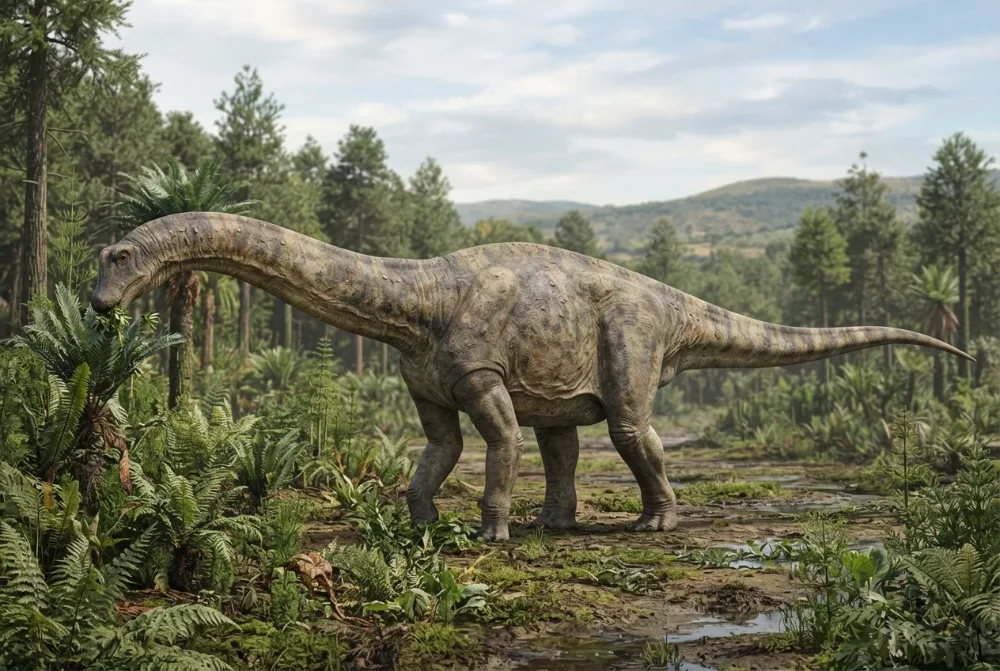
Europatitan was a giant, long-necked plant-eater that lived in what is now Spain about 124 million years ago. It was one of the biggest dinosaurs in Europe at the time, measuring longer than a tennis court!2
When did it live?
How big was it?
How long was it?
How tall was it?
at the shoulder
How heavy was it?
How big was Europatitan compared to YOU?
Just maths in your browser. Nothing is saved or sent anywhere.
How fast was it?
Fun facts
Europatitan is named after Europe and Clint Eastwood. The species name 'eastwoodi' honors the actor because the movie 'The Good, the Bad and the Ugly' was partly filmed near the dig site.1
Europatitan lived alongside another sauropod called Demandasaurus in the same ancient floodplain in Spain.1
Europatitan had air-filled bones (like a bird) and special hollows in its backbones that made its skeleton lighter for its huge size.1
This dinosaur had a long neck, but its neck bones had very small air holes (pleurocoels) compared to other sauropods.1
Scientists found Europatitan in a place called El Oterillo II, just 2.5 km from the village of Barbadillo del Mercado in northern Spain.1
Most asked questions about Europatitan
?How big was Europatitan?
Scientists estimate it was about 20 to 21.4 metres long and weighed 22 to 25 tonnes. That is longer than a tennis court.2
?What did Europatitan eat?
It was a plant-eater, or herbivore. It used its long neck to reach leaves high up in trees.3
?When did Europatitan live?
It lived about 124 to 120 million years ago, during the Early Cretaceous period.2
?Where was Europatitan found?
Its fossils were discovered in Spain, at a site called El Oterillo II near the village of Barbadillo del Mercado.2

Ask Rex about Europatitan
Rex only answers questions about this page. 10 questions a month.
Rex is an AI and can make mistakes. He runs on servers in the EU and questions are never saved. Never type your name or other personal things.
Myth buster
Myth: Europatitan might have lived in the water to support its heavy body.
Truth: Europatitan was a land dinosaur with strong leg bones and air-filled bones, living on dry floodplains.1
For dino experts
- Scientific name
- Europatitan
- Named by
- Torcida Fernández-Baldor et al. 20173
- Group
- Long-necks
- Family / clade
- Somphospondyli3
- Classification
- Sauropodomorpha > Sauropoda > Macronaria3
- Age of the rocks
- 126 to 120 million years (Barremian / Aptian)3
- Rock formations
- Castrillo de la Reina3
- Countries
- Spain3
- Fossil records
- 1 in the Paleobiology Database3
- Discovery
- Europatitan was named in 2017 by Spanish paleontologist Fidel Torcida Fernández-Baldor and his team. The fossils were dug up from the Castrillo de la Reina Formation in northern Spain in the 2000s.31
- Still debated
- Scientists are not sure if Europatitan is a direct relative of sauropods from Africa or if it is part of a relict European group.1
Where the facts come from
- Europatitan eastwoodi, a new sauropod from the lower ... - PMC (pmc.ncbi.nlm.nih.gov)
- Europatitan (en.wikipedia.org)
- Europatitan in The Paleobiology Database (CC BY 4.0): age, places, rock formations, classification.
Every fact on this page has a number that points to its source. If we got something wrong, sorry, we are dino fans, not a science journal. Tell us at hello@dinowiki.app and we will fix it.
 Rex is hungry! Dino Wiki is a dad's project for his dino-loving son, free with no ads. Grown-ups can feed Rex a snack to help keep it online.Feed Rex
 Brachiosaurus
 Diplodocus
 Brontosaurus
 Argentinosaurus
 Camarasaurus
 Morosaurus
 Stegosaurus
 Iguanodon
 Archaeopteryx
 Giganotosaurus
 Microraptor
 Deinonychus