
Jobaria
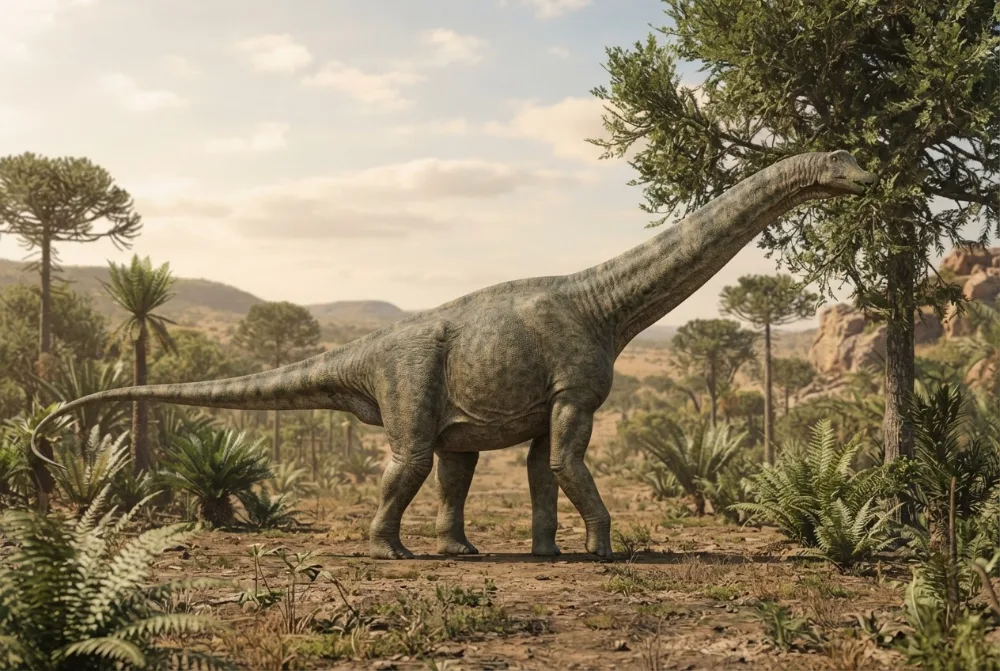
Jobaria was a huge, long-necked plant eater that stomped through the Sahara Desert millions of years ago. It was one of the most complete sauropod skeletons ever found, so scientists know a lot about it!1
Ɗuum wuurii nde?
Hol no o mawni?
No juutuno?
No toowuno?
No tedduno?
Hol no Jobaria mawninoo, so fondaama bee AAN?
Hiisa tan nder browser maa. Walaa huunde danndetee walla neldetee ka nokku fuu.
How fast was it?
Anndal belɗungal
Jobaria is one of the most complete sauropods ever found, with over 95% of its skeleton preserved.1
Its backbone and tail were simpler than those of later sauropods like Diplodocus, which had complex vertebrae and a whiplash tail.1
Scientists think Jobaria could rear up on its hind legs, like elephants can, because its weight was supported more by its back legs.1
Jobaria lived during the Middle Jurassic, about 167 to 161 million years ago, though some sources say Early Cretaceous.12
The name Jobaria comes from a mythical giant beast called Jobar, whose bones some Tuareg people thought the fossils were.1
Jobaria was discovered in 1997 during a four-month expedition led by paleontologist Paul Sereno.1
Naamne ɓurɗe naamneede fii Jobaria
?How big was Jobaria?
About 18.2 metres (60 feet) long and weighing around 22.4 tonnes (24.7 short tons), though some scientists give a smaller estimate of 16 metres (52 feet) and 16 tonnes (18 short tons).1
?What did Jobaria eat?
It was a plant eater, or herbivore, chomping on leaves and other vegetation.2
?Could Jobaria rear up on its hind legs?
Yes, scientists think it could, like elephants do, because its weight was supported more by its back legs.1
?When did Jobaria live?
It lived during the Middle Jurassic Period, about 167 to 161 million years ago, though some older sources say Early Cretaceous.1

Naamnu Rex fii Jobaria
Rex jaabata ƴamle dow hello ngo'o tan. Ƴamle 10 e lewru.
Rex ko AI, o waawi waɗugo juumre. O golla ka serverji nder EU, naamne danndetaake abada. Taa winndu innde maa walla huunde goɗnde ngam maa.
Feññinoowo goonga
Fenaande: Some people think Jobaria lived during the Early Cretaceous, about 132 million years ago.
Goonga: Scientists now think the rocks where it was found are actually Middle Jurassic, about 167 to 161 million years old.1
Ngam annduɓe dino
- Innde ganndal
- Jobaria
- Inndoowo
- Sereno et al. 19995
- Fedde
- Daaɗe juutɗe
- Fedde / clade
- Eusauropoda5
- Fedde
- Sauropodomorpha > Sauropoda5
- Duuɓi kaaƴe
- 162 haa 143 miliyon duuɓi (Oxfordian / Tithonian)5
- Cuuɗi kaaƴe
- Tiourarén5
- Leyɗe
- Nijer5
- Fosilji tawaaɗi
- 2 nder Paleobiology Database5
- Tawgol
- Jobaria was discovered in 1997 by a team led by Paul Sereno, during an expedition in the Sahara Desert. It was found in a mass-death site in Niger, and the species was named Jobaria tiguidensis in 1999.15
- Haa jooni ɓe ɗon yeddondira
- Scientists are still debating exactly where Jobaria fits in the sauropod family tree. Some think it is a basal macronarian, while others think it is a non-neosauropod eusauropod.1
To haalaaji ummii
- Jobaria (en.wikipedia.org)
- Jobaria | Natural History Museum (nhm.ac.uk)
- Discoveries | Paul Sereno - Paleontologist | The University of Chicago (paulsereno.uchicago.edu)
- paulsereno.uchicago.edu (paulsereno.uchicago.edu)
- Jobaria in The Paleobiology Database (CC BY 4.0): duuɓi, nokkuuje, cuuɗi kaaƴe, pecce.
Kala anndal nder ngal hello mari limre holloore iwdi mum. Si min mbaɗii juumre, yaafo min, min ko yiɗɓe dino, min wanaa jaaynde anndal. Haalan min ka hello@dinowiki.app, min moƴƴinan ɗum.
 Rex ɗon weelo! Dino Wiki, ɗum golle baaba ngam ɓiyiiko gorko mo yiɗi dinosauruuji, alaa njoɓdi, alaa ko yeeyata. Mawɓe mbaawi hokkude Rex ñaamdu ngam wallude lowre ndee heddoo e internet.Nyaamnu Rex
 Brachiosaurus
 Diplodocus
 Brontosaurus
 Argentinosaurus
 Camarasaurus
 Morosaurus
 Allosaurus
 Compsognathus
 Camptosaurus
 Nanosaurus
 Rhamphorhynchus
 Ceratosaurus