
Alanqa
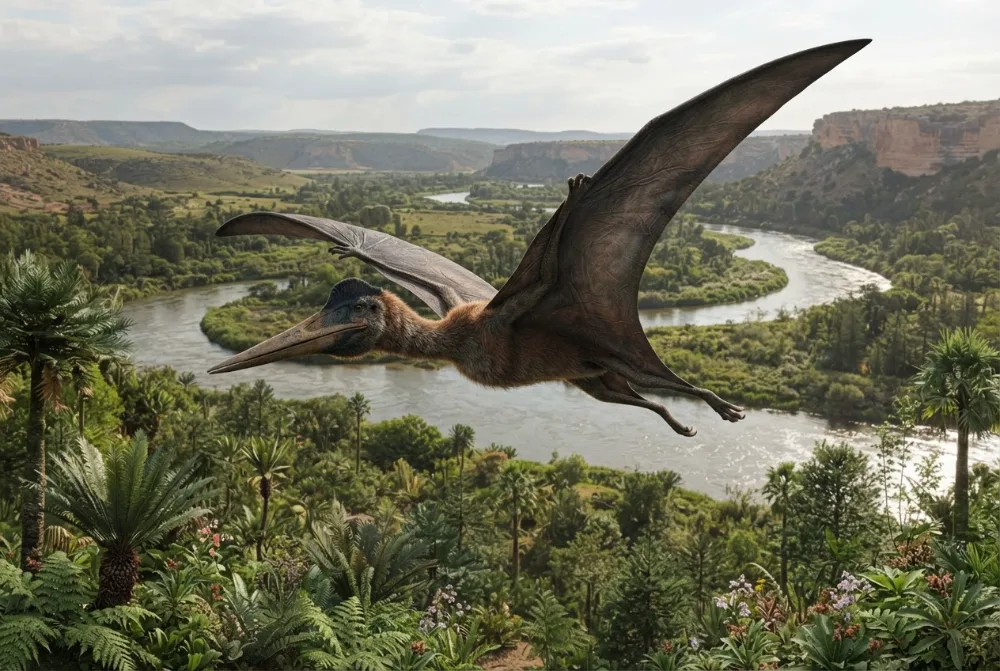
Alanqa was a giant flying reptile that soared over ancient rivers in what is now Morocco. It had a long, straight, pointed beak with no teeth, perfect for scooping up fish and other small animals.2
Ɗuum wuurii nde?
Hol no o mawni?
No yaajuno bibbe mum?
No tedduno?
Hol no Alanqa mawninoo, so fondaama bee AAN?
Hiisa tan nder browser maa. Walaa huunde danndetee walla neldetee ka nokku fuu.
How fast was it?
Anndal belɗungal
Alanqa is known from only five jaw fragments and possibly one neck vertebra, so scientists have not found a full skeleton yet.1
Its beak was straight and pointed, like a spear, and it had a raised bump on the top of its lower jaw near the back.2
The largest Alanqa individuals may have had a wingspan as wide as a small airplane, about 6 meters (20 feet).21
Alanqa lived alongside huge meat-eating dinosaurs like Spinosaurus and Carcharodontosaurus, which might have hunted it.1
The Kem Kem Beds where Alanqa was found were once a freshwater delta, full of rivers and swamps.1
Two of the jaw fragments were first described in 1999 but were not named until 2010, when scientists realized they belonged to a new species.1
Naamne ɓurɗe naamneede fii Alanqa
?How big was Alanqa?
Most Alanqa individuals had a wingspan of about 4 meters (13 feet), but a larger neck vertebra suggests some reached 6 meters (20 feet). An individual of that size would have weighed 16 to 37 kilograms (35 to 82 pounds).1
?What did Alanqa eat?
Alanqa probably ate small animals like crustaceans, mollusks, amphibians, small reptiles, and even small or juvenile dinosaurs. Grooves in its jaw suggest it also crushed hard foods like mollusks and seeds.1
?Is Alanqa a dinosaur?
No, Alanqa is a pterosaur, a flying reptile that is not a dinosaur.1
?Where was Alanqa found?
Alanqa was found in the Kem Kem Group of southeastern Morocco, in a place called Aferdou N'Chaft near the village of Begaa.1
?When did Alanqa live?
Alanqa lived during the Late Cretaceous period, specifically the Cenomanian stage, about 100 to 93 million years ago.1
?Did Alanqa have teeth?
No, Alanqa had no teeth. Its jaws were straight and pointed, like a spear, perfect for scooping up food.1
Naamnu Rex fii Alanqa
Rex jaabata ƴamle dow hello ngo'o tan. Ƴamle 10 e lewru.
Rex ko AI, o waawi waɗugo juumre. O golla ka serverji nder EU, naamne danndetaake abada. Taa winndu innde maa walla huunde goɗnde ngam maa.
Ngam annduɓe dino
- Innde ganndal
- Alanqa
- Inndoowo
- Ibrahim et al. 20104
- Fedde
- Reptilji diwooji
- Fedde / clade
- Azhdarchidae4
- Fedde
- Pterosauria > Pterodactyloidea > Azhdarchidae4
- Duuɓi kaaƴe
- 100 haa 94 miliyon duuɓi (Cenomanian)4
- Cuuɗi kaaƴe
- Ifezouane4
- Leyɗe
- Morocco4
- Fosilji tawaaɗi
- 4 nder Paleobiology Database4
- Tawgol
- Alanqa was named in 2010 by Ibrahim and colleagues based on a nearly complete lower jaw found at Aferdou N'Chaft, Morocco, in 2008.21
- Haa jooni ɓe ɗon yeddondira
- Scientists are not sure if the large neck vertebra really belongs to Alanqa or to a different, even bigger pterosaur.21
To haalaaji ummii
- Alanqa (en.wikipedia.org)
- A New Pterosaur (Pterodactyloidea: Azhdarchidae) from the Upper Cretaceous of Morocco - PMC (pmc.ncbi.nlm.nih.gov)
- PBDB Taxon (paleobiodb.org)
- Alanqa in The Paleobiology Database (CC BY 4.0): duuɓi, nokkuuje, cuuɗi kaaƴe, pecce.
Kala anndal nder ngal hello mari limre holloore iwdi mum. Si min mbaɗii juumre, yaafo min, min ko yiɗɓe dino, min wanaa jaaynde anndal. Haalan min ka hello@dinowiki.app, min moƴƴinan ɗum.
 Rex ɗon weelo! Dino Wiki, ɗum golle baaba ngam ɓiyiiko gorko mo yiɗi dinosauruuji, alaa njoɓdi, alaa ko yeeyata. Mawɓe mbaawi hokkude Rex ñaamdu ngam wallude lowre ndee heddoo e internet.Nyaamnu Rex
 Pteranodon
 Quetzalcoatlus
 Dorygnathus
 Rhamphorhynchus
 Anhanguera
 Pterodactylus
 Tyrannosaurus
 Triceratops
 Velociraptor
 Spinosaurus
 Ankylosaurus
 Parasaurolophus