
Carnotaurus
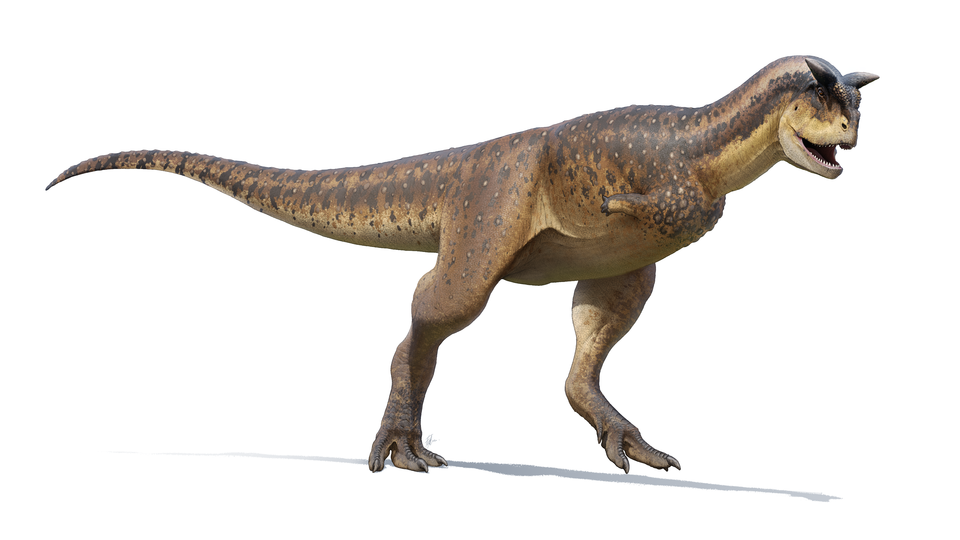
Carnotaurus was a meat-eating dinosaur with two thick horns above its eyes, just like a bull. It had very tiny arms and a strong, muscular neck. This dinosaur lived in South America near the end of the age of dinosaurs.12
When did it live?
How big was it?
Fun facts
Carnotaurus is the only meat-eating dinosaur known to have two thick horns on its head. The name means 'meat-eating bull' because of these horns.1
Its arms were even smaller than those of Tyrannosaurus rex. The forelimbs were very short and probably useless for grabbing prey.1
Scientists have found skin impressions from Carnotaurus. The skin was covered with small, bumpy scales, and there is no evidence of feathers.12
Carnotaurus had a very flexible lower jaw, similar to a snake. It could open its mouth wide and maybe swallow small animals whole.12
Some studies say Carnotaurus had a bite as strong as an American alligator, which has one of the strongest bites of any living animal.12
Only one complete skeleton of Carnotaurus has ever been found. It is one of the best-known theropod dinosaurs from the Southern Hemisphere.1
For dino experts
- Scientific name
- Carnotaurus
- Named by
- Bonaparte 19853
- Group
- Other meat-eaters
- Family / clade
- Abelisauridae3
- Classification
- Theropoda > Ceratosauria > Abelisauridae3
- Age of the rocks
- 72 to 66 million years (Maastrichtian)3
- Rock formations
- La Colonia3
- Countries
- Argentina3
- Fossil records
- 1 in the Paleobiology Database3
- Discovery
- The only skeleton of Carnotaurus was found in 1984 on a farm in Chubut, Argentina. It was named by paleontologist José Bonaparte in 1985.13
- Still debated
- Scientists still debate what Carnotaurus ate. Some think it hunted large sauropods, while others believe it fed mainly on small animals.12
Where the facts come from
- Carnotaurus (en.wikipedia.org)
- Carnotaurus | Natural History Museum (nhm.ac.uk)
- Carnotaurus in The Paleobiology Database (CC BY 4.0): age, places, rock formations, classification.
Every fact on this page has a number that points to its source. If we got something wrong, sorry, we are dino fans, not a science journal. Tell us at hello@dinowiki.app and we will fix it.
 Rex is hungry! Dino Wiki is free with no ads. Grown-ups can feed Rex a snack to keep it that way.Feed Rex
 Allosaurus
 Dilophosaurus
 Giganotosaurus
 Compsognathus
 Paronychodon
 Megalosaurus
 Triceratops
 Velociraptor
 Spinosaurus
 Ankylosaurus
 Parasaurolophus
.png)