
Clidastes
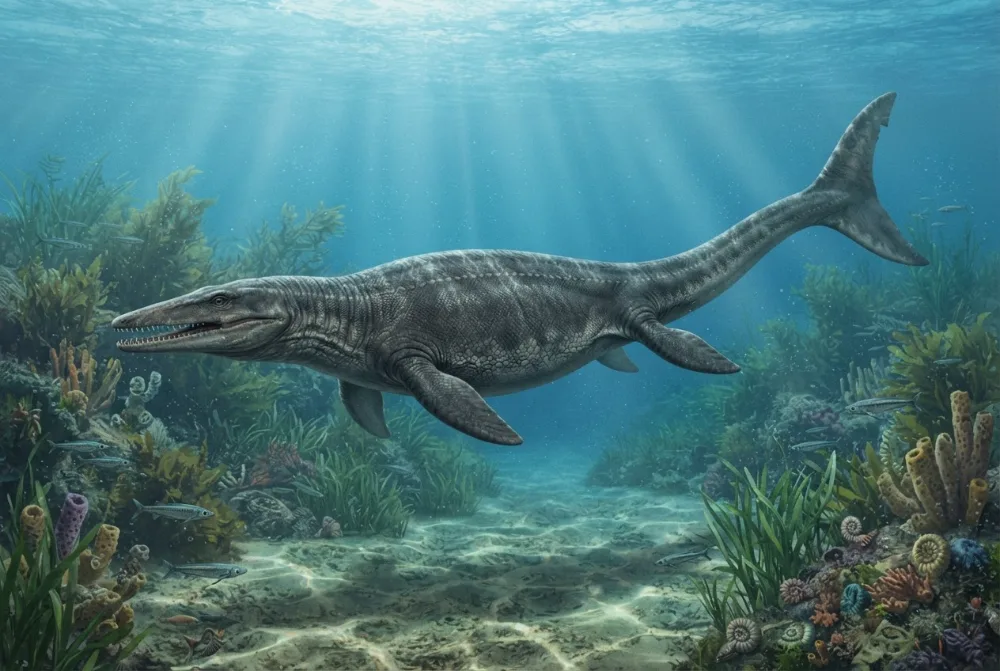
Clidastes was a small, speedy marine lizard that lived in the Late Cretaceous seas. It was one of the smallest mosasaurs, but it was a fast swimmer that chased down fish and squid in shallow waters.1
When did it live?
How big was it?
How big was Clidastes compared to YOU?
Just maths in your browser. Nothing is saved or sent anywhere.
Fun facts
Clidastes had special vertebrae that locked together, making its spine strong and stable for fast swimming.1
It was one of the smallest mosasaurs, only 2 to 4 meters long on average, but some grew up to 6.2 meters.1
Isotope studies on its teeth suggest Clidastes sometimes entered freshwater, like modern sea snakes.1
The first Clidastes fossils were found in Alabama in 1869 by E. D. Cope, and they were beautifully preserved.1
Its tail had extra-strong bones and muscles, which helped it chase down the fastest prey.1
Some scientists think that only one species, Clidastes propython, is valid, but others recognize more.1
Most asked questions about Clidastes
?Was Clidastes a dinosaur?
No, Clidastes was a marine lizard, not a dinosaur. It belonged to a group called mosasaurs, which are reptiles that lived in the sea.12
?How big was Clidastes?
Clidastes was one of the smallest mosasaurs, averaging 2 to 4 metres (6.6 to 13.1 feet) long. The largest specimens reached about 6.2 metres (20 feet).12
?What did Clidastes eat?
Clidastes likely ate cephalopods (like squid), fish, and other small vertebrates. It hunted in shallow water.12
?Could Clidastes swim in freshwater?
Yes, isotope studies on its teeth suggest Clidastes sometimes entered freshwater, similar to modern sea snakes.1

Ask Rex about Clidastes
Rex only answers questions about this page. 3 questions a day.
Rex is an AI and can make mistakes. He runs on servers in the EU and questions are never saved. Never type your name or other personal things.
For dino experts
- Scientific name
- Clidastes
- Named by
- Cope 18683
- Group
- Mosasaurs
- Family / clade
- Mosasauridae3
- Classification
- Mosasauroidea3
- Age of the rocks
- 94 to 66 million years (Turonian / Maastrichtian)3
- Rock formations
- Mooreville Chalk, Niobrara, Pierre Shale3
- Countries
- USA, Sweden, Germany, Mexico, Russia, Jordan3
- Fossil records
- 34 in the Paleobiology Database3
- Discovery
- E. D. Cope named Clidastes in 1868, and in 1869 he found the first good fossils in the Mooreville Chalk of Alabama.13
- Still debated
- Scientists debate whether fossils from Europe and Jordan really belong to Clidastes or to other mosasaurs.1
Where the facts come from
- Clidastes (en.wikipedia.org)
- Clidastes Facts for Kids (kids.kiddle.co)
- Clidastes in The Paleobiology Database (CC BY 4.0): age, places, rock formations, classification.
Every fact on this page has a number that points to its source. If we got something wrong, sorry, we are dino fans, not a science journal. Tell us at hello@dinowiki.app and we will fix it.
Rex is hungry! Dino Wiki is a dad's project for his dino-loving son, free with no ads. Grown-ups can feed Rex a snack to help keep it online.Feed Rex Mosasaurus
 Prognathodon
 Tylosaurus
 Platecarpus
 Globidens
 Halisaurus
 Triceratops
 Velociraptor
 Spinosaurus
 Ankylosaurus
 Parasaurolophus