
Halisaurus
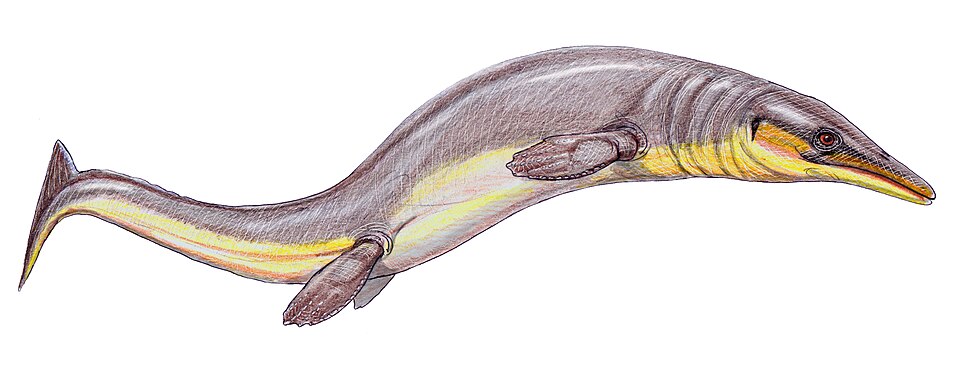
Halisaurus was a small, sleek marine lizard that swam in the warm seas of the Late Cretaceous. It was not a dinosaur, but a mosasaur, a relative of today's monitor lizards. It used its long tail and flippers to chase fish and other prey.1
When did it live?
How big was it?
Fun facts
Halisaurus was named by famous fossil hunter Othniel Charles Marsh in 1869.1
It was a small mosasaur, only about 3 to 4 metres long, much smaller than giants like Tylosaurus.1
Its flippers were not as specialized as those of later mosasaurs, so it was probably a slower swimmer.1
Fossils of Halisaurus have been found on every continent except Australia and Antarctica.2
The species Halisaurus onchognathus is known only from remains that were destroyed during World War II, so scientists are not sure if it was a real species.1
Halisaurus lived from about 85 to 66 million years ago, during the Late Cretaceous.2
Myth buster
Myth: Halisaurus was a dinosaur.
Truth: Halisaurus was a mosasaur, a marine reptile closely related to modern monitor lizards, not a dinosaur.1
For dino experts
- Scientific name
- Halisaurus
- Named by
- Marsh 18692
- Group
- Mosasaurs
- Family / clade
- Mosasauridae2
- Classification
- Mosasauroidea2
- Age of the rocks
- 86 to 62 million years (Santonian to Danian)2
- Rock formations
- Navesink, Severn, Marshalltown2
- Countries
- USA, Morocco, Chile, Peru, Jordan, Angola2
- Fossil records
- 30 in the Paleobiology Database2
- Discovery
- Halisaurus was named by Othniel Charles Marsh in 1869 based on a partial skull and vertebrae found near Hornerstown, New Jersey.1
- Still debated
- Scientists are not sure how many species of Halisaurus really existed, because some fossils are very fragmentary.1
Where the facts come from
- Halisaurus (en.wikipedia.org)
- Halisaurus in The Paleobiology Database (CC BY 4.0): age, places, rock formations, classification.
Every fact on this page has a number that points to its source. If we got something wrong, sorry, we are dino fans, not a science journal. Tell us at hello@dinowiki.app and we will fix it.
 Rex is hungry! Dino Wiki is free with no ads. Grown-ups can feed Rex a snack to keep it that way.Feed Rex
 Mosasaurus
 Prognathodon
 Tylosaurus
 Platecarpus
 Clidastes
 Globidens
 Triceratops
 Velociraptor
 Spinosaurus
 Ankylosaurus
 Parasaurolophus