
Tylosaurus
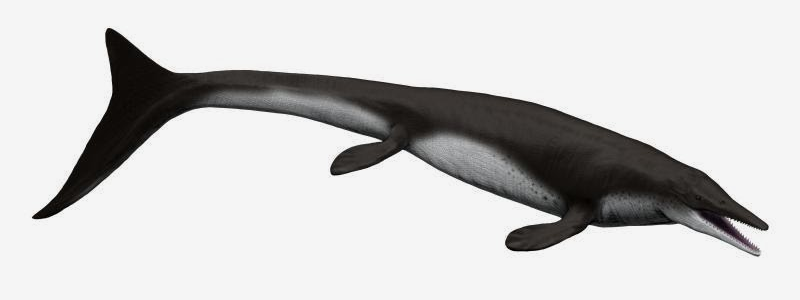
Tylosaurus was a giant marine lizard that swam in the oceans during the Late Cretaceous. It was not a dinosaur, but a mosasaur, a fierce predator with a long snout and paddle-like flippers. It could grow over 13 meters long, as big as a school bus!1
When did it live?
How big was it?
Fun facts
Tylosaurus had a long, bony snout that stuck out like a prow, which is why one species is named proriger, meaning 'prow-bearing'.1
Fossils show Tylosaurus fought each other, with bite marks on skulls and other bones.1
One Tylosaurus skeleton had the remains of a 2-meter-long mosasaur, a diving bird, a fish, and a shark all in its stomach at once.1
Tylosaurus had an endothermic (warm-blooded) metabolism, unlike most modern lizards and snakes.1
It gave birth to live young, not eggs, based on its close relatives.2
Tylosaurus lived from about 93.9 to 66 million years ago, during the Late Cretaceous.2
Myth buster
Myth: Tylosaurus was a dinosaur.
Truth: Tylosaurus was a mosasaur, a marine reptile more closely related to modern monitor lizards and snakes than to dinosaurs.1
For dino experts
- Scientific name
- Tylosaurus
- Named by
- Marsh 18722
- Group
- Mosasaurs
- Family / clade
- Mosasauridae2
- Classification
- Mosasauroidea2
- Age of the rocks
- 94 to 66 million years (Turonian to Maastrichtian)2
- Rock formations
- Niobrara, Pierre Shale, Tar Heel2
- Countries
- USA, Sweden, Canada, Angola, Belgium, Germany2
- Fossil records
- 67 in the Paleobiology Database2
- Discovery
- The first species, T. proriger, was described in 1869 by Edward Drinker Cope, and the genus Tylosaurus was named in 1872 by Othniel Charles Marsh. The type specimen was found in Kansas, USA, in the late 1860s.1
- Still debated
- Scientists still debate how many species of Tylosaurus existed and how they are related to each other.1
Where the facts come from
- Tylosaurus (en.wikipedia.org)
- Tylosaurus in The Paleobiology Database (CC BY 4.0): age, places, rock formations, classification.
Every fact on this page has a number that points to its source. If we got something wrong, sorry, we are dino fans, not a science journal. Tell us at hello@dinowiki.app and we will fix it.
 Rex is hungry! Dino Wiki is free with no ads. Grown-ups can feed Rex a snack to keep it that way.Feed Rex
 Mosasaurus
 Prognathodon
 Platecarpus
 Clidastes
 Globidens
 Halisaurus
 Triceratops
 Velociraptor
 Spinosaurus
 Ankylosaurus
 Parasaurolophus