
Zhongjianornis
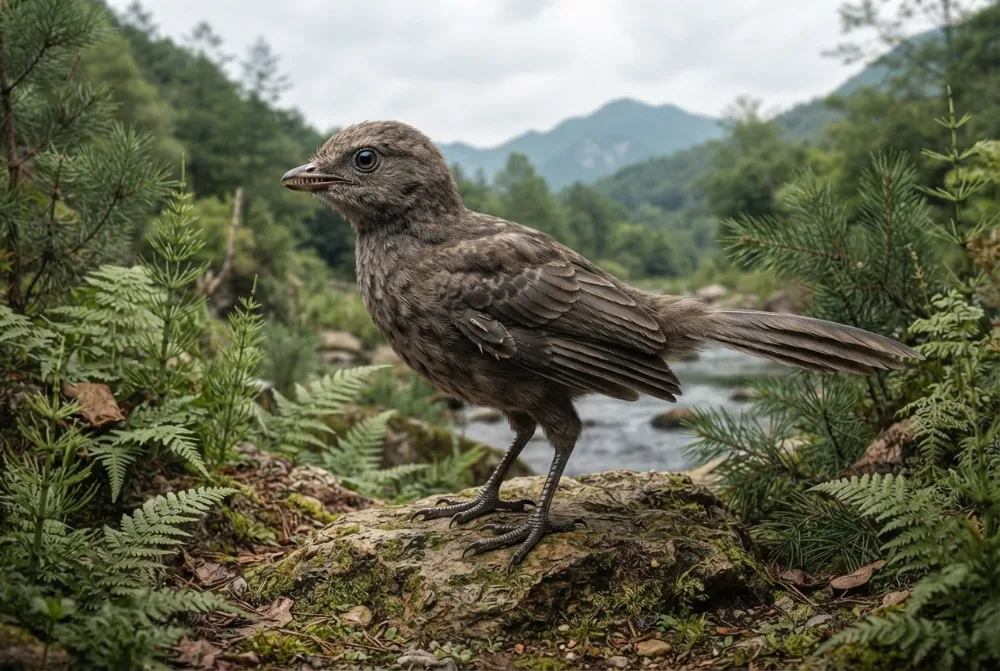
Zhongjianornis was a pigeon-sized bird that lived in China during the Early Cretaceous, about 120 million years ago. It had a toothless beak and strong wing muscles, making it a good flier. This little bird helps scientists understand how early birds evolved and lost their teeth.12
Ɗuum wuurii nde?
Hol no o mawni?
No juutuno?
No tedduno?
Hol no Zhongjianornis mawninoo, so fondaama bee AAN?
Hiisa tan nder browser maa. Walaa huunde danndetee walla neldetee ka nokku fuu.
How fast was it?
Anndal belɗungal
Zhongjianornis is one of the most primitive birds known to have completely lost its teeth, developing a beak instead.2
Its humerus had a large, robust deltopectoral crest, which was as wide as the bone shaft and more than one-third the total length of the humerus, indicating strong flight muscles.3
The only known fossil of Zhongjianornis is a nearly complete skeleton with some poorly preserved feather imprints.3
Zhongjianornis lived during the Aptian age of the Early Cretaceous, about 121 to 113 million years ago.3
Scientists initially thought Zhongjianornis was very primitive, but later research in 2012 suggested it was more similar to advanced euornithean birds like Chaoyangia.1
The species name yangi honors Yang Zhongjian, the founder of the Institute of Vertebrate Paleontology and Paleoanthropology in Beijing.1
Naamne ɓurɗe naamneede fii Zhongjianornis
?How big was Zhongjianornis?
About the size of a pigeon. It was a small bird.1
?Did Zhongjianornis have teeth?
No, it had a toothless beak. It is one of the most primitive birds known to have completely lost its teeth.12
?What did Zhongjianornis eat?
Scientists are not sure, but its toothless beak suggests it may have eaten seeds or small insects.1

Naamnu Rex fii Zhongjianornis
Rex jaabata ƴamle dow hello ngo'o tan. Ƴamle 10 e lewru.
Rex ko AI, o waawi waɗugo juumre. O golla ka serverji nder EU, naamne danndetaake abada. Taa winndu innde maa walla huunde goɗnde ngam maa.
Feññinoowo goonga
Fenaande: Zhongjianornis was the most primitive toothless bird.
Goonga: While initially thought to be very primitive, later analysis in 2012 showed that Zhongjianornis is more closely related to advanced euornithean birds, not the most primitive.1
Ngam annduɓe dino
- Innde ganndal
- Zhongjianornis
- Inndoowo
- Zhou et al. 20104
- Fedde
- Colli arani
- Fedde / clade
- Ornithuromorpha4
- Fedde
- Theropoda > Avialae4
- Duuɓi kaaƴe
- 121 haa 113 miliyon duuɓi (Aptian)4
- Cuuɗi kaaƴe
- Jiufotang4
- Leyɗe
- China4
- Fosilji tawaaɗi
- 1 nder Paleobiology Database4
- Tawgol
- Zhongjianornis was named and described by Zhou, Zhang, and Li in a paper published in January 2010 (though it appeared online in 2009). The only fossil, a nearly complete skeleton, was found at Jianchang in Liaoning Province, China.12
- Haa jooni ɓe ɗon yeddondira
- Scientists still debate whether Zhongjianornis was a very primitive bird or a more advanced euornithean, due to conflicting interpretations of its fossil's anatomy.1
To haalaaji ummii
- Zhongjianornis (en.wikipedia.org)
- A new Lower Cretaceous bird from China and tooth reduction in early avian evolution (royalsocietypublishing.org)
- PBDB Taxon (paleobiodb.org)
- Zhongjianornis in The Paleobiology Database (CC BY 4.0): duuɓi, nokkuuje, cuuɗi kaaƴe, pecce.
Kala anndal nder ngal hello mari limre holloore iwdi mum. Si min mbaɗii juumre, yaafo min, min ko yiɗɓe dino, min wanaa jaaynde anndal. Haalan min ka hello@dinowiki.app, min moƴƴinan ɗum.
 Rex ɗon weelo! Dino Wiki, ɗum golle baaba ngam ɓiyiiko gorko mo yiɗi dinosauruuji, alaa njoɓdi, alaa ko yeeyata. Mawɓe mbaawi hokkude Rex ñaamdu ngam wallude lowre ndee heddoo e internet.Nyaamnu Rex
 Archaeopteryx
 Hesperornis
 Ichthyornis
 Baptornis
 Jurapteryx
 Gobipteryx
 Stegosaurus
 Iguanodon
 Giganotosaurus
 Microraptor
 Deinonychus
 Baryonyx