
Platypterygius
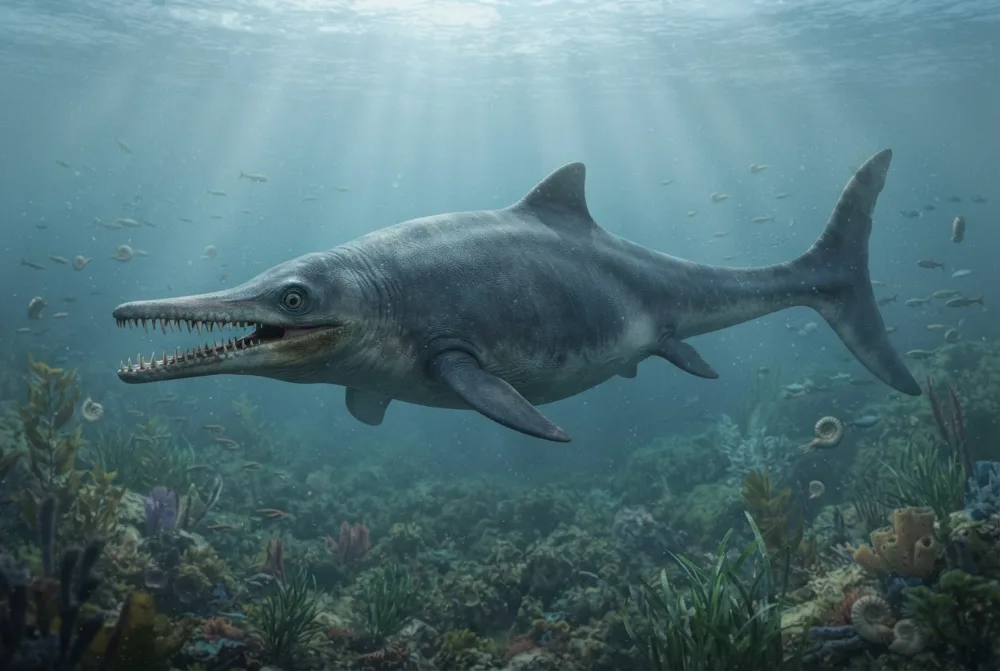
Platypterygius was a giant marine reptile that swam in the seas during the time of the dinosaurs. It looked a bit like a dolphin but had a long snout full of sharp teeth. It was a fast hunter that ate fish, sea turtles, and even baby birds.1
Ɗuum wuurii nde?
Hol no o mawni?
No juutuno?
Hol no Platypterygius mawninoo, so fondaama bee AAN?
Hiisa tan nder browser maa. Walaa huunde danndetee walla neldetee ka nokku fuu.
How fast was it?
Anndal belɗungal
Platypterygius means 'flat fin' because its flippers were wide and flat, like paddles.1
It lived from about 161 to 94 million years ago, during the Jurassic and Cretaceous periods.3
Fossils of Platypterygius have been found on every continent except Antarctica.3
Some Platypterygius fossils have baby sea turtles and bird bones in their stomachs, showing what it ate.1
Scientists think Platypterygius was a fast swimmer that chased prey in the open ocean.3
The name Platypterygius has been used for many different ichthyosaurs, and some scientists think it might include several different species.1
Naamne ɓurɗe naamneede fii Platypterygius
?How big was Platypterygius?
Different species reached different sizes. Platypterygius platydactylus was about 5 metres (16 ft) long, while Platypterygius australis was about 7 metres (23 ft) long.1
?What did Platypterygius eat?
It was a large predator that ate fish, squid, and other marine animals. One fossil even had baby sea turtles and bird bones in its stomach.12
?Is Platypterygius a dinosaur?
No, it is not a dinosaur. It is an ichthyosaur, a marine reptile that lived in the sea at the same time as dinosaurs.12
?When did Platypterygius live?
Platypterygius lived during the Cretaceous period, from about 141 million years ago to 65 million years ago.2
Naamnu Rex fii Platypterygius
Rex jaabata ƴamle dow hello ngo'o tan. Ƴamle 10 e lewru.
Rex ko AI, o waawi waɗugo juumre. O golla ka serverji nder EU, naamne danndetaake abada. Taa winndu innde maa walla huunde goɗnde ngam maa.
Ngam annduɓe dino
- Innde ganndal
- Platypterygius
- Inndoowo
- von Huene 19223
- Fedde
- Ichthyosaurs
- Fedde / clade
- Ophthalmosauridae3
- Fedde
- Ichthyosauria > Ichthyosauromorpha3
- Duuɓi kaaƴe
- 162 haa 94 miliyon duuɓi (Oxfordian / Cenomanian)3
- Cuuɗi kaaƴe
- Toolebuc, Zapata, Marnes bleues3
- Leyɗe
- Australia, Faransi, USA, Chile, Russia, Germany3
- Fosilji tawaaɗi
- 62 nder Paleobiology Database3
- Kadi anndiraa
- Longirostria, Myobradypterygius, Myopterygius, Plutoniosaurus, Tenuirostria (inɗe ɓooyɗe jooni ɗon limaa bana dabba gooto)3
- Tawgol
- Platypterygius was named by German paleontologist Friedrich von Huene in 1922. The first fossils were found in Germany.3
- Haa jooni ɓe ɗon yeddondira
- Scientists are not sure which species really belong to Platypterygius, because many different ichthyosaurs have been lumped into this group.1
To haalaaji ummii
- Platypterygius (en.wikipedia.org)
- Dinosaurs - Platypterygius longmani - The Australian Museum (australian.museum)
- Platypterygius in The Paleobiology Database (CC BY 4.0): duuɓi, nokkuuje, cuuɗi kaaƴe, pecce.
Kala anndal nder ngal hello mari limre holloore iwdi mum. Si min mbaɗii juumre, yaafo min, min ko yiɗɓe dino, min wanaa jaaynde anndal. Haalan min ka hello@dinowiki.app, min moƴƴinan ɗum.
 Rex ɗon weelo! Dino Wiki, ɗum golle baaba ngam ɓiyiiko gorko mo yiɗi dinosauruuji, alaa njoɓdi, alaa ko yeeyata. Mawɓe mbaawi hokkude Rex ñaamdu ngam wallude lowre ndee heddoo e internet.Nyaamnu Rex
 Ichthyosaurus
 Stenopterygius
 Khudiakovia
 Ophthalmosaurus
 Chonespondylus
 Cymbospondylus
 Stegosaurus
 Iguanodon
 Archaeopteryx
 Giganotosaurus
 Microraptor
 Deinonychus