
Platypterygius
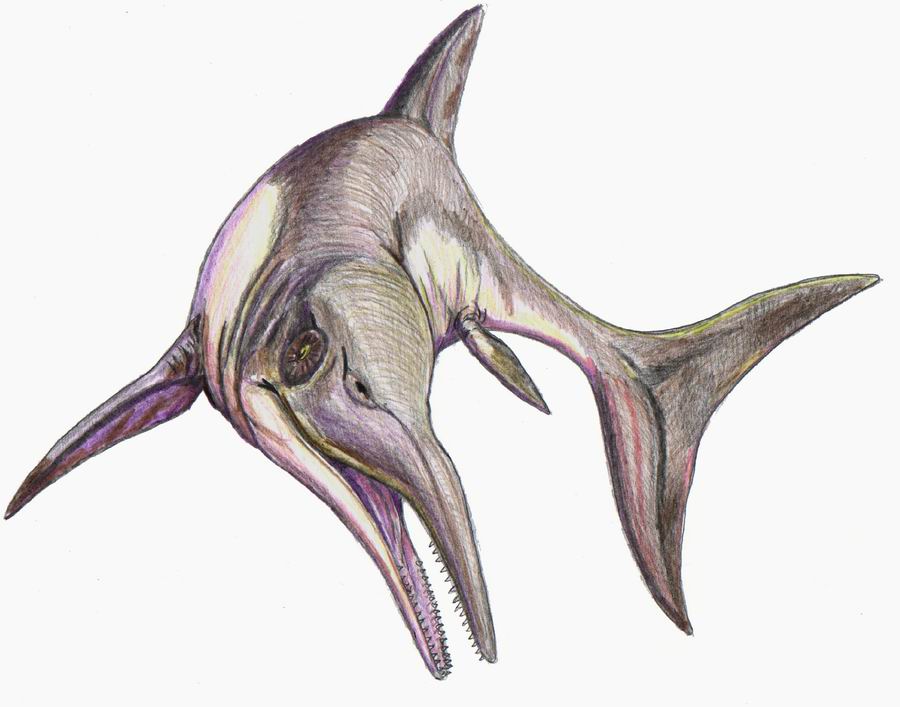
Platypterygius was a giant marine reptile that swam in the seas during the time of the dinosaurs. It looked a bit like a dolphin but had a long snout full of sharp teeth. It was a fast hunter that ate fish, sea turtles, and even baby birds.1
When did it live?
How big was it?
Fun facts
Platypterygius means 'flat fin' because its flippers were wide and flat, like paddles.1
It lived from about 161 to 94 million years ago, during the Jurassic and Cretaceous periods.2
Fossils of Platypterygius have been found on every continent except Antarctica.2
Some Platypterygius fossils have baby sea turtles and bird bones in their stomachs, showing what it ate.1
Scientists think Platypterygius was a fast swimmer that chased prey in the open ocean.2
The name Platypterygius has been used for many different ichthyosaurs, and some scientists think it might include several different species.1
For dino experts
- Scientific name
- Platypterygius
- Named by
- von Huene 19222
- Group
- Ichthyosaurs
- Family / clade
- Ophthalmosauridae2
- Classification
- Ichthyosauria > Ichthyosauromorpha2
- Age of the rocks
- 162 to 94 million years (Oxfordian to Cenomanian)2
- Rock formations
- Toolebuc, Zapata, Marnes bleues2
- Countries
- Australia, France, USA, Chile, Russia, Germany2
- Fossil records
- 62 in the Paleobiology Database2
- Also known as
- Longirostria, Myobradypterygius, Myopterygius, Plutoniosaurus, Tenuirostria (older names now counted as the same animal)2
- Discovery
- Platypterygius was named by German paleontologist Friedrich von Huene in 1922. The first fossils were found in Germany.2
- Still debated
- Scientists are not sure which species really belong to Platypterygius, because many different ichthyosaurs have been lumped into this group.1
Where the facts come from
- Platypterygius (en.wikipedia.org)
- Platypterygius in The Paleobiology Database (CC BY 4.0): age, places, rock formations, classification.
Every fact on this page has a number that points to its source. If we got something wrong, sorry, we are dino fans, not a science journal. Tell us at hello@dinowiki.app and we will fix it.
 Rex is hungry! Dino Wiki is free with no ads. Grown-ups can feed Rex a snack to keep it that way.Feed Rex
 Ichthyosaurus
 Stenopterygius
 Khudiakovia
 Ophthalmosaurus
 Chonespondylus
 Cymbospondylus
 Stegosaurus
 Iguanodon
 Archaeopteryx
 Giganotosaurus
 Microraptor
 Deinonychus