
Acamptonectes
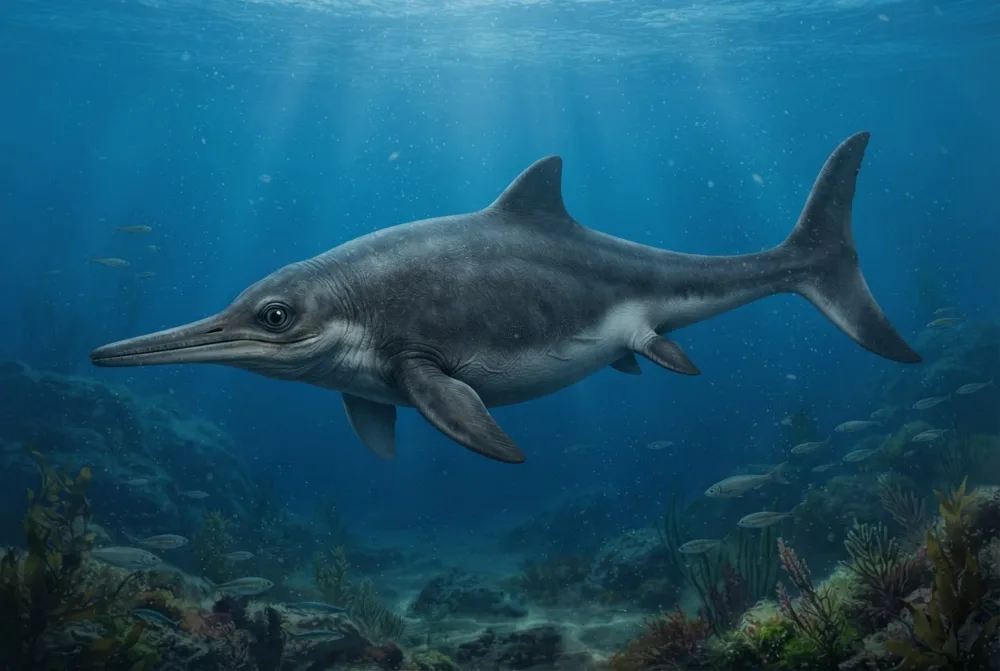
Acamptonectes was a fast-swimming marine reptile that lived in the Early Cretaceous seas. It had a stiff body and large eyes, perfect for hunting fish and squid in the deep ocean.12
Ɗuum wuurii nde?
Hol no o mawni?
No juutuno?
Hol no Acamptonectes mawninoo, so fondaama bee AAN?
Hiisa tan nder browser maa. Walaa huunde danndetee walla neldetee ka nokku fuu.
How fast was it?
Anndal belɗungal
Acamptonectes belongs to a group called ophthalmosaurids, which had very large eyes for seeing in dark, deep water.12
Its name means 'stiff swimmer' because its body was unusually rigid, helping it move fast through the water.1
Acamptonectes lived about 133 to 129 million years ago, during the Hauterivian stage of the Early Cretaceous.1
Scientists once thought most ichthyosaurs died out at the end of the Jurassic, but Acamptonectes shows they survived and thrived into the Cretaceous.21
The first Acamptonectes fossil was found in 1958 by geology students near Speeton, England, but it was not named until 2012.21
Its teeth had tiny ridges along the length, which helped it grip slippery prey like fish and squid.1
Naamne ɓurɗe naamneede fii Acamptonectes
?Was Acamptonectes a dinosaur?
No, it was a marine reptile called an ichthyosaur, not a dinosaur.1
?How big was Acamptonectes?
It was about 3 metres (9.8 feet) long.1
?What did Acamptonectes eat?
It likely ate soft, fleshy prey like fish and squid, using its slender ridged teeth to impale them.1
?Why did Acamptonectes have a stiff body?
Its stiff body helped it swim fast like a tuna by making it more streamlined in the water.1

Naamnu Rex fii Acamptonectes
Rex jaabata ƴamle dow hello ngo'o tan. Ƴamle 10 e lewru.
Rex ko AI, o waawi waɗugo juumre. O golla ka serverji nder EU, naamne danndetaake abada. Taa winndu innde maa walla huunde goɗnde ngam maa.
Ngam annduɓe dino
- Innde ganndal
- Acamptonectes
- Inndoowo
- Fischer et al. 20123
- Fedde
- Ichthyosaurs
- Fedde / clade
- Ophthalmosauridae3
- Fedde
- Ichthyosauria > Ichthyosauromorpha3
- Duuɓi kaaƴe
- 133 haa 126 miliyon duuɓi (Hauterivian)3
- Cuuɗi kaaƴe
- Speeton Clay3
- Leyɗe
- United Kingdom, Germany3
- Fosilji tawaaɗi
- 3 nder Paleobiology Database3
- Tawgol
- Acamptonectes was named in 2012 by a team of scientists including V. Fischer, M. W. Maisch, and D. Naish. The first specimen was collected in 1958 by geology students in Speeton, England, but it took decades to study and describe.23
- Haa jooni ɓe ɗon yeddondira
- Scientists are still debating whether Acamptonectes had a different diet or lifestyle from other Cretaceous ichthyosaurs because of its unusual shallow snout and tooth shape.1
To haalaaji ummii
- Acamptonectes (en.wikipedia.org)
- New Ophthalmosaurid Ichthyosaurs from the European Lower Cretaceous Demonstrate Extensive Ichthyosaur Survival across the Jurassic, Cretaceous Boundary (pmc.ncbi.nlm.nih.gov)
- Acamptonectes in The Paleobiology Database (CC BY 4.0): duuɓi, nokkuuje, cuuɗi kaaƴe, pecce.
Kala anndal nder ngal hello mari limre holloore iwdi mum. Si min mbaɗii juumre, yaafo min, min ko yiɗɓe dino, min wanaa jaaynde anndal. Haalan min ka hello@dinowiki.app, min moƴƴinan ɗum.
 Rex ɗon weelo! Dino Wiki, ɗum golle baaba ngam ɓiyiiko gorko mo yiɗi dinosauruuji, alaa njoɓdi, alaa ko yeeyata. Mawɓe mbaawi hokkude Rex ñaamdu ngam wallude lowre ndee heddoo e internet.Nyaamnu Rex
 Ichthyosaurus
 Platypterygius
 Stenopterygius
 Khudiakovia
 Ophthalmosaurus
 Chonespondylus
 Stegosaurus
 Iguanodon
 Archaeopteryx
 Giganotosaurus
 Microraptor
 Deinonychus