
Sphaerotholus
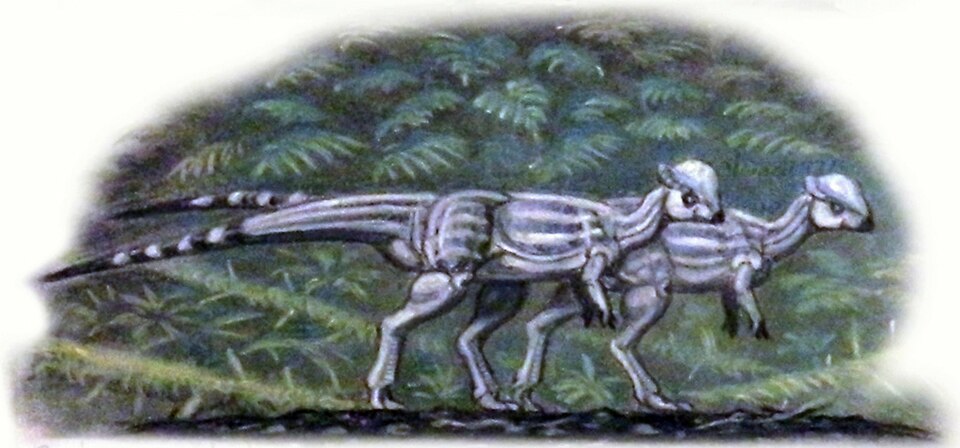
Sphaerotholus was a dome-headed dinosaur that lived near the end of the Age of Dinosaurs. It had a thick, bony dome on its skull and probably used it for head-butting contests.1
When did it live?
How big was it?
Fun facts
Sphaerotholus lived for a long time, about 7 to 8 million years, and spread across a wide area from New Mexico to Montana.1
There are five known species of Sphaerotholus, each with slightly different bumps and nodes on the back of their skulls.1
One species, S. triregnum, had a triple row of small bony nodes on its skull, making it look like it wore a triple crown.1
Another species, S. lyonsi, had a double row of small nodes, while others had a single row of large nodes.1
The name Sphaerotholus means 'ball dome', which describes its round, dome-shaped skull.1
Sphaerotholus is considered a highly evolved, or derived, pachycephalosaur.1
Myth buster
Myth: Some people think Sphaerotholus used its dome for ramming like a battering ram.
Truth: Scientists are not sure. The dome might have been for head-butting, but it could also have been for showing off to mates or recognizing each other.1
For dino experts
- Scientific name
- Sphaerotholus
- Named by
- Williamson and Carr 20032
- Group
- Dome-heads
- Family / clade
- Pachycephalosauridae2
- Classification
- Ornithischia > Pachycephalosauria2
- Age of the rocks
- 84 to 66 million years (Campanian to Maastrichtian)2
- Rock formations
- Hell Creek, Kirtland, Frenchman2
- Countries
- USA, Canada2
- Fossil records
- 6 in the Paleobiology Database2
- Discovery
- The first species, Sphaerotholus goodwini, was named by Thomas Williamson and Thomas Carr in 2002 from a partial skull found in New Mexico. The species name honors paleontologist Mark Goodwin.1
- Still debated
- Scientists still debate whether some species, like S. edmontonensis, are really separate or just the same as others, because their skulls look very similar.1
Where the facts come from
- Sphaerotholus (en.wikipedia.org)
- Sphaerotholus in The Paleobiology Database (CC BY 4.0): age, places, rock formations, classification.
Every fact on this page has a number that points to its source. If we got something wrong, sorry, we are dino fans, not a science journal. Tell us at hello@dinowiki.app and we will fix it.
 Rex is hungry! Dino Wiki is free with no ads. Grown-ups can feed Rex a snack to keep it that way.Feed Rex
 Pachycephalosaurus
 Stegoceras
 Prenocephale
 Foraminacephale
 Brontotholus
 Colepiocephale
 Triceratops
 Velociraptor
 Spinosaurus
 Ankylosaurus
 Parasaurolophus