
Pachycephalosaurus
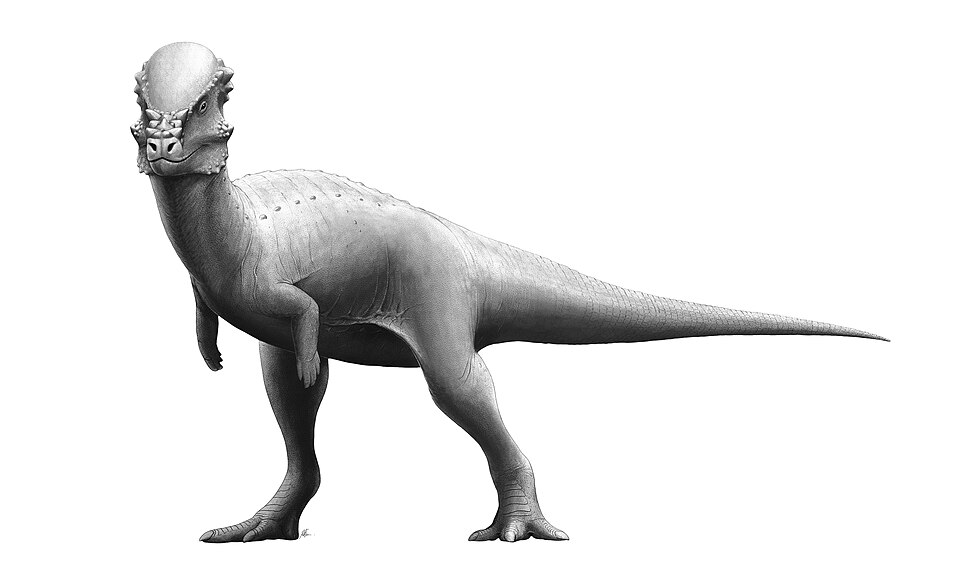
Pachycephalosaurus was a dinosaur with a super thick, bony dome on its head. It walked on two legs and used its beak to snip plants. It lived at the very end of the Age of Dinosaurs, about 69 to 66 million years ago.12
When did it live?
How big was it?
Fun facts
The bony dome on its skull could be up to 25 centimetres (10 inches) thick, safely cushioning its tiny brain.2
Scientists used to think Stygimoloch and Dracorex were different dinosaurs, but now most believe they were just young Pachycephalosaurus.12
The first Pachycephalosaurus fossil was found around 1860 and was thought to be from an armadillo-like creature. It was named Tylosteus.12
Pachycephalosaurus was one of the last non-bird dinosaurs alive before the big extinction 66 million years ago.2
Its dome may have been used for head-butting fights, like bighorn sheep, but some scientists now disagree.2
Pachycephalosaurus had a beak for cropping plants and small, serrated teeth that could also shred meat, so it might have eaten some meat too.2
Myth buster
Myth: Pachycephalosaurus used its dome to ram into rivals at full speed.
Truth: The dome was probably used for head-butting, but the shape and structure suggest it was more for pushing or flank-butting, not full-speed ramming.2
For dino experts
- Scientific name
- Pachycephalosaurus
- Named by
- Brown and Schlaikjer 19433
- Group
- Dome-heads
- Family / clade
- Eupachycephalosauria3
- Classification
- Ornithischia > Pachycephalosauria3
- Age of the rocks
- 84 to 66 million years (Campanian to Maastrichtian)3
- Rock formations
- Hell Creek, Lance, Ferris3
- Countries
- USA, Canada3
- Fossil records
- 34 in the Paleobiology Database3
- Also known as
- Dracorex, Stenotholus, Stygimoloch, Tylosteus (older names now counted as the same animal)3
- Discovery
- The name Pachycephalosaurus was created in 1943 by Barnum Brown and Erich Maren Schlaikjer after more complete skulls were found in Montana and South Dakota.12
- Still debated
- Scientists still debate whether Stygimoloch and Dracorex are really just young Pachycephalosaurus or separate species.2
Where the facts come from
- Pachycephalosaurus | Natural History Museum (nhm.ac.uk)
- Pachycephalosaurus (en.wikipedia.org)
- Pachycephalosaurus in The Paleobiology Database (CC BY 4.0): age, places, rock formations, classification.
Every fact on this page has a number that points to its source. If we got something wrong, sorry, we are dino fans, not a science journal. Tell us at hello@dinowiki.app and we will fix it.
 Rex is hungry! Dino Wiki is free with no ads. Grown-ups can feed Rex a snack to keep it that way.Feed Rex
 Stegoceras
 Prenocephale
 Sphaerotholus
 Foraminacephale
 Brontotholus
 Colepiocephale
 Triceratops
 Velociraptor
 Spinosaurus
 Ankylosaurus
 Parasaurolophus