
Nicorhynchus
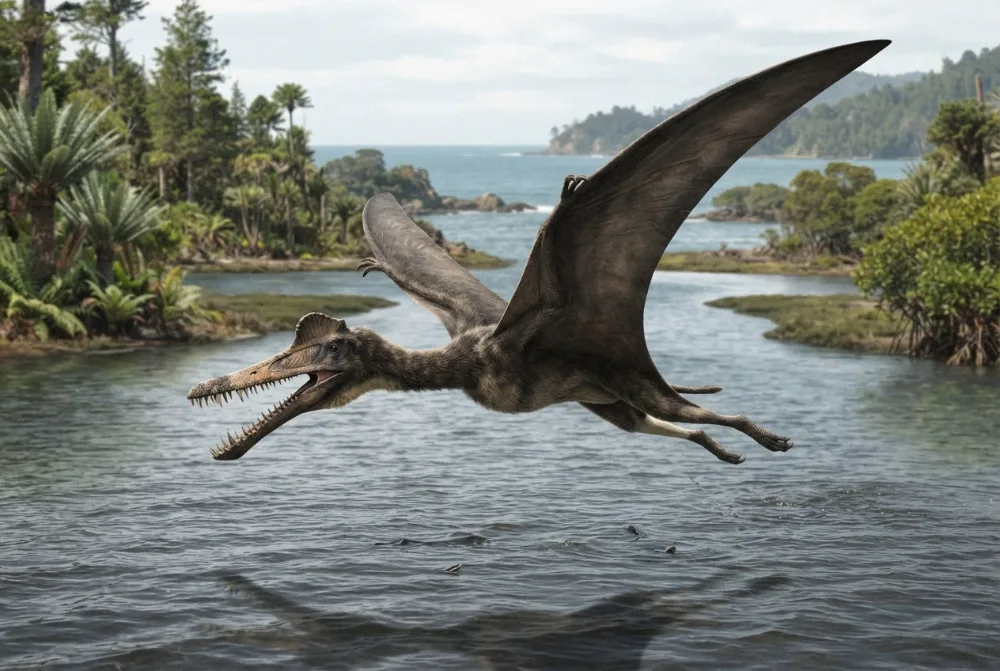
Nicorhynchus was a big flying reptile that soared over ancient seas and rivers. It had a long snout full of pointy teeth and a crest on its head. It swooped down to catch fish with its jaws.1
When did it live?
How big was it?
How wide were its wings?
How big was Nicorhynchus compared to YOU?
Just maths in your browser. Nothing is saved or sent anywhere.
How fast was it?
Fun facts
Nicorhynchus is one of the largest toothed pterosaurs, second only to Tropeognathus. Its skull could have been up to 75 cm (30 inches) long.1
The tip of its snout was shaped like a boxy rosette, wider than the rest of the jaw, and its front teeth pointed straight forward.1
Its name comes from the Old English word 'nicor', meaning a water dragon or knucker.1
Nicorhynchus lived about 105 to 92.5 million years ago, during the Cretaceous Period.1
Scientists first thought Nicorhynchus was a species of Coloborhynchus, but in 2020 it got its own genus.12
The two species are Nicorhynchus capito from England and Nicorhynchus fluviferox from Morocco.1
Most asked questions about Nicorhynchus
?How big was Nicorhynchus?
It was one of the largest toothed pterosaurs, with an estimated wingspan of about 7 metres (23 feet) and a skull up to 75 cm (30 inches) long.1
?What did Nicorhynchus eat?
It ate fish. It swooped down over ancient seas and rivers to catch fish with its long, toothy jaws.13
?When did Nicorhynchus live?
It lived during the Cretaceous Period, about 105 to 92.5 million years ago.1
?Is Nicorhynchus a dinosaur?
No, it is not a dinosaur. It is a pterosaur, a flying reptile that lived at the same time as dinosaurs.1

Ask Rex about Nicorhynchus
Rex only answers questions about this page. 10 questions a month.
Rex is an AI and can make mistakes. He runs on servers in the EU and questions are never saved. Never type your name or other personal things.
For dino experts
- Scientific name
- Nicorhynchus
- Named by
- Holgado and Pegas 20203
- Group
- Flying reptiles
- Family / clade
- Anhangueridae3
- Classification
- Pterosauria > Pterodactyloidea3
- Age of the rocks
- 106 to 94 million years (Albian / Cenomanian)3
- Rock formations
- West Melbury Marly Chalk, Ifezouane3
- Countries
- United Kingdom, Morocco3
- Fossil records
- 4 in the Paleobiology Database3
- Discovery
- The first fossils were named Ornithocheirus capito by Harry Seeley in 1870. In 2020, Borja Holgado and Rodrigo Pêgas gave it the new genus name Nicorhynchus.12
- Still debated
- Some scientists think the differences between Nicorhynchus and Coloborhynchus are too small, and they may be the same genus.1
Where the facts come from
- Nicorhynchus (en.wikipedia.org)
- A taxonomic and phylogenetic review of the anhanguerid pterosaur group Coloborhynchinae and the new clade Tropeognathinae - Acta Palaeontologica Polonica (app.pan.pl)
- Nicorhynchus in The Paleobiology Database (CC BY 4.0): age, places, rock formations, classification.
Every fact on this page has a number that points to its source. If we got something wrong, sorry, we are dino fans, not a science journal. Tell us at hello@dinowiki.app and we will fix it.
 Rex is hungry! Dino Wiki is a dad's project for his dino-loving son, free with no ads. Grown-ups can feed Rex a snack to help keep it online.Feed Rex
 Pteranodon
 Quetzalcoatlus
 Dorygnathus
 Rhamphorhynchus
 Anhanguera
 Pterodactylus
 Tyrannosaurus
 Triceratops
 Velociraptor
 Spinosaurus
 Ankylosaurus
 Parasaurolophus