
Geosternbergia
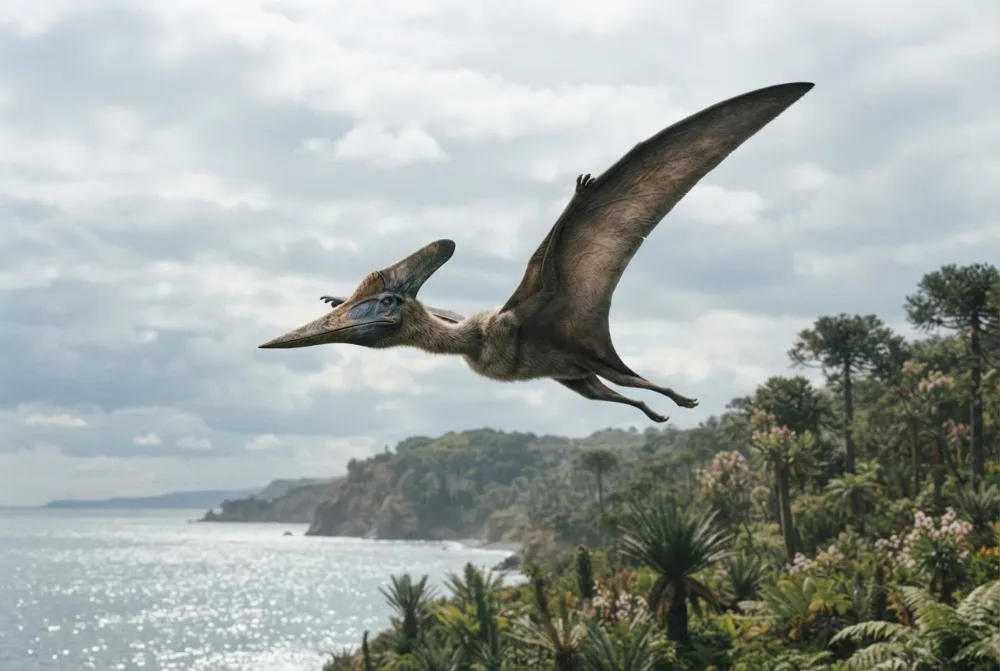
Geosternbergia was a flying reptile that soared over the ancient seas of North America. It had a long, toothless beak and a big crest on its head. It was a pterosaur, not a dinosaur.3
When did it live?
How big was it?
How wide were its wings?
How big was Geosternbergia compared to YOU?
Just maths in your browser. Nothing is saved or sent anywhere.
How fast was it?
Fun facts
Geosternbergia lived during the Campanian age, about 83 to 72 million years ago.3
Its fossils were found in the Pierre Shale Formation, which was once the bottom of a shallow sea.3
The name Geosternbergia honors Charles Sternberg, a famous fossil hunter.3
Geosternbergia belonged to the family Pteranodontidae, which includes large, toothless pterosaurs.3
Only one species of Geosternbergia is known: Geosternbergia maiseyi.1
The type specimen of Geosternbergia maiseyi is a partial skull, stored at the University of Kansas.1
Most asked questions about Geosternbergia
?How big was Geosternbergia?
Geosternbergia was among the largest pterosaurs, with a wingspan of up to 6 metres (20 ft) in males. Most adults had wingspans between 3 and 6 metres (9.8 and 19.7 ft).2
?Did Geosternbergia have teeth?
No, Geosternbergia had a toothless beak made of solid, bony margins, similar to modern birds. Its beak was long, slender, and ended in a sharp point.2
?What did Geosternbergia eat?
Scientists think Geosternbergia ate fish and other sea creatures, because it lived over shallow seas and had a long, toothless beak like a bird that catches fish. The sources do not give a direct answer, but its habitat and beak shape suggest a fish-eating diet.2
?Is Geosternbergia a dinosaur?
No, Geosternbergia is a pterosaur, a flying reptile that lived at the same time as dinosaurs but is not a dinosaur.2
?When did Geosternbergia live?
Geosternbergia lived during the Late Cretaceous period, about 88 to 80.5 million years ago. The species G. maiseyi lived between 81.5 and 80.5 million years ago.23
?Why did Geosternbergia have a crest?
The crest on Geosternbergia's head was probably used for display, like to attract mates or show off to other pterosaurs. It may have also had other functions, but scientists are not sure.2

Ask Rex about Geosternbergia
Rex only answers questions about this page. 10 questions a month.
Rex is an AI and can make mistakes. He runs on servers in the EU and questions are never saved. Never type your name or other personal things.
For dino experts
- Scientific name
- Geosternbergia
- Named by
- Miller 19783
- Group
- Flying reptiles
- Family / clade
- Pteranodontidae3
- Classification
- Pterosauria > Pterodactyloidea > Pteranodontidae3
- Age of the rocks
- 84 to 72 million years (Campanian)3
- Rock formations
- Pierre Shale3
- Countries
- USA3
- Fossil records
- 1 in the Paleobiology Database3
- Discovery
- Geosternbergia was named by Halszka Osmólska in 1978, based on fossils found in South Dakota. The species G. maiseyi was named by Alexander Kellner in 2010.31
Where the facts come from
- PBDB Taxon (paleobiodb.org)
- Pteranodon sternbergi (en.wikipedia.org)
- Geosternbergia in The Paleobiology Database (CC BY 4.0): age, places, rock formations, classification.
Every fact on this page has a number that points to its source. If we got something wrong, sorry, we are dino fans, not a science journal. Tell us at hello@dinowiki.app and we will fix it.
 Rex is hungry! Dino Wiki is a dad's project for his dino-loving son, free with no ads. Grown-ups can feed Rex a snack to help keep it online.Feed Rex
 Pteranodon
 Quetzalcoatlus
 Dorygnathus
 Rhamphorhynchus
 Anhanguera
 Pterodactylus
 Tyrannosaurus
 Triceratops
 Velociraptor
 Spinosaurus
 Ankylosaurus
 Parasaurolophus