
Troodon
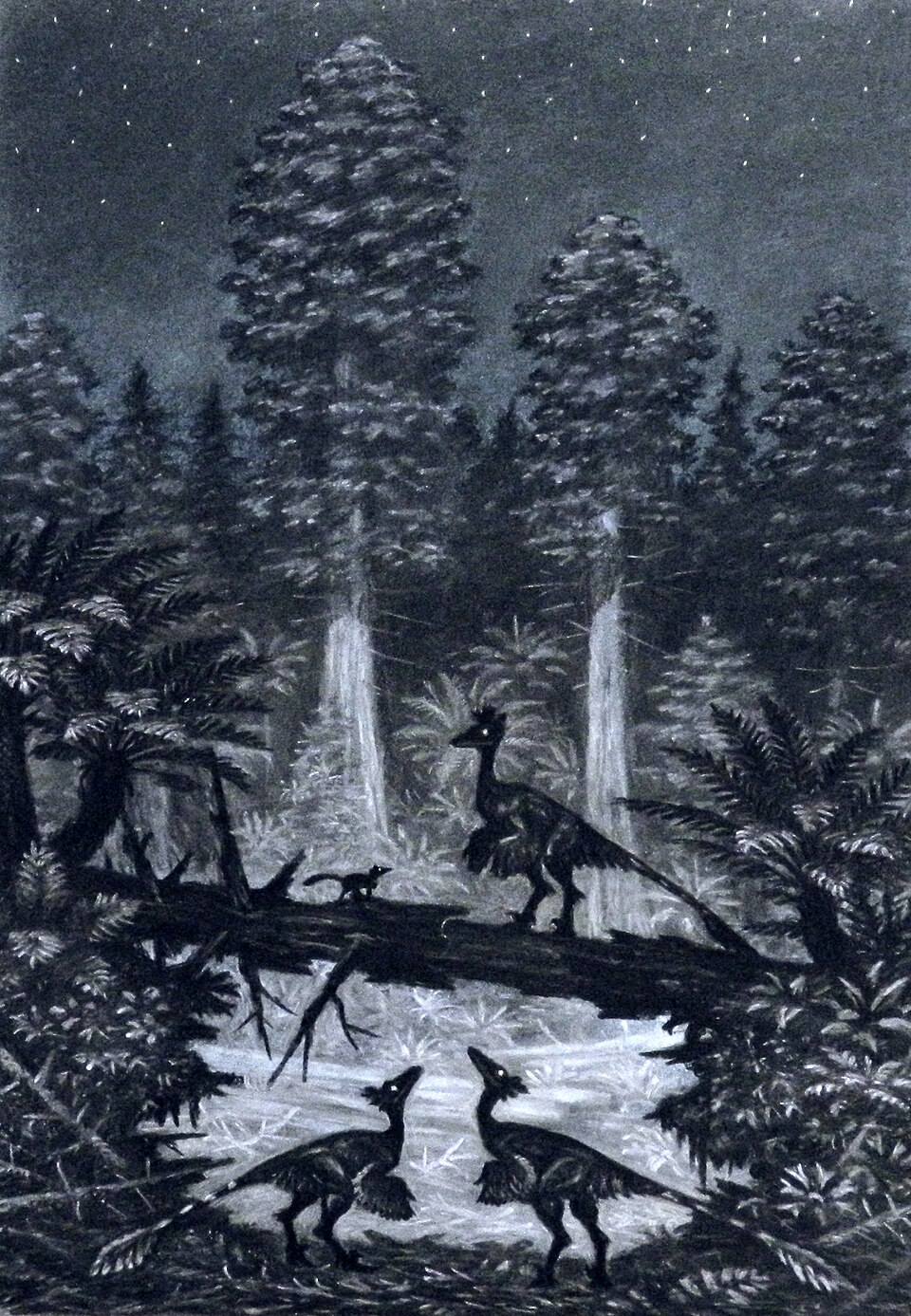
Troodon was a small, smart dinosaur that lived in North America and Asia. It had big eyes and a big brain, and scientists think it may have eaten both plants and meat. Troodon was not a raptor like Velociraptor, but it was a close cousin.2
When did it live?
How big was it?
Fun facts
Troodon is often called one of the smartest dinosaurs because its brain was large for its body size.1
Troodon was not a dromaeosaur (the group that includes Velociraptor), but it was closely related to them.2
Some Troodon relatives had a hooked claw on their foot, like the raptors, but scientists think they may have evolved it separately.2
The first Troodon fossil was a single tooth found in Montana in 1855 by Ferdinand Hayden.1
For many years scientists thought Troodon might be a lizard or a pachycephalosaur, until more fossils showed it was a small meat-eating dinosaur.1
Troodon lived about 79 to 75 million years ago, during the Late Cretaceous period.2
Fossils of Troodon have been found in many places, including Alaska, which was much warmer when Troodon was alive.3
Myth buster
Myth: Troodon was a raptor like Velociraptor.
Truth: Troodon was not a dromaeosaur (the group called raptors), but it was a close relative in the troodontid family.2
For dino experts
- Scientific name
- Troodon
- Named by
- Leidy 18563
- Group
- Raptors
- Family / clade
- Troodontidae3
- Classification
- Theropoda > Troodontidae3
- Age of the rocks
- 84 to 66 million years (Campanian to Maastrichtian)3
- Rock formations
- Dinosaur Park, Oldman, Judith River3
- Countries
- Canada, USA, Russia, China3
- Fossil records
- 103 in the Paleobiology Database3
- Also known as
- Polyodontosaurus (older names now counted as the same animal)3
- Discovery
- In 1855, Ferdinand Hayden found a single tooth in the Judith River badlands of Montana. Joseph Leidy named it Troodon formosus in 1856, which means 'beautiful wounding tooth'.1
- Still debated
- Some scientists argue that the name Troodon formosus should be thrown out because the first tooth fossil is too incomplete to be sure it belongs to a unique species.1
Where the facts come from
- Troodontid specimens from the Cretaceous Two Medicine Formation of Montana (USA) and the validity of Troodon formosus | Journal of Paleontology | Cambridge Core (cambridge.org)
- Troodon | Natural History Museum (nhm.ac.uk)
- Troodon in The Paleobiology Database (CC BY 4.0): age, places, rock formations, classification.
Every fact on this page has a number that points to its source. If we got something wrong, sorry, we are dino fans, not a science journal. Tell us at hello@dinowiki.app and we will fix it.
 Rex is hungry! Dino Wiki is free with no ads. Grown-ups can feed Rex a snack to keep it that way.Feed Rex
 Velociraptor
 Microraptor
 Deinonychus
 Asiamericana
 Richardoestesia
 Saurornitholestes
 Triceratops
 Spinosaurus
 Ankylosaurus
 Parasaurolophus
 Pteranodon