
Citipes
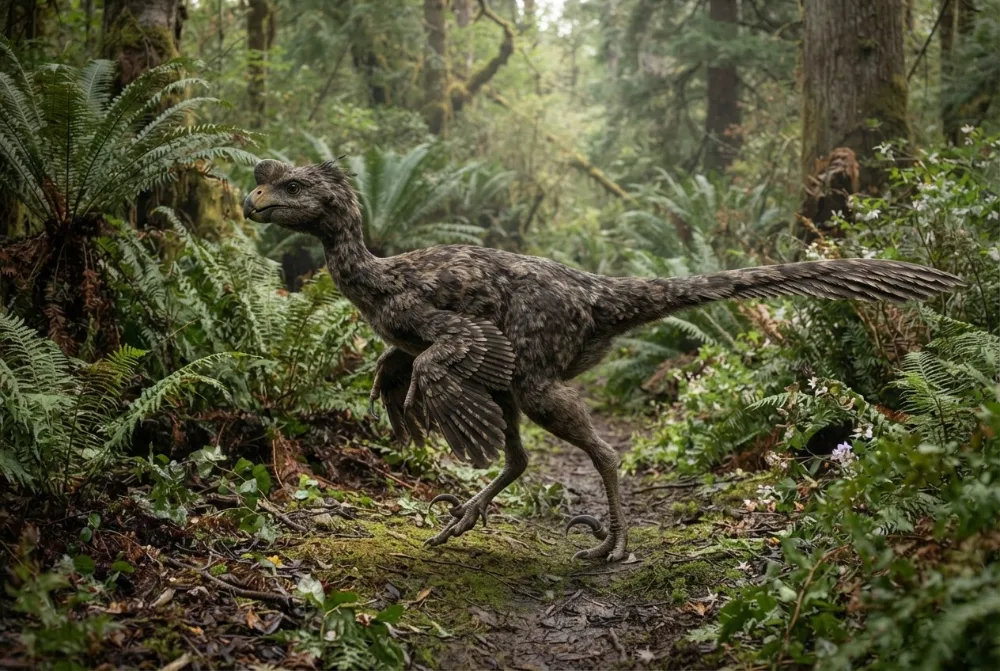
Citipes was a small, fast-running dinosaur that lived in what is now Canada and the USA. It had a beak like a parrot and probably ate plants and small animals. Scientists think it was covered in feathers.1
When did it live?
How big was it?
How big was Citipes compared to YOU?
Just maths in your browser. Nothing is saved or sent anywhere.
Fun facts
Citipes was named in 2020, but its fossils were first discovered in 1926 and were thought to belong to other dinosaurs like Ornithomimus.1
A fossil of a young Gorgosaurus was found with the legs of at least two Citipes inside its stomach, showing that Citipes was hunted by this larger dinosaur.1
The Citipes legs inside the Gorgosaurus were from babies less than one year old, and the Gorgosaurus seemed to prefer eating the muscular hind legs.1
Citipes had a fused ankle and strong leg muscles, which made it a very fast runner.1
One Citipes fossil shows a broken hip bone that had healed, meaning the animal survived a serious injury.1
Citipes lived alongside two other similar dinosaurs, Caenagnathus and Chirostenotes, but they were different sizes and probably ate different foods to avoid competing.1
Most asked questions about Citipes
?How big was Citipes?
Citipes was a small dinosaur, roughly the size of an emu when fully grown. The juveniles found in the Gorgosaurus stomach were about the size of a turkey.2
?What did Citipes eat?
Citipes probably ate plants and small animals, since it had a beak like a parrot. It lived alongside two similar dinosaurs that ate different foods to avoid competing.1
?Did Citipes have feathers?
Yes, scientists think Citipes was covered in feathers, like many other bird-like dinosaurs. It was a caenagnathid, a type of feathered theropod.1

Ask Rex about Citipes
Rex only answers questions about this page. 3 questions a day.
Rex is an AI and can make mistakes. He runs on servers in the EU and questions are never saved. Never type your name or other personal things.
Myth buster
Myth: Citipes is often confused with the dinosaur Citipati, which has a similar name.
Truth: Citipes and Citipati are different dinosaurs. Citipati is an oviraptorid from Mongolia, while Citipes is a caenagnathid from North America.1
For dino experts
- Scientific name
- Citipes
- Named by
- Funston 20203
- Group
- Odd feathered dinos
- Family / clade
- Caenagnathidae3
- Classification
- Theropoda > Oviraptorosauria3
- Age of the rocks
- 84 to 66 million years (Campanian / Maastrichtian)3
- Rock formations
- Dinosaur Park, Hell Creek3
- Countries
- Canada, USA3
- Fossil records
- 12 in the Paleobiology Database3
- Discovery
- The first Citipes fossils were found in 1926 in Alberta, Canada, by a University of Toronto expedition. They were named Ornithomimus elegans by William Parks in 1933, but later moved to their own genus Citipes by Gregory Funston in 2020.1
- Still debated
- Scientists are not sure exactly what Citipes ate. It had a beak but no teeth, so it may have eaten plants, small animals, or both.1
Where the facts come from
- Citipes (en.wikipedia.org)
- Young tyrannosaur found with baby dinosaurs in its stomach | CBC News (cbc.ca)
- Citipes in The Paleobiology Database (CC BY 4.0): age, places, rock formations, classification.
Every fact on this page has a number that points to its source. If we got something wrong, sorry, we are dino fans, not a science journal. Tell us at hello@dinowiki.app and we will fix it.
Rex is hungry! Dino Wiki is a dad's project for his dino-loving son, free with no ads. Grown-ups can feed Rex a snack to help keep it online.Feed Rex Therizinosaurus
 Oviraptor
 Chirostenotes
 Leptorhynchos
 Avimimus
 Caenagnathus
 Triceratops
 Velociraptor
 Spinosaurus
 Ankylosaurus
 Parasaurolophus