
Oviraptor
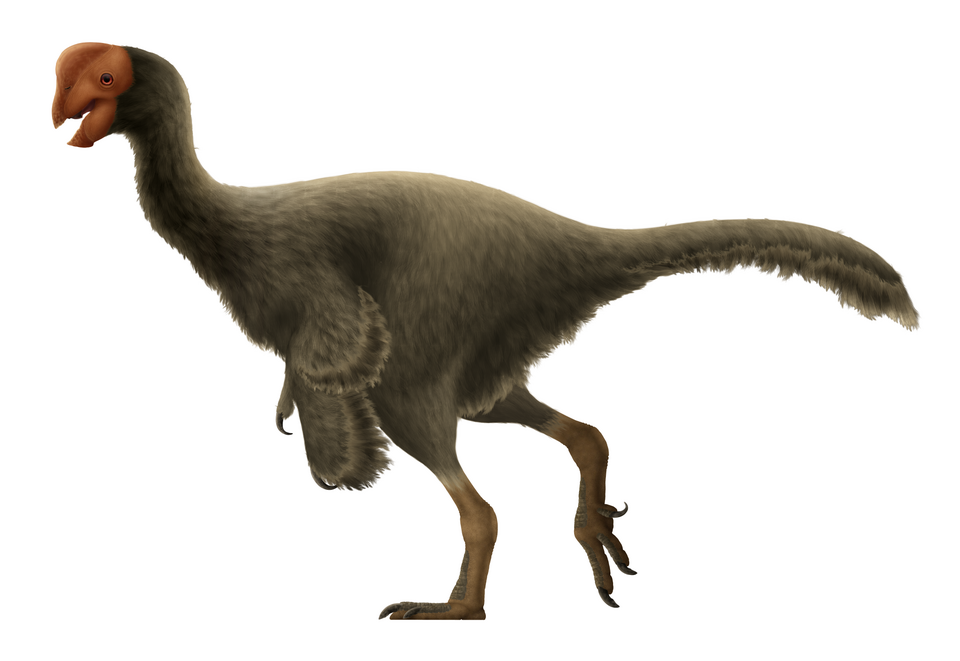
Oviraptor was a small, feathered dinosaur that lived in the Gobi Desert. It had a strong beak like a parrot and no teeth. For a long time people thought it stole eggs, but now we know it was actually a caring parent.12
When did it live?
How big was it?
Fun facts
Oviraptor had no teeth. Instead it used a horny beak to crush its food.2
The first Oviraptor fossil was found lying on top of a nest of eggs. Scientists thought it was stealing them, but later they realized it was probably protecting its own eggs.1
Oviraptor was covered in feathers. Its tail ended in a pygostyle, a bone that supported a fan of feathers.1
Oviraptor lived about 75 to 71 million years ago, during the Late Cretaceous period.1
Its arms were long and ended in three fingers with curved claws.1
The name Oviraptor means 'egg thief' because the first fossil was found with eggs. But scientists now think it was a good parent, not a thief.1
Myth buster
Myth: Oviraptor stole and ate the eggs of other dinosaurs.
Truth: The Oviraptor fossil was found on a nest, but it was probably sitting on its own eggs to keep them warm, like a bird. It likely ate plants, fruits, and small animals, not eggs.1
For dino experts
- Scientific name
- Oviraptor
- Named by
- Osborn 19243
- Group
- Odd feathered dinos
- Family / clade
- Oviraptoridae3
- Classification
- Theropoda > Oviraptorosauria3
- Age of the rocks
- 90 to 72 million years (Coniacian to Campanian)3
- Rock formations
- Djadokhta, Dabrazhin3
- Countries
- Mongolia, Kazakhstan3
- Fossil records
- 3 in the Paleobiology Database3
- Discovery
- Oviraptor was discovered in 1923 in the Gobi Desert of Mongolia during an expedition led by Roy Chapman Andrews. It was named by Henry Fairfield Osborn in 1924.1
- Still debated
- Scientists are not sure exactly what Oviraptor ate. Its strong beak could crush hard objects, but whether it mainly ate plants, eggs, or shellfish is still debated.21
Where the facts come from
- Oviraptor (en.wikipedia.org)
- Oviraptor | Natural History Museum (nhm.ac.uk)
- Oviraptor in The Paleobiology Database (CC BY 4.0): age, places, rock formations, classification.
Every fact on this page has a number that points to its source. If we got something wrong, sorry, we are dino fans, not a science journal. Tell us at hello@dinowiki.app and we will fix it.
 Rex is hungry! Dino Wiki is free with no ads. Grown-ups can feed Rex a snack to keep it that way.Feed Rex
 Therizinosaurus
 Chirostenotes
 Citipes
 Leptorhynchos
 Avimimus
 Caenagnathus
 Triceratops
 Velociraptor
 Spinosaurus
 Ankylosaurus
 Parasaurolophus