
Angaturama
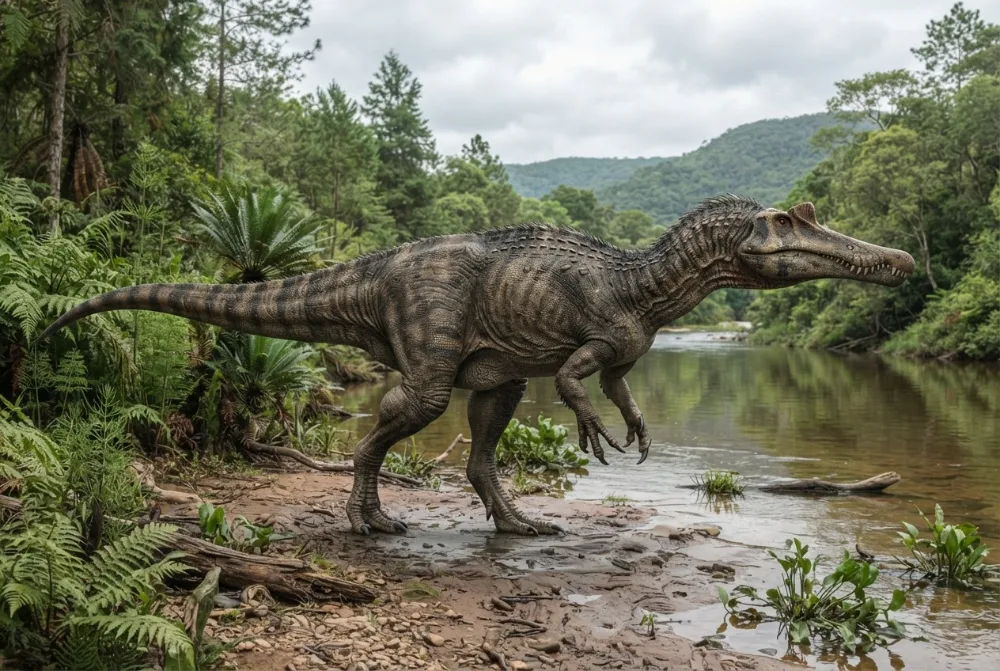
Angaturama was a meat-eating dinosaur that lived about 115 million years ago in what is now Brazil. It had a long, narrow snout with a rosette of teeth at the tip, perfect for catching fish. This dinosaur was one of the smallest spinosaurids, but it was still a fierce hunter.1
When did it live?
How big was it?
Fun facts
Angaturama's snout tip was shaped like a rosette, with long teeth that interlocked to trap slippery fish.1
Its nostrils were placed far back on the snout, which helped it breathe while its mouth was underwater.1
Angaturama had a thin crest on top of its head where strong neck muscles attached, helping it snap its jaws quickly.1
This dinosaur lived in a tropical coastal lagoon environment, surrounded by dry land with plants like cycads and conifers.1
Angaturama is known only from a snout tip, but a replica skeleton was built using other bones from the same formation and is displayed in Brazil.1
For dino experts
- Scientific name
- Angaturama
- Named by
- Kellner and Campos 19964
- Group
- Spinosaurs
- Family / clade
- Spinosauridae4
- Classification
- Theropoda > Spinosauridae4
- Age of the rocks
- 120 to 113 million years (Aptian)4
- Rock formations
- Romualdo4
- Countries
- Brazil4
- Fossil records
- 1 in the Paleobiology Database4
- Discovery
- Angaturama was named by Brazilian paleontologists Alexander W. A. Kellner and Diogenes de Almeida Campos in February 1996. The fossil snout tip was found in a limestone nodule from the Romualdo Formation in Brazil.13
- Still debated
- Scientists are not sure if Angaturama is a separate species from Irritator, or if they are the same dinosaur.21
Where the facts come from
- Irritator (en.wikipedia.org)
- PBDB Taxon (paleobiodb.org)
- First Early Cretaceous theropod dinosaur from Brazil with comments on Spinosauridae - Neues Jahrbuch für Geologie und Paläontologie - Abhandlungen Band 199 Heft 2, Schweizerbart science publishers (schweizerbart.de)
- Angaturama in The Paleobiology Database (CC BY 4.0): age, places, rock formations, classification.
Every fact on this page has a number that points to its source. If we got something wrong, sorry, we are dino fans, not a science journal. Tell us at hello@dinowiki.app and we will fix it.
 Rex is hungry! Dino Wiki is free with no ads. Grown-ups can feed Rex a snack to keep it that way.Feed Rex
 Spinosaurus
 Baryonyx
 Suchomimus
 Camarillasaurus
 Ceratosuchops
 Iberospinus
 Stegosaurus
 Iguanodon
 Archaeopteryx
 Giganotosaurus
 Microraptor
 Deinonychus