
Woolly mammoth
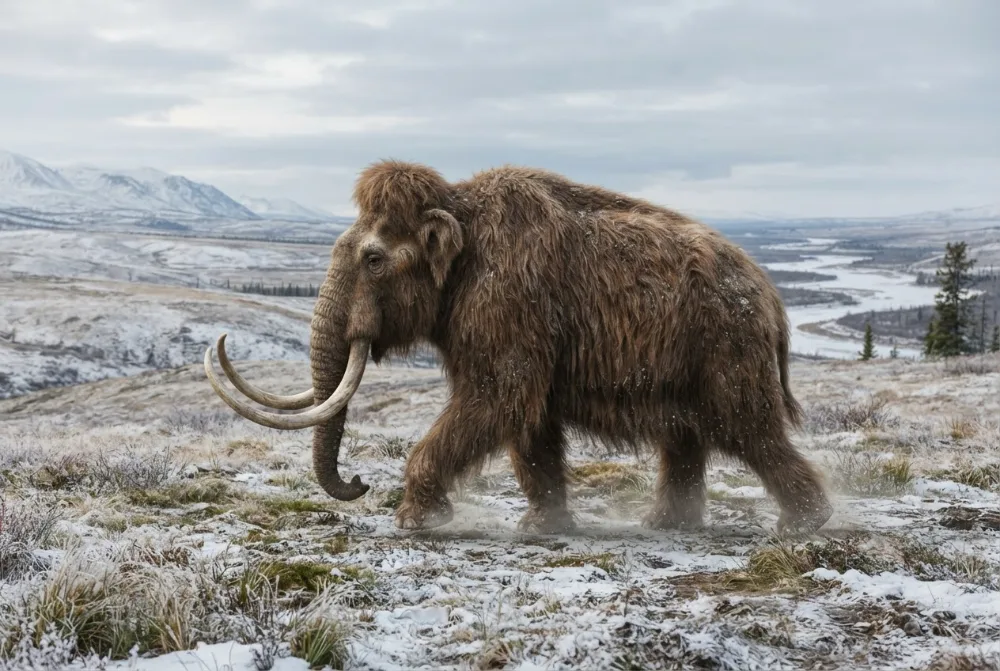
The woolly mammoth was a huge, furry elephant that lived during the Ice Age. It had long, curved tusks and a thick coat of hair to keep warm in the freezing cold. These amazing animals roamed across Europe, Asia, and North America.1
Ɗuum wuurii nde?
Hol no o mawni?
No juutuno?
No toowuno?
No tedduno?
Hol no Woolly mammoth mawninoo, so fondaama bee AAN?
Hiisa tan nder browser maa. Walaa huunde danndetee walla neldetee ka nokku fuu.
How fast was it?
Anndal belɗungal
Woolly mammoths had very small ears and a short tail to stop them from getting frostbite in the cold.1
A newborn woolly mammoth calf weighed about 90 kilograms (200 pounds), as much as a large adult human.1
Woolly mammoths and Columbian mammoths sometimes mated and had hybrid babies in North America.1
The last woolly mammoths lived on Wrangel Island in the Arctic Ocean until about 4,000 years ago, when the Egyptian pyramids were already built.1
Woolly mammoths had four molars that were replaced six times during their life, just like modern elephants.1
Scientists have found frozen woolly mammoth carcasses with fur, skin, and even stomach contents still preserved.1
Naamne ɓurɗe naamneede fii Woolly mammoth
?How big was a woolly mammoth?
About the same size as a modern African elephant. Males stood 2.67 to 3.49 metres tall at the shoulder and weighed 3.9 to 8.2 tonnes.1
?What did woolly mammoths eat?
They mainly ate forbs and grasses. Their diet was similar to that of modern elephants.1
?When did woolly mammoths go extinct?
Most woolly mammoths died out about 10,000 years ago, but small groups survived on islands. The very last ones lived on Wrangel Island until about 4,000 years ago.1
?Did woolly mammoths have fur?
Yes, they had a thick, shaggy coat of fur to keep warm in the Ice Age cold. It had long guard hairs and a shorter, dense undercoat.1
?How long were woolly mammoth tusks?
Their tusks were long and curved, but the exact length varied. They used them for fighting, foraging, and moving objects.1
?Did humans hunt woolly mammoths?
Yes, early humans hunted woolly mammoths for food and used their bones and tusks to make art, tools, and shelters.1
?Are woolly mammoths dinosaurs?
No, they are not dinosaurs. Woolly mammoths are mammals, specifically a type of extinct elephant.1
?Why did woolly mammoths have small ears?
Their small ears helped prevent frostbite and reduce heat loss in the freezing cold.1
?Can we bring woolly mammoths back?
Scientists have talked about trying to revive them using DNA, but none of those methods are possible right now.1

Naamnu Rex fii Woolly mammoth
Rex jaabata ƴamle dow hello ngo'o tan. Ƴamle 10 e lewru.
Rex ko AI, o waawi waɗugo juumre. O golla ka serverji nder EU, naamne danndetaake abada. Taa winndu innde maa walla huunde goɗnde ngam maa.
Feññinoowo goonga
Fenaande: Many people think woolly mammoths lived only in snowy, icy landscapes.
Goonga: Woolly mammoths actually lived on a dry, grassy steppe called the mammoth steppe, which was not covered in ice and snow all year.1
Ngam annduɓe dino
- Innde ganndal
- Mammuthus primigenius
- Inndoowo
- (Blumenbach 1799)4
- Fedde
- Anndaaɓe jamanuuji kiiɗɗi
- Fedde / clade
- Elephantidae4
- Fedde
- Mammalia > Proboscidea > Elephantidae4
- Duuɓi kaaƴe
- 7.2 haa 0.0 miliyon duuɓi (Messinian / Holocene)4
- Cuuɗi kaaƴe
- Wiota Gravels, Oberer Travertin4
- Leyɗe
- USA, Canada, Germany, United Kingdom, Russia, Netherlands4
- Fosilji tawaaɗi
- 77 nder Paleobiology Database4
- Tawgol
- In 1796, French scientist Georges Cuvier was the first to show that woolly mammoth fossils were from an extinct species, not modern elephants. German naturalist Johann Friedrich Blumenbach gave it the scientific name Elephas primigenius in 1799.1
- Haa jooni ɓe ɗon yeddondira
- Scientists are still debating exactly why woolly mammoths went extinct, whether it was due to climate change, hunting by humans, or a combination of both.1
To haalaaji ummii
- Woolly mammoth (en.wikipedia.org)
- Genomics of adaptive evolution in the woolly mammoth: Current Biology (cell.com)
- Woolly Mammoth — size, diet & habitat | DinoLifePedia (dinolifepedia.com)
- Woolly mammoth in The Paleobiology Database (CC BY 4.0): duuɓi, nokkuuje, cuuɗi kaaƴe, pecce.
Kala anndal nder ngal hello mari limre holloore iwdi mum. Si min mbaɗii juumre, yaafo min, min ko yiɗɓe dino, min wanaa jaaynde anndal. Haalan min ka hello@dinowiki.app, min moƴƴinan ɗum.
 Rex ɗon weelo! Dino Wiki, ɗum golle baaba ngam ɓiyiiko gorko mo yiɗi dinosauruuji, alaa njoɓdi, alaa ko yeeyata. Mawɓe mbaawi hokkude Rex ñaamdu ngam wallude lowre ndee heddoo e internet.Nyaamnu Rex
 Megalodon
 Sabre-toothed cat
 Dimetrodon
 Arthropleura
 Helicoprion
 Deinosuchus